From the ICU to the long road back to health and giving back to the ostomy community.

In the afternoon of July 17, 2016, I had just returned home from an ice cream social (and I had eaten ice cream at a party the night before, as well. More on that later). I felt tired, so I laid down for a nap. Almost immediately, I began to feel abdominal pain. I went to the bathroom to see if I could alleviate matters by sitting on the toilet. For about a month, I had been having some constipation, but it had not raised any major red flags for me. And I had just turned 46 — too early for a colonoscopy at that time. When sitting on the toilet didn’t help and the pain got worse, I called for my husband. By the time he came upstairs, I was lying on the bathroom floor in tremendous pain. My stomach had become extremely distended, and I had removed a lot of my clothing because it was binding me. My husband called 911. The paramedics put me on a stretcher and carried me down the stairs and into the ambulance.

I remember the ride to the hospital, and I have a few sketchy memories of being in a hospital room, trying to hold in an enema, but failing to do so because of the pain. At that point, the doctor in the ER thought I just had severe constipation.

The next thing I remember is waking up in the ICU almost a week later in a heavily sedated fog and with a ventilator tube stuck down my throat. At some point later, the ventilator tube was removed (a day after a failed attempt to do so). My husband had to explain to me that a CT scan did not show anything wrong, but I was admitted to the hospital due to my pain. When my blood pressure dropped precipitously on July 19, the on-call surgeon was pulled in. He looked at the CT scan and saw evidence of air, which is a sign of a perforation. I was rushed into emergency surgery, where the surgeon found a cancerous tumor in my colon that had caused my stool to be impacted, which in turn, had triggered a massive perforation of my large intestine. I was in septic shock and close to death. The surgeon removed the tumor, resected my colon, and gave me a colostomy. I owe my life to that surgeon.

I found the right pouching system by making a multitude of phone calls and not giving up or settling until l found the right solution for me.

Initially, the plan was that in two to three months, I would have the colostomy reversed. Then, that changed to include six months of chemotherapy to eradicate any microscopic cancer cells floating around in my abdomen, due to the contents of my colon having been dumped into my abdomen. After that, I would get my colon reconnected.

However, that was not to be. I was starting to recover a bit in a regular hospital room. But due to the perforation, I had developed multiple abscesses of infected fluid in my abdomen. I started with a drainage tube, but eventually, my surgeon discovered that there were many abscesses unreachable by drainage tubes. So, on August 5, I went into surgery to drain all the areas of infected fluid. Unfortunately, I ended up back in the ICU on a ventilator. And I was told that because the infection had damaged organs, my spleen, 60% of my small intestine, and the entirety of my colon were removed. I now had a permanent ileostomy. And despite the second surgery, I eventually ended up needing three drainage tubes for three new abscesses that formed.
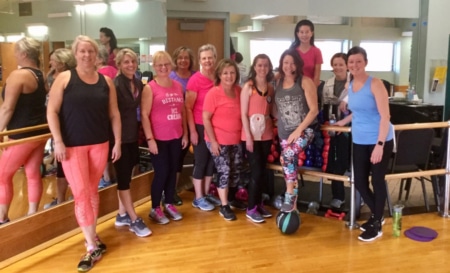

Halloween 2018 – my group fitness exercise class, where I showed my ostomy pride and spread awareness by wearing an ostomy pouch on the outside of my clothes, with a stoma sticker in the center.

I was quite sick and ended up staying in the hospital a total of 52 days, followed by two weeks at a rehab facility. During all this time, my husband was amazing. He kept friends and family up to date with nearly daily emails, on top of working full time, taking care of our 12 and 15-year-old sons, and visiting me in the hospital almost every day. My mother-in-law, friends, and people from my synagogue helped out with meals for my husband and sons. I received so many flowers that my hospital window sill looked like a florist shop. I also had an incredible number of phone calls and visits from friends and family. My parents came from Arizona and my brother came from California at one point while I was in the hospital, and a sister-in-law came from Texas while I was in rehab.

Once I got home, I had a PICC line through which I had to give myself antibiotics (continuing on with the antibiotics I received the entire time I was in the hospital and rehab). I bottomed out at 70 pounds and had little energy. I was also experiencing frequent ostomy leaks and still had one last drainage tube that had to stay until the abcess fully drained (which didn’t happen until November) and a fistula that had formed closed up (which didn’t happen until April 2017). I became very depressed and started to think about ways I might end it all. When I started verbalizing these suicidal thoughts, my husband told a home healthcare nurse, who urged him to take me to the hospital. I did not want to go, but when my 12-year-old son said that he did not want to NOT have a mommy, I agreed to go. Even though my stay in behavioral health did nothing to solve my ostomy leaks or my weight loss, I came home with my head screwed on a little more tightly.

There is nothing like being in a room with other people who know exactly what you are going through.

The next several months were a whirlwind of doctor appointments and drainage tube checks at interventional radiology. A caretaker helped me during the day and got me to my medical appointments while my husband was at work. Throughout the fall, I continued struggling with ostomy leaks, often happening in the middle of the night. My husband helped clean up my messes and helped me with my pouch changes. I had three public leaks, which were mortifying.  I also started to notice numbness in my feet. I figured out it was neuropathy caused by my long-term antibiotic use. As soon as the last abscess was completely drained, I called my infectious disease doctor and asked if I could finally stop the taking the antibiotics. Thankfully, he said yes. While the neuropathy didn’t spread any further after that, I unfortunately ended up with permanent numbness in my feet. I have a fuzzy feeling in them to this day, although I don’t think about it most of the time.

Eventually, I got two months of at-home TPN to help with my weight. I had become malnourished because my body was not absorbing nutrients. With the TPN, one thousand calories a night went into my body intravenously, bypassing my apparently faulty digestive system. This helped tremendously to boost my weight. And while it took me time to feel comfortable with the idea of eating ice cream again (given that my harrowing experience started after eating ice cream), eventually I did!
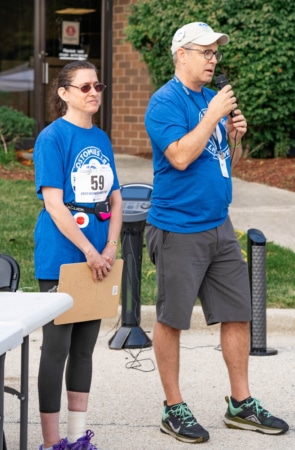
Barbara with fellow ostomate and Illinois Ostomy 5k co-director Bret Cromer.

After becoming fed up with ostomy leaks, I called all the ostomy pouch manufacturers and tried tons of samples. I kept getting my hopes up that each new pouching system would work, and then it would fail. However, I eventually found a winner with a custom pouch from Nu-Hope. It gave me my life back. I was able to go back to working with my organizing clients in their homes without worrying about leaks.

My father found out about the Ostomy Support Group of DuPage County and contacted its leader, Bret Cromer. A friend introduced me to a fellow synagogue congregant and member of this UOAA affiliated support group. She encouraged me to start attending meetings. In January 2017, I finally felt well enough to go to my first meeting, and I have been an active member ever since. There is nothing like being in a room with other people who know exactly what you are going through. I have made great friends and learned about helpful products that I have incorporated into my ostomy care routine. Fellow members helped me when I first joined, so now I try to pay it forward by helping new members.

I was a long-distance runner from age seven through eighteen. After years of suffering from shin splints every time I tried to run, I finally figured out in 2012 how to plant my foot when running to relieve stress on my shins. After my intestinal surgeries, I gradually got back to taking the group fitness exercise classes I had taken pre-illness, but every time I tried to run, it felt like I had cement blocks on my feet. Eventually, though, I started to get a bit more spring in my step. I tried running again one day, and while initially I had the cement-block feeling, I kept going and it got easier. I was thrilled to be able to run again!

In 2018, I saw the UOAA webpage of Run for Resilience Ostomy 5k runs throughout the country for Ostomy Awareness Day. That motivated me to organize my support group’s first informal Run for Resilience 5k. I organized these informal virtual ostomy 5ks every year through 2023. I also became the treasurer for my support group in 2023, and in 2024, Bret Cromer and I co-organized our first official UOAA run, located in Downers Grove, Illinois!

My husband and older son have been very involved with the support group. They attend social/holiday gatherings of the group with me, and they have helped at the 5k events. As for me, being an active member in the support group and organizing the 5k events make me feel pride in having an ostomy. I still have private pity parties occasionally, but overall, I feel that I am an emotionally strong and resilient ostomate.
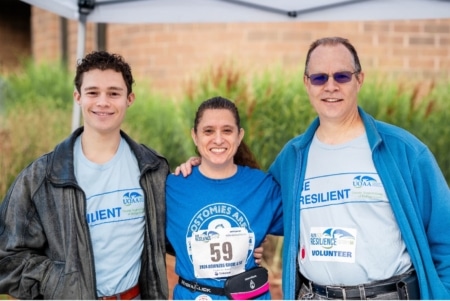
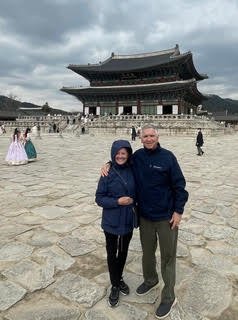
October 5, 2024 – my older son, me, and my husband at the Run for Resilience Ostomy 5k in Downers Grove, Illinois.

My parents have a charitable fund through the Arizona Community Foundation. They have generously donated to my support group and to the UOAA through this fund. I am so grateful for their support. In 2019, I was greatly honored to be inducted into my high school Athletic Hall of Fame. At the ceremony, my father introduced me, and I shared my cancer and ostomy story in my acceptance speech.

I never received chemotherapy. By the time I was healthy enough for it, my oncologist said it would not be very effective. Instead, he watched me very closely with frequent CT scans and bloodwork. Every time anything looked suspicious, I had follow-up tests and biopsies that thankfully showed benign masses, some of which resolved on their own. Finally, in June 2023, after having several clean scans, my oncologist told me about a new option called a circulating tumor DNA test. I jumped at the opportunity. A lab took my original tumor and determined its DNA. Then, the lab looked for that DNA in my current blood plasma, and there was no evidence of it! My oncologist released me from cancer surveillance. Getting the good test result and saying goodbye to my oncologist were very emotional moments for me.

Being an active member in the support group and organizing the 5k events make me feel pride in having an ostomy.

Among many things throughout my journey, I have learned the power of self-advocacy. Here are a few examples. I found the right pouching system by making a multitude of phone calls and not giving up or settling until l found the right solution for me. Through online research, I discovered a much more palatable oral contrast for my CT scans than barium sulfate, called water-soluble iodinated oral contrast. It turned out that my cancer center knew about this option, but did not offer it to me until I asked if they had it. And I had to make multiple requests to speak to my GI doctor to request blood work to prove to my GI doctor that I did not have Celiac disease, after he claimed I did when an endoscopy showed flattened villi in my small intestine.

I have had several hiccups along the way involving hospitalizations related to my ostomy (severe dehydration and diarrhea, small intestinal bacterial overgrowth, and blockages) and tendinitis injuries that make it difficult for me to run, but somehow, I always manage to bounce back.

Thank you to Barbara for sharing this inspiring story and giving back. To learn more or sign-up for a Run for Resilience Ostomy 5k near you or virtually visit ostomy.org/5k. To celebrate the resilience of Barbara and her ostomy community donate to the Downers Grove, IL Run for Resilience Ostomy 5k.
We’re Christina and Molly — best friends who both have Crohn’s disease and ileostomies. Over the years, we’ve come to realize what a gift it is to have each other’s support on this journey, and now we want to share that gift with others.

Christina is 43 and has lived with Crohn’s for 24 years. She’s had her ileostomy for 13 years and lives in Texas with her husband and their 7-year-old son. Her son was conceived and delivered while she had her ileostomy, proving that yes, a successful pregnancy can be done!

Molly is 38 and has had Crohn’s for 21 years and an ileostomy for 18. Born and raised on the island of Oahu, Hawaii, she now splits her time between California and Hawaii. Thanks to her ileostomy, she has a great quality of life — she wakesurfs, does hot yoga, plays pickleball, and, best of all, no longer has to plan her life around bathroom trips.

We’ve partnered with UOAA to create videos and share resources that provide honest, uplifting, and helpful support for ostomates — whether you’re newly adjusting or have had your ostomy for years. Your life isn’t over– you’re just simply learning your new normal. We are hoping to help you thrive in your new normal living with an ostomy.

Christina and Molly started sharing their health journeys on YouTube at Crohn’s Talk: Belly Laughs and Battles where you can find more of their videos. Stay tuned to @TheUOAAInc on YouTube to discover new videos by them for the ostomy community in the weeks ahead. Feel free to comment and let us know what topics  you would like to see discussed. Disclaimer: They are not providing medical advice, but sharing to help others. 

My Ostomy Story

Hello! My name is Marcia Benedict. I have a urostomy due to bladder cancer.

Facing an ostomy and what life would be after surgery can be overwhelming and I found myself repeating, “I never expected this”.  I was dumbfounded, speechless; and at first, all I could do was cry. I hope my story will give you the strength, support, and desire to thrive beyond expectations.

My Journey

After retiring to Tucson, AZ in 2019, I remembered hearing, “if you ever find yourself in need of medical attention and don’t know who or where to turn, search for the nearest teaching hospital”. I sought medical attention at Banner University Medical Center. The support from doctors and their care team, my Ostomy nurse (CWOCN) and our local Ostomy Support Group has been invaluable.

Despite the initial fear and challenges, I adapted to my new normal by being my own best advocate. I needed to speak up, be determined and resilient.Through it all: Urogram, cystoscopy, cytology, TURBT (transurethral resection of bladder tumor).  Diagnosis: T2/T3 tumor of the bladder invading the vaginal wall. Treatment: chemotherapy, radical cystectomy and hysterectomy. Recovery: one day at a time. Time for emotional and physical healing, following doctors’ orders, being kind and patient with myself. I survived each step, repeating each as needed along the way, and so can you!

Be Prepared – a Few Hints and Hacks

As I was living alone and my cat was not proficient in nursing duties, I requested skilled nursing rehab (SKF) upon hospital discharge. Though my surgeon recommended recovery with home health, he understood my dilemma and helped make those arrangements through his nurse navigator and case manager, followed by home health services (visiting nurse, PT/OT, nutritionist) when I returned home.

Support was such a lifeline in helping me better understand and cope,

Before surgery, I ensured I had a waterproof mattress pad, chux (puppy pads) for my bed and bathroom. Upon discharge from SKF and home health therapy, I preordered my ostomy supplies with the help of my WOC nurse. Over time, I became efficient in changing my pouching system, reducing the time from over an hour to now 15 minutes. Practice makes perfect (most of the time). Despite initial challenges, I adapted with determination. I set alarms on my phone to remind me to empty my pouch and avert potential leaks. Just in case, I always carry a puppy pad under the front seat of my car. To this day, I have repeat calendar schedules to change my pouch. Once, driving on the Interstate, I improvised with an empty water bottle as a makeshift urinal when restrooms were closed during the pandemic. I also keep an empty disposable water bottle (with the cap) in my car and a complete pouch change packet in my purse or backpack. These experiences taught me valuable lessons and have helped me manage with confidence.

You Are Not Alone

Two days before my surgery at the suggestion of my WOC nurse, I went to an Ostomy Support Group, a local affiliate of UOAA. To my surprise, I walked into a roomfull of ostomates of all types. They were welcoming. In a roundtable setting, they talked about the facts, the foibles and the freedom of living with an ostomy. They gave me strength to face what was coming and faith that there was life after ostomy surgery.

That first meeting led me to fulfill one of my retirement goals: …to give back by helping  others facing similar journeys. Recovering during the pandemic, in-person meetings were cancelled. Support was such a lifeline in helping me better understand and cope, I signed up as a phone contact. The Local Group initiated monthly Zoom meetings; and when restrictions were lifted, in-person monthly meetings reconvened.

I’m excited to be attending for the first time this year’s UOAA National Conference in Orlando. I’ve heard from previous attendees the information is educational, inspiring and a good time is had by all. I look forward to meeting some of the wonderful UOAA personnel who have helped me along my journey. Enough can’t be said about their resources: tips, educational publications, particularly the “Living with a Urostomy” guide online, supportive Ostomy Academy discussions and video sessions. If you haven’t tapped into the website www.ostomy.org or the UOAA Facebook page, I encourage you to check it out.

The Future

Initially, everything was daunting, but my expectations for retirement and recovery have exceeded my dreams. I’m healthy, happy and fearless.

Despite the initial fear and challenges, I adapted to my new normal by being my own best advocate.

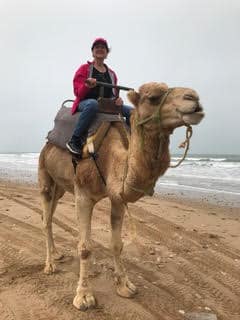
Surrounded by family and friends, I’m active. I play golf, swim, and dance again. I travel by car, plane, and train in the U.S and internationally. Supplies and all, I braved a 26-day cruise. I even rode a camel!

Wherever I go, my “Bathroom Access Card” is in my wallet, and translated in 2 foreign languages on my phone. In recovery, I found the time and strength to redesign and renovate my kitchen. Made time to socialize. I recently attended my oldest granddaughter’s college graduation and all the festivities. I’m looking forward to it all over again with my second granddaughter who is studying medicine. Since my surgery, I feel blessed indeed, going on 6 years NED (no evidence of disease).

And I’m no longer single! I have a wonderful relationship with a man who adores me for who I am, including my ostomy. There is little to keep me from a fulfilling life, and you shouldn’t let a pouch stop you either.

You’ve Got This!

Stella. Betty Poop. Homer the Stoma.

To some, stoma names may seem silly or childish. A stoma is not a pet, after all. Not a car or childhood stuffed animal. People don’t typically name their liver or spleen—so why, then, would anyone name a stoma?

For many people with ostomies, naming their stoma isn’t just a quirky custom; it’s a meaningful practice. It’s not about trivializing a potentially life-saving surgery or minimizing the complexity of ostomy life. Rather, it’s a tool for healing. Naming may be a way to reclaim agency in moments of powerlessness, to bring levity to something heavy, and to create connection—with yourself and others—amid profound change.

Naming your stoma as a coping strategy

Seeing your stoma for the first time may be a deeply jarring experience. That small section of intestine or urinary tract, visible through your abdominal wall, can trigger a range of emotions: shock, grief, maybe even a sense of bodily betrayal. Your stoma may feel like a glaring marker of surgery, illness, or loss—a visible reminder of all you’ve been through or what makes you feel different.

Adapting to an ostomy is a deeply personal journey, shaped by physical, psychological, and social factors. For many, the experience goes far beyond ordering ostomy supplies or managing pouch changes. It touches self-image, identity, and the core questions we ask in moments of significant change: Who am I now? What does this mean for my life?

While there’s no single path through this process, research shows that how you relate to your stoma matters. How you view it, speak about it, and ultimately integrate it into your life could play a pivotal role in emotional and psychological adaptation.

One surprising but potentially powerful tool in the process? Naming your stoma.

In a 2018 survey by ostomy care nurses Jane Cook and Jackie Hatton, 75% of respondents who named their stoma said it helped them cope with the aftermath of surgery. As one participant explained, naming their stoma helped it “become part of [them]”—less foreign, more personal.

In this way, naming may be an act of reclamation, a powerful gesture when you have a new body part stitched into place, a system rerouted and reimagined. New language—pancaking, flange, peristomal skin—comes with new routines and instructions. When so much is out of your control, naming your stoma might be one thing you get to choose. It’s one way to say: I didn’t choose all this, but I can choose how I meet it.

The role of humor and connection in adapting to ostomy life

Naming a stoma isn’t just about finding agency or control; it may also bring humor, creativity, and connection into an experience that is often heavy.

Many people with ostomies choose names that reflect the “personality” of their stoma. Maybe it’s Sassy Sasha, if it has a flair for dramatic entrances. Great Gassy, if it’s mysterious but persistent. Or Mildred, if it’s all business. With a name, suddenly the stoma isn’t just a surgical site. It’s Oscar, having a bad day and making sure everyone knows it. It’s Lola, the life of the party when you’re trying to focus. It’s Hank, sneaking up at the most inopportune moment. These names may transform the stoma from something clinical into something human, giving you language to talk about it, joke about it, even roll your eyes at it.

As playful as many stoma names are, it’s not just about cracking jokes for the sake of it. Research shows suggests that humor may be a valuable coping strategy for some people with ostomies, helping to promote acceptance and psychological resilience. With a little wit, the stoma may shift from a source of shame or discomfort into a character in the story of healing: sometimes annoying, sometimes funny, but no longer invisible or feared.

This reframe may also help break down the stigma surrounding ostomies by encouraging open communication. In one study, a survey participant shared how their family shouts, “Shut up, Lily!” when their stoma acts up, turning what might otherwise be an isolating experience into shared laughter. What once felt unspeakable becomes something everyone can talk about—a starting point for connection and support.

Respecting personal choice: Not everyone names their stoma

While naming a stoma can be a meaningful part of the healing process for some, it’s not for everyone—and that’s okay. Choosing not to name a stoma can be just as intentional as a name like Rosie or Winnie the “Poo.” In fact, some people with ostomies say that naming can create a sense of separation they don’t want. They don’t see their stoma as something “other,” something that needs to be softened or humanized. The stoma is simply “my stoma.” No need for nicknames or extra narrative—it just is.

Interestingly, for those who do choose to name their stoma, that relationship may change over time. Some ostomates who initially name their stoma eventually stop using the name. For them, what began as a coping mechanism may be less necessary as the stoma becomes just another part of their body. As the name fades, so does the need to frame the stoma as anything other than a part of moving forward.

Living with an ostomy: Your story, your terms

What naming offers isn’t a right or wrong way to “do” life with a stoma. It simply offers space for choice, connection, and self-expression. Some stoma names will stick. Others won’t. Some may only be whispered in private, while others are worn like a badge of resilience or pride.

What matters most isn’t whether you call your stoma Stanley or Scooby-Poo or nothing at all. It’s that you get to choose. That even after illness and surgery—even after everything—you get to choose how your story goes.

References

Cook, J., & Hatton, J. (2018). Giving a stoma a name: A mixed-methods study of naming habits and attitudes among ostomates. Gastrointestinal Nursing, 16(7). https://doi.org/10.12968/gasn.2018.16.7.28

Jayarajah, U., & Samarasekera, D. N. (2017). Psychological Adaptation to Alteration of Body Image among Stoma Patients: A Descriptive Study. Indian journal of psychological medicine39(1), 63–68. https://doi.org/10.4103/0253-7176.198944

Simpson, E., Pourshahidi, K., Davis, J., Slevin, M., Lawther, R., O’Connor, G., Porrett, T., Marley, J., & Gill, C. (2023). Living with and without an intestinal stoma: Factors that promote psychological well-being and self-care: A cross-sectional study. Nursing open10(12), 7811–7825. https://doi.org/10.1002/nop2.2030


Coloplast develops products and services that make life easier for people with intimate healthcare needs. Working closely with the people who use our products, we create solutions that are sensitive to their special needs. Our business includes ostomy care, continence care, advanced wound care, interventional urology, and voice & respiratory care.

Follow Coloplast on InstagramFacebook, and YouTube, or visit us online at https://www.coloplast.us/


Editor’s note: This blog is from a UOAA digital sponsor, Coloplast. Sponsor support along with donations from readers like you help to maintain our website and the free trusted resources of UOAA, a 501(c)(3) nonprofit organization.


Rob Nunnery is returning to professional sports—and raising awareness about living fully with an ostomy.

When Rob Nunnery stepped onto the pickleball court for the first time post-surgery, it wasn’t just about hitting balls. It was about proving—to himself and others—that life after a colostomy isn’t just livable. It can be powerful.

The professional pickleball player and podcast host spent the better part of two years in unrelenting pain, battling what turned out to be severe perianal Crohn’s disease. It began in March 2022 with a painful abscess—but quickly spiraled into a complex web of fistulas, surgeries, and daily limitations.

“I tried to manage it for as long as I could,” Rob says. “But the pain never really left. I couldn’t sit. I couldn’t train. I was just trying to survive.”

Through it all, Rob kept competing—and remarkably, he reached the #1 ranking in men’s doubles at points during both 2023 and 2024. But by early 2025, after five colorectal surgeries and years of pushing through chronic pain, Rob made a life-changing decision: he underwent a colostomy.

A New Chapter Begins

Rob had the surgery on February 20, 2025—a choice he once feared, but now credits with giving him his life back.

“I was scared. I had all the same questions and doubts,” he says. “But I reached a point where I had nothing left to prove to anyone—and everything to gain if I could just get out of pain.”

Just seven weeks post-op, Rob was preparing to return to competition. His first tournament back was the Dubai Open this May and despite it being a lot to manage physically he won in pro men’s doubles and got silver in pro mixed doubles! “I‘m proud that I went and even more proud of the result being my first tournament back,” Rob says.

Up next, you can follow his return to the Association of Pickleball Players’ APP Tour with the New York City Open May 20-25.

Rebuilding from scratch, this New York stop is where he won both men’s and mixed doubles two years earlier.

Breaking the Silence

For Rob, this comeback is about more than rankings. It’s about visibility and impact.

“I want to show that thriving with an ostomy is not just possible—it’s powerful.”

“There’s so much stigma around ostomies, especially in men and athletes,” he says. “I want to show people that you can still perform at the highest level. You can still live fully. You can still compete.”

He’s deeply aware that not everyone sees examples of active adults—let alone professional athletes—thriving with an ostomy. That’s why he’s choosing to speak out, and to live publicly in a way that helps others feel less alone.

Support and Strength

Rob credits his significant other, Malan Doty, as his rock throughout this entire journey.

“She’s been through it all with me. Every surgery, every setback, every painful day—she never left,” he says. “There’s no way I’d be here without her support.”

Now, Rob wants to be that kind of support for others—especially young people, men, and athletes facing ostomy surgery.

Rob was told of UOAA by his stoma nurse at the Mayo Clinic. “The (ostomy.org) website has been my go-to in terms of education and learning how to navigate having an ostomy from supplies to nutrition to exercise. The travel info was super helpful on my recent trip to compete too.”

Rob is thankful for the work UOAA does to support the ostomy community. “It has made a huge difference in my own journey.”

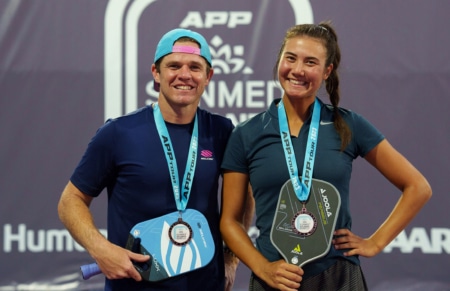
Rob Nunnery and Pro Mixed Doubles Partner Vivian Glozman | Photo by: Lucas Boland

More Than a Comeback

As Rob steps back onto the court, he’s not just chasing points. He’s showing that strength can look different than it used to—and that adapting is its own form of power.

“I want to show that thriving with an ostomy is not just possible—it’s powerful.”

Tips he’d give to other ostomates on being active? “Ease into it. Listen to your body, don’t try to do too much too soon. Going on walks was so grounding for me. I’m lucky to live close to a beach, so feet in the sand and having less pain during walks have been amazing. And good for me mentally too.” Rob shares.

“My colostomy gave me my life back. If I can help just one person stop feeling ashamed or afraid because of their bag, then all of this will have meant something more.”

You can follow Rob on (Instagram @robnunnery) and sign-up for his daily newsletter link at (read.robnunnery.com)

You can also see Rob at UOAA’s 2025 National Conference where he will be a co-speaker for a session entitled Health, Fitness and Active Living on Saturday, August 16 in Orlando, Florida.

Remembering Ruth Fawley

By Ed Pfueller, UOAA Communications and Outreach Manager

In 1950, Ruth Fawley celebrated her 21st birthday, but the following decade was spent mainly in hospitals. Her ulcerative colitis led to an ostomy in 1951 and multiple unsuccessful intestinal surgeries. At one point, she was in a life-threatening coma for a week. Considering her health struggles, few people at the time might have predicted she would live an active life and reach the age of ninety-four before her passing in 2024.

A turning point in Fawley’s life came with her introduction to Dr. Harry Ellicott Bacon, Professor and Chairman of the Department of Proctology at Temple University Hospital in Philadelphia, Pennsylvania. He performed ileostomy revisions and subsequent surgeries that ultimately allowed her to lead a more normal life.

Dr. Bacon was an internationally renowned and innovative surgeon who prioritized the emotional well-being of his patients. He invited Ruth to a peer support group for women with ostomies and related surgeries.

Ruth worked as an executive secretary and while working at the travel magazine Holiday met many well-known authors, likely sparking her lifelong passion for travel.

She married her longtime husband, J. Russell Fawley, Jr., in 1959. When it came to starting a family, doctors at that time were not sure if a woman with an ileostomy could get pregnant and give birth. “She would later joke that out of the nineteen surgeries she endured, the only time she left the hospital with more than she went in with was when she had her two Cesareans,” remembers her daughter Nancy Fawley.

She thinks her mother would want fellow ostomates reading this article, “To be inspired and know you can have a family, travel and have a long normal life with an ostomy.”

Nancy says her mother was a wonderful cook and loved to garden. Ruth loved the water, whether swimming at the Jersey Shore or doing near-daily water aerobics later in life. Ruth also had a keen artistic eye, loved to sew and was well-known for the dynamic use of colors in her quilts.

Like many of her generation, Ruth carried on quietly in life with an ostomy but had to manage the challenges of short bowel from her many surgeries. She was a longtime supporter and member of UOA and UOAA and an avid reader of The Phoenix Magazine.

A June 2011 article on Army Pilot Bob Cuyler’s story of flying in a combat zone with an ostomy inspired her to write a letter to him. He responded in kind by sending her a Presentation Flag his unit took into active duty, which she cherished for years after. In her return letter, she thanks Cuyler for his service and fortitude and shares that even finding ostomy appliances was difficult in those early days. “An ileostomy was not spoken of and I know the humiliation, embarrassment and stigma attached to it,” she shared. But her sense of humor shines through as she ends her letter joking that the old Ostomy Quarterly magazines used to arrive in plain brown paper wrappers, leading her neighbor to think she was getting Playboy Magazine!

“If I get to the gates of heaven and still have this ostomy pouch I’m turning around!”

Nancy says that her mother shared many Phoenix articles with her over the years so she would have a better understanding of her condition. “I relied on this information when I worked with doctors, health care professionals and hospice caregivers who had little to no experience with patients with an ileostomy,” Nancy says.

In honor of her mother’s memory, Nancy has donated to UOAA at The Phoenix Society Diamond level in part because of UOAA’s continued commitment to ostomy education for both patients and medical professionals.

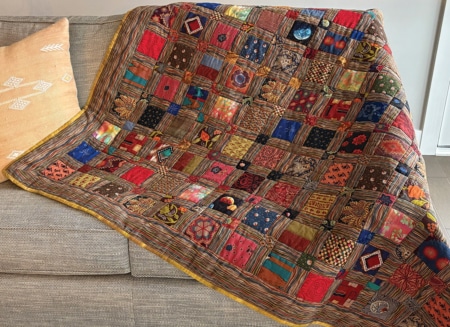
In her later years, Ruth herself became a caretaker for her husband as he battled with Parkinson’s disease and dementia before his death in 2014. During this time, she created a striking quilt with dynamic colors she entitled “meltdown.” Ruth’s colors live on in the many quilts she gifted to family and friends.

In her final months, Nancy got to hear more stories of her mother’s travels in England and France and a doctor’s direction that a bit of scotch can help in digestion. She thinks her mother would want fellow ostomates reading this article, “To be inspired and know you can have a family, travel and have a long normal life with an ostomy.”

At the end of her 94-years she had just about enough of dealing with it though, “If I get to the gates of heaven and still have this ostomy pouch I’m turning around!” she told her daughter. The amazing mix of humor and resilience required after 73 years with an ostomy still shining through.


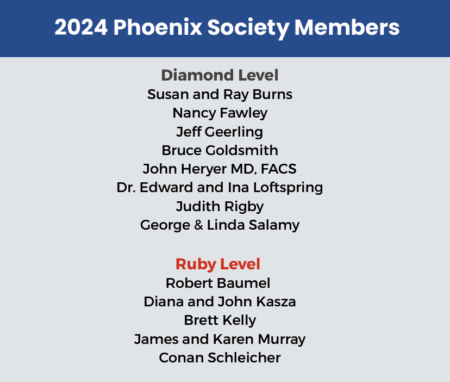
The Phoenix Society recognizes those individuals who are able to sustain and/or increase their total annual donation of $500 or more during each calendar year. Become a member of The Phoenix Society or donate at any level to help UOAA fulfill its mission to promote the quality of life for people with ostomies and continent diversions through information, support, advocacy, and collaboration. UOAA is thankful for those who give, including Nancy Fawley and the other Diamond and Ruby Level members listed below. 


My Ostomy Story

By Carol Billian

I only know my story because my family told me. I was in a coma after suffering an abdominal aortic aneurysm, which caused my colon to rupture. I was in septic shock and multi-organ failure. Doctors performed an emergency ileostomy, and told my family on numerous occasions they were not sure I would survive.

After being in the ICU for 35 days, on a mechanical ventilator, and hospitalized for four months, I was finally discharged after completing a cycle of intensive physical therapy. At discharge, I weighed 69 pounds. I had to move in with my Mom for two years, while I gained weight and she nursed me back to health.

Over the next two years, I would need four additional surgeries to revise my ileostomy, open heart surgery because of damage to my heart from the sepsis, and ultimately a surgery to revise and relocate my ostomy. As of this writing, my weight has finally reached 95 pounds, which is still very underweight. It has been very difficult gaining because my body has difficulty absorbing nutrition.

I finally heard about UOAA, when I complained to my ostomy nurse there were no resources near me in Maryland to support ostomy patients. As a result of everything I endured, I vowed to go on and help other people. I am on social media platforms as @Carsueb, advocating for ostomy patients, and providing all kinds of facts, tips, and ways to handle your Ostomy. I also attend Ostomy Support groups to help people, and support groups for ICU Survivors, like myself.

An ostomy can truly be a lifesaver, as mine was. It was not the end of my life, but the start of a new, different life.

Peer support is mandatory for those with ostomies. I speak about my ostomy to everyone who will listen. It is a part of me, and no one should feel embarrassed or afraid to talk about their Ostomy. If more people spoke openly, doctors would not tell their patients an ostomy is a last resort. They would tell their patients, “Ostomy surgery will give you back your life, and will give you a great quality of life.” This is what I hope to accomplish in talking to Colorectal surgeons. I do not want them telling Crohn’s or UC patients an Ostomy is their last resort.
I’m on an Advisory Board at the University of Pittsburgh Medical Center, and local hospitals in Baltimore. These surgeons respect what I’m doing and have asked for my help.

I want to help prepare people for surgery. I want them go in with a positive outlook. I tell them what their body will look like after surgery, how they will feel, and what to expect. I show them my stoma. Knowledge is power. I don’t want them to feel afraid, so I am totally open.

An ostomy can truly be a lifesaver, as mine was. It was not the end of my life, but the start of a new, different life. I feel very lucky. I feel very blessed and feel I must tell my story to help as many people as I can. I am trying to normalize the talk about ostomies, and remove the stigma.

By Charlie Grotevant

As someone who underwent successful ileostomy surgery in 1983 followed by immediate membership in the Kankakee, Illinois chapter of United Ostomy Associations (UOA), my history is long. My wife Joyce and I attended several UOA National Conferences during the 1990s and 2000s, making friends from around the country.

In 2014, I began a Memoir entitled The Healthy Years chronicling my life beginning with 1983.  It consists of 162 pages with nearly 60,000 words and photos. There is an abundance of information regarding UOAA, taken from emails, writeups in Affiliated Support Group (ASG) newsletters, notes written shortly following many of the events, etc. This narrative is gleaned from my Memoirs.

Like our symbol, the Phoenix, UOAA rises from the Ashes of UOA

During the UOA years Ken and Linda Aukett served, during different intervals, as President of UOA, including a term for Ken as President of the International Ostomy Association.

Linda led advocacy efforts with elected and appointed government officials and interacted with other health-related support and research organizations.

My visibility with UOA became nationwide when I was the recipient of the 18th annual Great Comebacks Award in 2002. At that time the program was financially sponsored by Convatec and co-sponsored by Crohn’s & Colitis Foundation. UOAA became an additional co-sponsor in 2006.

During March of 2005, it became apparent UOA was planning to dissolve due to financial shortcomings. Contributing to this decision was the withdrawal of the Canadian chapters of UOA to become the Ostomy Canada national organization several years prior. UOA announced it would cease operations on September 30, 2005 after 43 years of providing essential services.

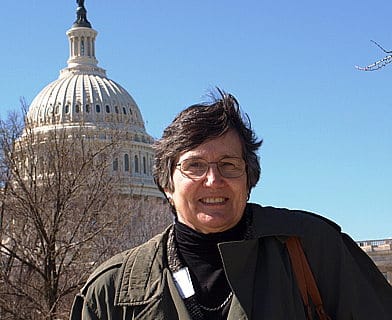
UOAA C0-Founder Linda Aukett at the Capitol in Washington, D.C. while serving as President of DDNC (Digestive Diseases National Coalition).

Ken and Linda Aukett were determined that a national ostomy support organization was essential for the continued support and education of approximately 750,000 Americans, their caregivers, and patients considering or needing ostomy surgery. Pursuing advocacy issues, as had been done with UOA, was equally important.

The Auketts began creating a Steering Committee to establish the successor organization.  It was to become an organization of individual Affiliated Support Groups (ASGs) operating under the umbrella of the national organization. ASGs would collect dues from individual members to maintain their respective local groups and would send ASG dues to UOAA.

UOA had served as a national organization with several hundred Chapters throughout the country. UOA published the Ostomy Quarterly magazine and sponsored a Youth Rally camp as well many other functions on the national level.

Mary Jane Wolfe had a lead role in setting up the new organization, helping come up with the name United Ostomy Associations of America (UOAA), but did not want to be on the Steering Committee. She recommended me to Ken who put the “hard sell” on this busy Illinois farmer to be the 7th member. Mary Jane was also a major force in the prior UOA Rally, leading by example from her wheelchair.

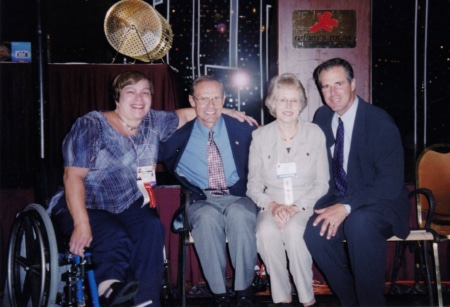
Charlie and Joyce, center, with Mary Jane Wolfe, left, and NFL legend and ostomy advocate Rolf Benirschke, right, at a National Conference.

The Steering Committee consisted of Ken as President, Julielynn Gibbons as Vice President, Ginnie Kasten as Secretary, Dave Rudzin as Treasurer, Ron Titlebaum and myself as Directors. Linda Aukett was officially recognized as the Advocacy Chair. George Salamy was named as Chair of the Trustees.

A major role incorporating UOAA, securing 50 (c3) tax-exempt status, and assisting with writing the Constitution of UOAA was filled by Philadelphia lawyer, Sheldon Sokol, working pro bono, for whom we are forever grateful.

Bob Baumel, who had served as webmaster for UOA, became and expanded the webmaster duties with UOAA. Thank you, Bob for all you have done and continue to do.

Ian Settlemire, who had served as Editor of Ostomy Quarterly, created The Phoenix magazine, the official publication of the UOAA. A free copy was sent to each former Ostomy Quarterly subscriber in December of 2005. Subscription fees to The Phoenix have been an important source of revenue for the UOAA for the past 20 years.

The final UOA National Conference was held August 3rd-6th in Anaheim, California with UOAA given time to tell of the new organization and respond to questions and concerns.

The Steering Committee members were given assignments to meet with vendors, UOA officials, medical professionals, and health service providers. In addition to the explanatory sessions, I was to meet with Dave Johnson, VP of Convatec, telling the goals of UOAA and requesting financial support. I was well acquainted with Dave because of the Great Comebacks Program and subsequent publicity events. He pledged a significant monetary commitment to UOAA.

Outhouse to White House

As a farm boy, who was 9 ½ years old before we had running water and indoor plumbing, I have truthfully gone from the outhouse to the White House. The White House adventure was arranged by Convatec at the time of the 2007 Great Comebacks National Awards in Washington, DC, with separate Congressional lobbying calls on the agenda, carried out the next day.

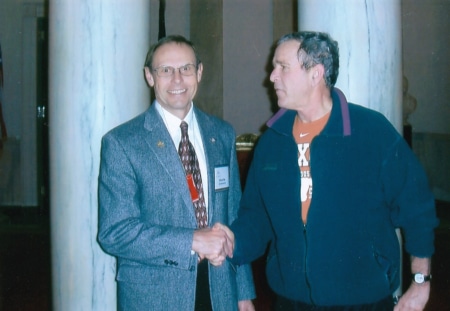
Charlie with President George W. Bush at the White House in 2007.

A White House after hours visit was hosted by Marvin Bush, younger brother of President George W. Bush.  Marvin is a member of the 5P Club, People who Poop or Pee in a Plastic Pouch, a survivor of IBD.

Marvin needed to leave prior to the arranged time for the mini bus to take us back to the hotel.  Then the President arrived on the scene, and this group of 13 had an interesting 25 minutes of non-political chit-chat.

Even though Convatec has undergone ownership changes, I remain forever grateful for all they have done for us and other recipients of the Great Comebacks Award.

Early Years of UOAA

On October 1st, 2005, UOAA became an official legal entity and the Steering Committee became the initial Membership Board of Directors, a bare-bones organization.  In later years after multiple staff positions were created, the designation MBoD became Board of Directors.

Linda arranged for the UOA toll-free number to be transferred to UOAA, with each Board member to take the calls one day a week. Lots of calls on some of my assigned days into an answering machine. I responded as soon as possible. Some wanted genuine information and encouragement, but a few wanted a shoulder to cry on or complain.

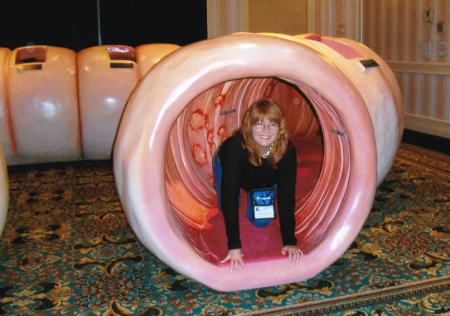
Coco, the Colossal Colon at the 2007 UOAA National Conference. It had been previously featured on The Today Show and UOAA volunteers appeared with it on an episode of Shipping Wars.

I was also happy to server as Liaison to Youth Rally, which became separate nonprofit organization.  I became a volunteer counselor in 2006 and continued as a counselor through 2012 when my hearing was deteriorating badly and I considered myself a liability rather than an asset to the Rally. Those weeklong camps at various college campuses were the most rewarding and most tiring weeks of those years. I continue to support Youth Rally financially.

2006 was a busy year for UOAA and others on the MBoD. Early that year, Joan McGorry was hired as Office Administrator to work out of her home.  This eliminated the weekly telephone response sessions on the part of those of us on the MBoD.

In February, I received a call from a WOC nurse in southern Illinois telling of a young lady being denied insurance coverage for ostomy supplies.  I consulted Linda Aukett regarding this issue and received guidance.

A few weeks later, I was invited by Convatec to speak at a national sales conference in New Jersey. At the sales conference, I met with the Convatec Director of Health Economics and Reimbursement and a separate healthcare consultant to discuss ways to proceed with the Illinois reimbursement issue.

A month later, following the testimony of the aggrieved ostomy patient to the Illinois Insurance Committee, I presented testimony and supporting evidence. An insurance lobbyist in his lawyer language quickly denied the need for mandatory coverage.

The Chair of the Committee appointed a sub-committee to study the issue. Net result, SB 2444, an amendment to the Illinois Insurance Code, passed requiring coverage for ostomy supplies, although allowing deductibles to occur. A victory for UOAA!

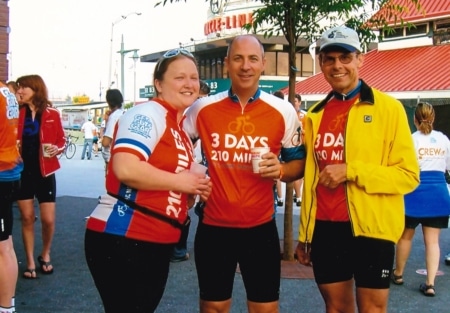
Julielynn Gibbons, Bob Baker and Charlie as UOAA reps at the 2007 GYGIG 3-day bike ride.

Also in 2006, UOAA became a co-sponsor and beneficiary of Get Your Guts In Gear (GYGIG), a 3-day bike ride fundraiser for UOAA, Crohn’s & Colitis Foundation, The Colon Club, and other organizations focused on IBD, colorectal cancer, and the needs of ostomy patients. This was the third year of the GYGIG event. In each of the first two years I rode, UOAA received $60,000.

In 2007, UOAA had additions with Mary Jane Wolfe, Kristin Knipp, Lynne Kramer and LeeAnn Barcus joining the MBoD.

A Support Group Ambassador Program was also initiated with the goal of surfacing volunteers to act throughout their respective states and regions in efforts to gain more ASGs and increase membership.

On a personal level, because of three winter months on the Gulf Coast of Florida, I visited and spoke to as many as a dozen ostomy support groups, facilitating changes in leadership and bringing one major hospital into UOAA. I did the same in Illinois.

2008 brought Bob Baker onto the UOAA MBoD. I was acquainted with Bob because of his Regional Great Comebacks Award. We also shared a GYGIG ride in 2007. Bob has now rejoined the UOAA Board.

One of the basic foundations of UOAA is the need for constant and competent advocacy with elected and appointed officials.

Susan Burns also joined the MBoD that year followed by Jim Bob Murray the next year. Millie Parker then came onto MBoD in another year or two as did Justin Blum. Many more followed.

At the end of 2008, I exited the MBoD because the hearing deficit was reducing my effectiveness. I continued as UOAA Ambassador and remain willing to call on ASGs and individuals when asked. I also continue leading the Kankakee ASG.

As I conclude this narrative, I praise Ken and Linda Aukett for all they have done and what Ken continues to do with years of total involvement in the greater ostomy community. They became the heart and soul of UOA, UOAA, and the International Ostomy Association, traveling to every continent except Antarctica.

Linda also served as the UOAA representative on the Digestive Diseases National Coalition (DDNC) Board and was later Chaired that organization, linking 23 national organizations together in advocating for common interests.

Evidence of Linda’s advocacy efforts was shown in 2011 when Ken and I accompanied a former US Senate staffer who was rudely examined by TSA personnel as he prepared to board a flight.

A few years prior, UOAA led the effort in getting the Blue Notification Card accepted by TSA as proper notification of special medical conditions and the need for the screening to be done in a discreet manner. Even so, continued insufficient training of some TSA personnel continued to result in occasional major mistreatments.

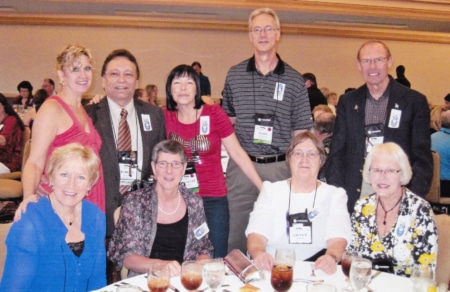
2013 UOAA National Conference in Jacksonville, FL.

A meeting, arranged by the insider using his personal friendship with the President of the Senate, occurred in the TSA office. TSA Director John Pistole, TSA Legal Counsel Jackson, and the Director of Operations were with us for an hour to meet and discuss the problems still arising during TSA screenings.

During our self-introductions, when Ken identified himself, the Legal Counsel asked of Linda. Jackson, quickly stated to the effect that ‘I have had many conversations with Linda and we continue to work on solutions for the problems at hand. Yes, the name Aukett brought instant recognition.

One of the greatest losses to our ostomy community was the passing of Linda in 2013 due to cancer. Her knowledge and abilities, whether with Youth Rally, with UOA and UOAA functions, and especially with advocacy efforts on Capitol Hill where she was known by elected and appointed officials is beyond comparison in my opinion.

Thank you, Ken and Linda for your ‘over and above’ efforts throughout many years of helping others.

Be the Future

As for my thoughts for the future of UOAA. One of the basic foundations of UOAA is the need for constant and competent advocacy with elected and appointed officials. This is more so than ever before due to the political divisiveness threatening all aspects of everyone’s life. UOAA has a wonderful Advocacy Program with many ways to get involved.

With all the inaccurate information floating through all media, including websites, blogs, etc., it is critical for UOAA to be the voice of accuracy. This will require increased determination on the part of everyone associated with UOAA to be the voice on the local level as well as nationally. Yes, UOAA can go forward if enough concerned people become UOAA members and come forward to volunteer and assist in meeting the challenges before us.

I invite others to share historical UOAA memories and let me know if everything I have shared is accurate. We hope to see many of you in Orlando for the 2025 National Conference where we will take time to celebrate 20 Years of UOAA!


By LaTesha Harrison-Thompson

Living with an ostomy can bring about significant changes in your life, but it doesn’t mean you have to give up your social life or let go of cherished friendships. Here’s my story of how I kept my friendships and social life intact while living with an ostomy during my teenage/young adult years.

My friends were more than willing to make small accommodations, whether that meant picking a restaurant with accessible restrooms or planning less physically demanding outings.

Open Communication

Although this was extremely hard, transparency was my first step. I found it helpful to explain my condition to my close friends. It wasn’t always easy, but being honest about my needs and limitations made a world of difference. Their support and understanding grew out of their awareness of my situation, turning what could have been an awkward subject into a source of mutual trust and strength. I didn’t reveal my condition to everyone and most family did not know but the small core that did know was understanding and accepting. Trusting your friends and family to care for you when you are unable is a huge step.

Choosing Comfort and Confidence

I took some time to learn about my new normal, which included finding the right ostomy supplies that worked for me. Comfortable and discreet options boosted my confidence, making me feel more at ease in social settings. This confidence was key to enjoying myself without constantly worrying about my ostomy.

Planning Ahead

For outings and get-togethers, a bit of planning went a long way. I always carried a small kit with extra supplies, and scouted out restrooms when I arrived at new places. This allowed me to relax and have fun without the nagging fear of unexpected issues.

Adapting Activities

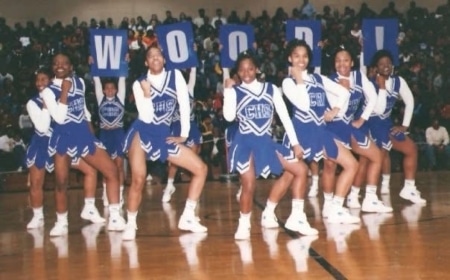
I realized that while some activities might require slight adjustments, I didn’t have to miss out. Whether it was cheerleading, going to the mall, or just a night out, finding ways to adapt and participate fully kept my social life vibrant and my confidence boosted. My friends were more than willing to make small accommodations, whether that meant picking a restaurant with accessible restrooms or planning less physically demanding outings.

Lean on Support Groups

Connecting with others who have similar experiences can provide a unique form of support and camaraderie. Although I didn’t have this opportunity growing up, joining an ostomy support group can offer practical tips and emotional encouragement, and you can make great friends who truly understand your journey.


Staying Positive and Proactive

Maintaining a positive attitude was crucial. Instead of focusing on limitations, I embraced what I could still do and enjoyed the moments with friends to the fullest. By staying proactive in managing my health and well-being, I found that my ostomy became just a small part of my life rather than a barrier.

Living with an ostomy certainly comes with its challenges, but with the right mindset and strategies, friendships and social activities don’t have to take a backseat. By prioritizing communication, confidence, and adaptability, I discovered that I could still lead a fulfilling and fun-filled life.

20 years ago, UOAA formed and continued a legacy of advocacy and support for the ostomy community.

I had my Ostomy Surgery in 1992 due to ulcerative colitis. At that time the national organization for our community was the United Ostomy Associations (UOA). Around that time UOA was working on a project to increase the allowable amount of ostomy supplies a person can order. They wanted to double the amount that a person could order, because if a patient had skin problems or leakage problems a person would need more supplies than normal.  As it stood the allowable wasn’t enough and if a person needed more they had to be paid for out of pocket and UOA members were calling to see if something could be done. That was the start of the Advocacy program at UOA.

When UOA folded in 2005 former members put together the new organization, United Ostomy Associations of America (UOAA) it was determined that the new organization would have an Advocacy Program from the start. That was a confirmation to us all, as to how important an advocacy program is to UOAA and its members. Today, that legacy continues with an active advocacy network and national advocacy goals everyone should be involved with.

When I had my surgery, I was a married man with four daughters and worried about the future and whether I would be able to provide for them. My ET Nurse (Entrostomal Therapist), today’s WOC Nurse, gave my wife information on the local support group. My wife and I attended a meeting and after talking to a few attendees, I began to feel a lot better about myself.  I was so appreciative of the Information that I had received that I decided I needed to do more and at the next meeting, they had sample letters that they were asking people to type up and send to their senators. One member brought the letter back after a UOA National Conference and made copies of it. My brother had given me his old computer and printer so I retyped the letter up and printed out 50 copies, printed out envelopes and donated the stamps to send them for the group. All someone would have to do is sign the letter, put it in the envelope and mail it.  After that, the board of directors of the support group asked me and my wife to join their board. We gladly accepted.

We went to two of our first national conferences in 1995, what an eye-opener for both of us. there were so many sessions that both of us wanted to attend but couldn’t make it to all of them because some were at the same time, so my wife said,” how about we split up and report back to each other at the end of the day.” It was fantastic. A few years later UOA decided it was going to dissolve. We were devastated.

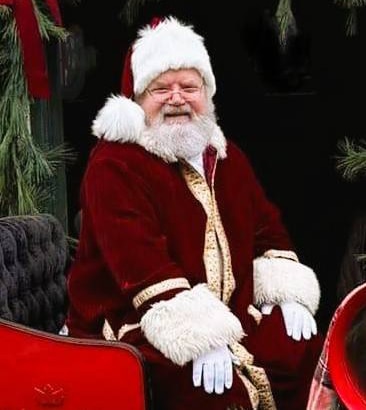
During the holiday season Stanley Cooper enjoys playing Santa Claus in the Philadelphia area.

We thought we were going to our last conference in Anaheim, California when it was announced that a new organization was forming. That was a huge relief to me and my family to know that there would be a national organization with the same values as the former organization to fulfill the emotional needs and be able to help any future family members or friends that someday may find out that they need to have an ostomy.

UOAA has continued the tradition and I was honored to volunteer when it came to Philadelphia in 2019. This year UOAA is hosting its 9th National Conference August 14-16, 2025 in Orlando, Florida.

Today UOAA also has an outstanding website here with ostomy.org that patients and medical professionals can go to and print out information on ostomy management and more. This is a huge help to new ostomy patients and ostomates who have had their ostomies for a while and are having problems can solve it on their own or postpone their need until they can get to see a doctor or WOC Nurse.

UOAA also has a Network of Affiliated Support Groups around the country where patients can go to a meeting and talk to other ostomates about having an ostomy, get answers to their questions such as will I be able to return to work? What type of clothing will I be able to wear? Will I be able to have relations with my husband, wife, boyfriend, girlfriend or significant other? Just some of the questions that have come out and there are hundreds more. Local Support Groups are vital to all ostomy patients and can be found on UOAA’s website with their support group finder.

Ostomies are lifesavers and I’ve been active in my retirement as a bakery worker and have gotten to serve as a Santa Claus in my community around Philadelphia.

We continue to support Ostomy Awareness Day each year and also any advocacy actions we can take on a state or local level. We’re all lucky UOAA is here for our community. Happy 20th Anniversary!

If you’d like to share a story about how UOAA has helped you or others in the past 20 years with ostomy advocacy, support, educational resources, events or more- email us at info@ostomy.org