
Resilience Story: Barbara Tischler
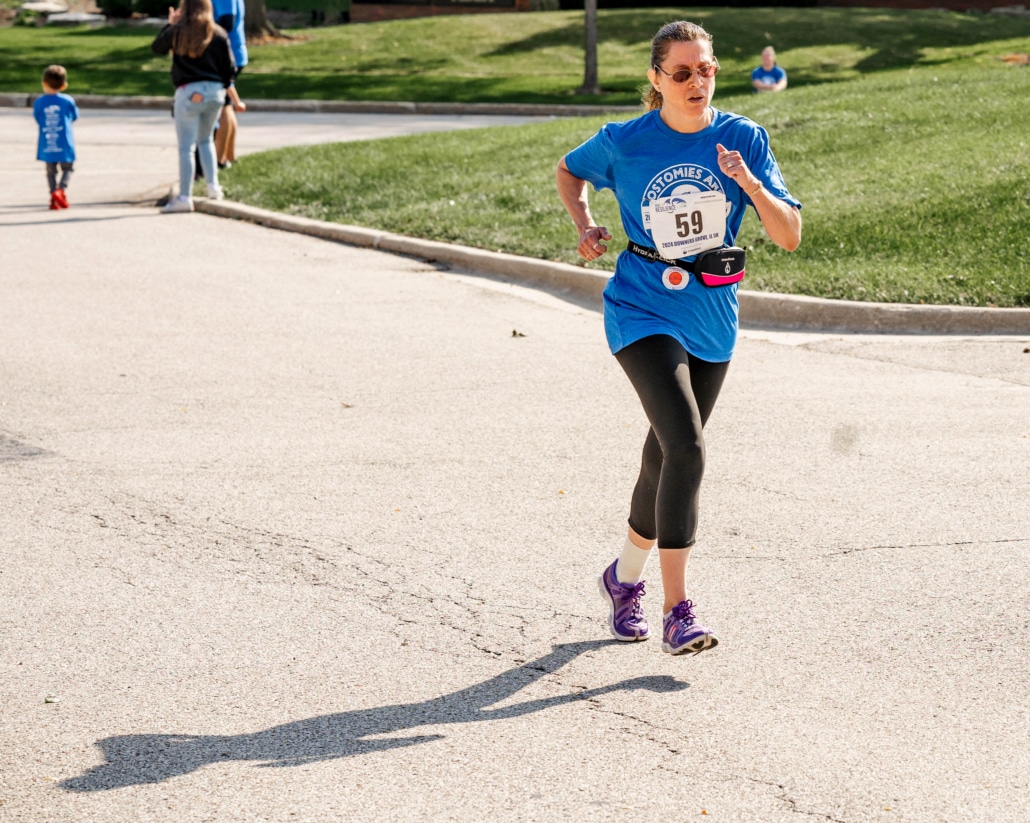
From the ICU to the long road back to health and giving back to the ostomy community.
In the afternoon of July 17, 2016, I had just returned home from an ice cream social (and I had eaten ice cream at a party the night before, as well. More on that later). I felt tired, so I laid down for a nap. Almost immediately, I began to feel abdominal pain. I went to the bathroom to see if I could alleviate matters by sitting on the toilet. For about a month, I had been having some constipation, but it had not raised any major red flags for me. And I had just turned 46 — too early for a colonoscopy at that time. When sitting on the toilet didn’t help and the pain got worse, I called for my husband. By the time he came upstairs, I was lying on the bathroom floor in tremendous pain. My stomach had become extremely distended, and I had removed a lot of my clothing because it was binding me. My husband called 911. The paramedics put me on a stretcher and carried me down the stairs and into the ambulance.
I remember the ride to the hospital, and I have a few sketchy memories of being in a hospital room, trying to hold in an enema, but failing to do so because of the pain. At that point, the doctor in the ER thought I just had severe constipation.
The next thing I remember is waking up in the ICU almost a week later in a heavily sedated fog and with a ventilator tube stuck down my throat. At some point later, the ventilator tube was removed (a day after a failed attempt to do so). My husband had to explain to me that a CT scan did not show anything wrong, but I was admitted to the hospital due to my pain. When my blood pressure dropped precipitously on July 19, the on-call surgeon was pulled in. He looked at the CT scan and saw evidence of air, which is a sign of a perforation. I was rushed into emergency surgery, where the surgeon found a cancerous tumor in my colon that had caused my stool to be impacted, which in turn, had triggered a massive perforation of my large intestine. I was in septic shock and close to death. The surgeon removed the tumor, resected my colon, and gave me a colostomy. I owe my life to that surgeon.
I found the right pouching system by making a multitude of phone calls and not giving up or settling until l found the right solution for me.
Initially, the plan was that in two to three months, I would have the colostomy reversed. Then, that changed to include six months of chemotherapy to eradicate any microscopic cancer cells floating around in my abdomen, due to the contents of my colon having been dumped into my abdomen. After that, I would get my colon reconnected.
However, that was not to be. I was starting to recover a bit in a regular hospital room. But due to the perforation, I had developed multiple abscesses of infected fluid in my abdomen. I started with a drainage tube, but eventually, my surgeon discovered that there were many abscesses unreachable by drainage tubes. So, on August 5, I went into surgery to drain all the areas of infected fluid. Unfortunately, I ended up back in the ICU on a ventilator. And I was told that because the infection had damaged organs, my spleen, 60% of my small intestine, and the entirety of my colon were removed. I now had a permanent ileostomy. And despite the second surgery, I eventually ended up needing three drainage tubes for three new abscesses that formed.
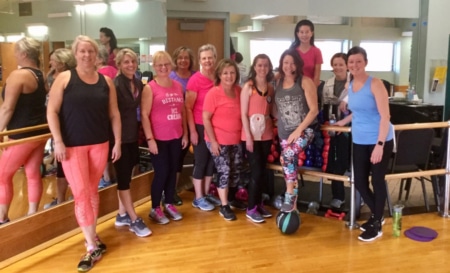
Halloween 2018 – my group fitness exercise class, where I showed my ostomy pride and spread awareness by wearing an ostomy pouch on the outside of my clothes, with a stoma sticker in the center.
I was quite sick and ended up staying in the hospital a total of 52 days, followed by two weeks at a rehab facility. During all this time, my husband was amazing. He kept friends and family up to date with nearly daily emails, on top of working full time, taking care of our 12 and 15-year-old sons, and visiting me in the hospital almost every day. My mother-in-law, friends, and people from my synagogue helped out with meals for my husband and sons. I received so many flowers that my hospital window sill looked like a florist shop. I also had an incredible number of phone calls and visits from friends and family. My parents came from Arizona and my brother came from California at one point while I was in the hospital, and a sister-in-law came from Texas while I was in rehab.
Once I got home, I had a PICC line through which I had to give myself antibiotics (continuing on with the antibiotics I received the entire time I was in the hospital and rehab). I bottomed out at 70 pounds and had little energy. I was also experiencing frequent ostomy leaks and still had one last drainage tube that had to stay until the abcess fully drained (which didn’t happen until November) and a fistula that had formed closed up (which didn’t happen until April 2017). I became very depressed and started to think about ways I might end it all. When I started verbalizing these suicidal thoughts, my husband told a home healthcare nurse, who urged him to take me to the hospital. I did not want to go, but when my 12-year-old son said that he did not want to NOT have a mommy, I agreed to go. Even though my stay in behavioral health did nothing to solve my ostomy leaks or my weight loss, I came home with my head screwed on a little more tightly.
There is nothing like being in a room with other people who know exactly what you are going through.
The next several months were a whirlwind of doctor appointments and drainage tube checks at interventional radiology. A caretaker helped me during the day and got me to my medical appointments while my husband was at work. Throughout the fall, I continued struggling with ostomy leaks, often happening in the middle of the night. My husband helped clean up my messes and helped me with my pouch changes. I had three public leaks, which were mortifying. I also started to notice numbness in my feet. I figured out it was neuropathy caused by my long-term antibiotic use. As soon as the last abscess was completely drained, I called my infectious disease doctor and asked if I could finally stop the taking the antibiotics. Thankfully, he said yes. While the neuropathy didn’t spread any further after that, I unfortunately ended up with permanent numbness in my feet. I have a fuzzy feeling in them to this day, although I don’t think about it most of the time.
Eventually, I got two months of at-home TPN to help with my weight. I had become malnourished because my body was not absorbing nutrients. With the TPN, one thousand calories a night went into my body intravenously, bypassing my apparently faulty digestive system. This helped tremendously to boost my weight. And while it took me time to feel comfortable with the idea of eating ice cream again (given that my harrowing experience started after eating ice cream), eventually I did!
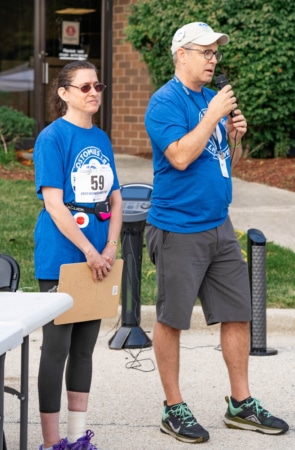
Barbara with fellow ostomate and Illinois Ostomy 5k co-director Bret Cromer.
After becoming fed up with ostomy leaks, I called all the ostomy pouch manufacturers and tried tons of samples. I kept getting my hopes up that each new pouching system would work, and then it would fail. However, I eventually found a winner with a custom pouch from Nu-Hope. It gave me my life back. I was able to go back to working with my organizing clients in their homes without worrying about leaks.
My father found out about the Ostomy Support Group of DuPage County and contacted its leader, Bret Cromer. A friend introduced me to a fellow synagogue congregant and member of this UOAA affiliated support group. She encouraged me to start attending meetings. In January 2017, I finally felt well enough to go to my first meeting, and I have been an active member ever since. There is nothing like being in a room with other people who know exactly what you are going through. I have made great friends and learned about helpful products that I have incorporated into my ostomy care routine. Fellow members helped me when I first joined, so now I try to pay it forward by helping new members.
I was a long-distance runner from age seven through eighteen. After years of suffering from shin splints every time I tried to run, I finally figured out in 2012 how to plant my foot when running to relieve stress on my shins. After my intestinal surgeries, I gradually got back to taking the group fitness exercise classes I had taken pre-illness, but every time I tried to run, it felt like I had cement blocks on my feet. Eventually, though, I started to get a bit more spring in my step. I tried running again one day, and while initially I had the cement-block feeling, I kept going and it got easier. I was thrilled to be able to run again!
In 2018, I saw the UOAA webpage of Run for Resilience Ostomy 5k runs throughout the country for Ostomy Awareness Day. That motivated me to organize my support group’s first informal Run for Resilience 5k. I organized these informal virtual ostomy 5ks every year through 2023. I also became the treasurer for my support group in 2023, and in 2024, Bret Cromer and I co-organized our first official UOAA run, located in Downers Grove, Illinois!
My husband and older son have been very involved with the support group. They attend social/holiday gatherings of the group with me, and they have helped at the 5k events. As for me, being an active member in the support group and organizing the 5k events make me feel pride in having an ostomy. I still have private pity parties occasionally, but overall, I feel that I am an emotionally strong and resilient ostomate.
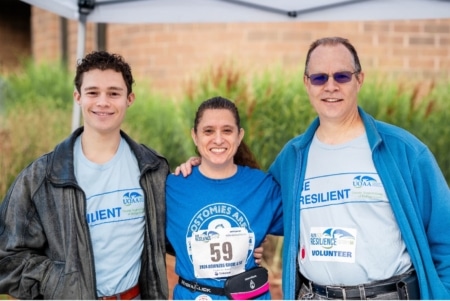
October 5, 2024 – my older son, me, and my husband at the Run for Resilience Ostomy 5k in Downers Grove, Illinois.
My parents have a charitable fund through the Arizona Community Foundation. They have generously donated to my support group and to the UOAA through this fund. I am so grateful for their support. In 2019, I was greatly honored to be inducted into my high school Athletic Hall of Fame. At the ceremony, my father introduced me, and I shared my cancer and ostomy story in my acceptance speech.
I never received chemotherapy. By the time I was healthy enough for it, my oncologist said it would not be very effective. Instead, he watched me very closely with frequent CT scans and bloodwork. Every time anything looked suspicious, I had follow-up tests and biopsies that thankfully showed benign masses, some of which resolved on their own. Finally, in June 2023, after having several clean scans, my oncologist told me about a new option called a circulating tumor DNA test. I jumped at the opportunity. A lab took my original tumor and determined its DNA. Then, the lab looked for that DNA in my current blood plasma, and there was no evidence of it! My oncologist released me from cancer surveillance. Getting the good test result and saying goodbye to my oncologist were very emotional moments for me.
Being an active member in the support group and organizing the 5k events make me feel pride in having an ostomy.
Among many things throughout my journey, I have learned the power of self-advocacy. Here are a few examples. I found the right pouching system by making a multitude of phone calls and not giving up or settling until l found the right solution for me. Through online research, I discovered a much more palatable oral contrast for my CT scans than barium sulfate, called water-soluble iodinated oral contrast. It turned out that my cancer center knew about this option, but did not offer it to me until I asked if they had it. And I had to make multiple requests to speak to my GI doctor to request blood work to prove to my GI doctor that I did not have Celiac disease, after he claimed I did when an endoscopy showed flattened villi in my small intestine.
I have had several hiccups along the way involving hospitalizations related to my ostomy (severe dehydration and diarrhea, small intestinal bacterial overgrowth, and blockages) and tendinitis injuries that make it difficult for me to run, but somehow, I always manage to bounce back.
Thank you to Barbara for sharing this inspiring story and giving back. To learn more or sign-up for a Run for Resilience Ostomy 5k near you or virtually visit ostomy.org/5k. To celebrate the resilience of Barbara and her ostomy community donate to the Downers Grove, IL Run for Resilience Ostomy 5k.








I’m having reversal colostomy surgery on July 24at 8:30, UNMC, Omaha. I’m either going to walk out of the hospital WITHOUT a bag or I’m going to heaven to meet my Lord and Savior.