Temporary Ostomy

Ostomy surgery for the digestive system is often temporary. A stoma is the opening created by ostomy surgery and is most often made with the intention of reversal at a future date. Learn what questions to ask and how best to adapt while healing and wearing an ostomy pouch.

What are the reasons for a temporary ostomy?

  • To allow the bowel to heal after surgery

    (bowel resection, J-pouch creation)

  • To relieve large bowel (colon) inflammation

What are the conditions which may require a temporary ostomy?

  • Colorectal cancer
  • Diverticulitis
  • Ulcerative colitis
  • Crohn’s disease
  • Familial polyposis
  • Intestinal trauma due to accident or injury
  • Congenital problems
  • Severe constipation
  • Conditions related to pelvic floor muscles

What are the emotional aspects of having a temporary ostomy?

  • Body Image and Self-Esteem
  • Self-care concerns
  • Relationship concerns impacting closeness with family and friends, social life, work
  • Sexual function issues

What are some coping methods?

  • Know that you are not alone
  • Read reputable internet resources

    (United Ostomy Associations of America, Wound Ostomy Continence Nurses Society, American Cancer Society, Crohn’s and Colitis Foundation, Manufacturers of ostomy products)

  • Request a referral to a counselor/therapist

Here are some suggested questions to ask your medical team before your surgery:

  • Can I keep my ostomy?
  • Can I have reversal surgery?
  • How long will I have it?
  • Does the reversal have to be done within a certain time period?
  • How do we know I can have it reversed?
  • Are there tests to check?
  • What are the tests and how are they done?
  • What are the risks of surgery?
  • Will I have a change in bowel movement or become incontinent?
  • Will this affect my fertility?
  • How will this affect my chance of becoming pregnant?
  • Can this surgery cause erectile dysfunction?
  • Why do temporary ostomies sometimes become permanent?
  • How is reversal surgery done?
  • How long will I be in the hospital after surgery?
  • What factors affect the length of my hospital stay?
  • Is there anything I can do ahead of time to help shorten my recovery time, such as nutrition or exercise?
  • What is follow up care after surgery?
  • How long will I need to be off of work?

Why do people with IBD often have a temporary ostomy?

A temporary ostomy is often done to allow a resected bowel, stricture or fistula to heal. Most commonly done in resections and in proctocolectomy with J-pouch/IPAA to allow the bowel to rest prior to reconnection.

Creation and Characteristics of Temporary Stomas

The information below describes the creation and characteristics of temporary stomas. The content was written by David E. Beck, MD, FACS, FASCRS, Clinical Professor of Surgery at Vanderbilt University for UOAA’s New Ostomy Patient Guide and revised by Linda Coulter, BSN, MS, RN, CWOCN in 2024.

Types of Ostomies

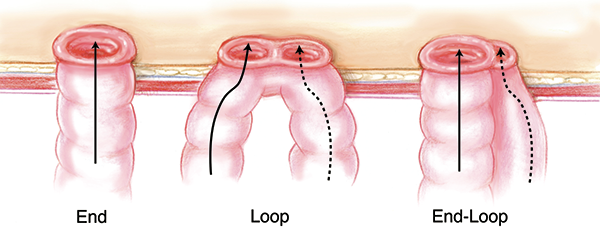
There are several types of ostomies: loop, end, and end loop (Figure 1). In an end stoma, the end of the bowel is brought through the abdominal wall and the stoma has a single lumen or opening. A loop stoma, as described below, has two openings.

An end stoma is usually created when bowel has been removed. The other end of the bowel may be absent or left in the abdomen as a Hartmann’s pouch (closed off rectum). It may also be brought through the abdominal wall and connected to the skin. Intestinal contents don’t come out of this part of the bowel, but mucous does. Because of this it is often called a mucous fistula.

Figure 1

More often temporary stomas are loop stomas. A loop stoma is generally easier to create. A loop stoma has two openings. This type of stoma diverts the intestinal contents away from and protects the portion of the bowel that has been operated on. Loop stomas are usually easier to close as both ends of the bowel are close together. The indications for a temporary stoma include bowel obstructions (tumors, inflammatory disease, diverticulitis, or Crohn’s disease), leaks or fistulas, or to protect an anastomosis (i.e. new constructions, such as j-pouches or repairs like low anterior resections).

A variation of a loop stoma is an end loop stoma. In this type of stoma the end of the loop is sutured closed. This completely diverts the bowel contents and is used when it is difficult for the bowel to reach the skin.

Even if a stoma is planned to be temporary, some will become permanent. This may happen if a person’s disease progresses or other conditions develop or worsen. Some people decide they are happy with their stoma and/or they don’t want another operation. For these reasons, and to minimize any problems while the stoma is in place, it is very important to have the stoma created correctly. That is the stoma should be in a good location and should protrude adequately.

Stoma Location

It is best to pick the location of the stoma prior to surgery. A portion of the abdomen is selected that is relatively flat and not near bony prominences, scars, and folds of fat and skin. It is important that the patient can see the location. It is important to evaluate the proposed location with the patient standing and sitting because skin folds may be present in some positions, but not others. The assistance of an ostomy nurse in selecting stoma locations is often helpful.

The opening through the abdominal wall must be adequate size to allow the bowel and its accompanying blood vessels to pass through without constriction. A certain amount of bowel protrusion is desired. The amount will depend on the type of stoma and whether there is not too much stretch on the bowel and its mesentery (the tissue that supports the bowel and related blood vessels and nerves). A 2-3 cm (1 inch) protrusion is preferred for ileostomies and 0.5 – 1 cm (? inch) for colostomies. The bowel is then folded back on itself and attached to the skin with several absorbable sutures. This is referred to as stomal maturation. The edge of bowel mucosa is sutured to the dermal or inner layer of the skin. To maintain the desired protrusion, the bowel wall is sutured to the subcutaneous fat or the maturation suture also includes part of the bowel wall. Close approximation of the mucosa to the skin hastens healing. If there is a lot of tension on the bowel, which can pull the bowel back into the abdomen, surgeons will often use a plastic rod to help support the loop stoma for a few days following surgery.

Special Circumstances

A number of patient characteristics can make stoma creation challenging. One of the more common of these is obesity where excess fat is deposited in the abdominal wall and bowel mesentery. A fatty mesentery is often shorter, making it harder to reach through the abdominal wall. It also requires a larger hole in the abdominal wall in order for the bowel to pass through. A thick subcutaneous fat layer also makes it difficult for the bowel to reach the skin.

Losing weight prior to a planned surgery can help, but this is often difficult or impossible. Another option is abdominal wall modification or contouring. Diseased bowel (radiated or involved with Crohn’s disease) is also difficult to manipulate. It is preferred to use healthier bowel that is soft and pliable.

Stoma Closure or Ostomy Reversal

When the temporary stoma is no longer needed, it can be reversed. The time from creation of a temporary ostomy to closure can vary from six weeks to six months. This period allows the patient to recover from their previous surgery, time for the stoma to mature, and scar tissue to soften making the subsequent operation easier. The time chosen will vary among surgeons and on the patient, their disease process, and treatment.

If the initial surgery was hard or there was significant infection or inflammation, a longer recovery time is preferred. If the patient needs chemotherapy, some surgeons prefer to wait until the patient’s chemotherapy is completed before the stoma is closed. Others, including this author, prefer to close the stoma before chemotherapy is given.

Reversal of a loop stoma is usually referred to as a stomal closure, while reversal of an end stoma is often referred to as a stomal takedown. A stomal closure is usually a much smaller operation than a stomal takedown. With a loop stoma, both ends of the bowel are attached to the skin, so the surgeon only needs to detach the bowel (stoma) from the skin using a scalpel or electrocautery and then divide any adhesions of the bowel surface to the subcutaneous fat and abdominal wall muscles. This is usually done with scissors or electrocautery. Once the bowel limbs are freed, the ends of the bowel can be reconnected or anastomosed. This anastomosis is done with staples or sutures. The different types of anastomosis are described in Figure 2.

Most surgeons use a side-to-side function, end-to-end type when they close a loop stoma. The reconnected bowel is then dropped back into the abdomen and the muscles of the ostomy site are closed with sutures. The skin and subcutaneous tissue can then be left open, partially closed, or closed with sutures or staples. The author prefers to partially close the skin. This reduces the time required to heal and lessens the chance of infection. The operation usually takes less than an hour.

Figure 2

A stomal takedown is a bigger operation. As the distal end of the bowel is inside the abdomen, an incision is required to expose it. Usually, the previous midline incision is opened. Knowing which piece of bowel will be used will help guide whether all or part of the previous incision will be needed. If the distal bowel is a Hartmann’s pouch (closed rectum) the lower part of the incision is used. If the distal bowel is the transverse colon, the upper portion of the wound is used.

Once the muscles of the abdomen are opened, adhesions are divided and the distal bowel is located and mobilized. The end stoma is then detached from the abdominal wall as described above for loop stomas. The two ends of the bowel are then brought together and an anastomosis is performed. The major incision and the old stoma site are closed with sutures.

There are risks associated with any surgery including a stomal closure. These include bleeding, infection, and leakage from the bowel. Fortunately, these are uncommon.

Post Operative Function

After surgery, the patient’s bowel will be slow to function, which is a condition called ileus. Following a stoma takedown postoperative ileus is about the same as after a bowel resection. Ileus is usually shorter after a stoma closure than after a stoma takedown.

Most patients will be started on liquids the evening of or the day after surgery. With modern perioperative care the hospital stay is one to three days.

Long term bowel function after stoma reversal depends upon how much bowel remains usable. If most of the bowel remains, bowel function will be near normal. The more bowel that has been removed, the more frequent and loose the bowel movements will be. Fortunately, the remaining bowel can take over some of the function of the lost bowel.

Top: Figure 1; Types of fecal stomas.
Bottom: Figure 2; Types of bowel anastomosis.

Additional Reading

  1. Beck DE, Harford FJ. Intestinal stomas. In Beck DE (ed). Handbook of
  2. Colorectal Surgery, 2 ed. New York: Marcel Dekker, 2003, pp 127-148.
    Beck DE. Stomal Prolapse. Ostomy Quarterly. 2004:41:54-55
winding road

Twists and Turns of J-Pouch Recovery

, , , ,
By Robin Glover The recovery process for a j-pouch is just that. It’s a process. It takes time and patience and is different for everyone. For some, it can be relatively easy. For others, it can be a winding path with twists and turns just…

Living With An Ostomy: An 18-Year-Old’s Perspective

, , ,
By Steven Berit I fainted the first time I lost a tooth. Not from the actual pain of the removal, but from the sight of the blood dripping from my mouth. I also fainted during a health talk in the sixth grade. Most people would call me “squeamish,”…

Facts About Ostomy Reversals

, , ,
Colorectal Cancer: Be informed if you are a candidate for an ostomy reversal    By Joanna Burgess-Stocks, BSN, RN, CWOCN   Not everyone who has an ostomy as a result of colorectal cancer and other diseases will have the…