United Ostomy Associations of America
  • HOME
  • OSTOMY INFORMATION
    • Ostomy Information
      • What Is An Ostomy?
      • Living with an Ostomy: FAQs
      • Diet + Nutrition
      • Ostomy Skin Care
      • Sexuality
      • Bill Of Rights
      • New Ostomy Patient Guide
    • My Ostomy
      • Ileostomy
      • Colostomy
      • Urostomy
      • J-Pouch
      • Continent Diversions + Other Ostomy Types
      • Temporary Ostomy
      • Short Bowel Syndrome
      • Español
    • Children to Young Adults with Ostomies
      • Infant/Toddler (0-3 Years)
      • Preschool (3-5 Years)
      • Elementary School (6-9 Years)
      • Pre-Adolescent (10-13 Years)
      • Adolescent (14-18 Years)
      • Young Adult (18-25 Years)
      • Parents & Clinicians Resources
      • Know Your Rights
      • What To Expect After Surgery
      • Odor Control
      • Fast Facts
      • Ostomy Game
    • Crohn’s Disease & Ulcerative Colitis Information
      • Defining, Caring and Treating
      • Preparing for Ostomy Surgery
      • Common Issues, Managing Diet, Mental Health
      • Intimacy, Fertility and Pregnancy
      • Resources
    • General Information
      • UOAA Ostomy Marketplace
      • Product + Supply Information
      • UOAA Resources Library
      • Resources for Nurses/Home Health
      • Travel Tips + TSA
      • Donate Your Ostomy Supplies
      • Emergency Supplies
      • Related Links
      • UOAA Virtual Ostomy Clinic
      • Outpatient Ostomy Services Locator
  • SUPPORT
      • discussion
        Ostomy 101:
        Easily communicate “What is an ostomy?" with our infographic.

        Read More

    • Find Support
      • Support Group Finder
      • Support Group Websites
      • UOAA Virtual Ostomy Clinic
      • Online Peer and Ostomy Support Programs
      • Outpatient Ostomy Services Locator
      • Find a Mental Health Provider
      • Find an Ostomy Nurse
      • Online Discussion Board
      • Apps for Ostomates
      • Emotional Concerns
    • Connect With Us
      • Start/Affiliate Your Group With UOAA
      • Resources For ASGs
      • National Membership
      • Sign Up for Our E-Newsletter
    • Participate
      • Attend An Event
      • Become An Advocate
      • Join Us for a Conference
      • Make A Donation
      • Become a Member of The Phoenix Society
      • Donate Your Ostomy Supplies
      • Take A Survey
  • ADVOCACY
      • portal
        Roadmap to Establishing Outpatient Ostomy Services
        Documents that are available as PDFs to download and print.

        Read More

    • About
      • Advocacy Program
      • Advocacy Priorities
      • 10 Questions to Help You Speak Up and Self-Advocate
    • Get Involved
      • Understanding the Medicare Competitive Bidding Program 2025 Ruling
      • Take Action
      • Join Advocacy Network
      • How to Be An Ostomy Champion
      • Ostomy Awareness Day
      • Roadmap to Establishing Outpatient Ostomy Services
    • Tools and Resources Library
      • Non-Medical Switching Resources
      • Ostomy and Continent Diversion Patient Bill of Rights
      • Restroom Access Self-Advocacy Tools
      • Travel Tips + TSA Communication Card
      • Swimming with an Ostomy
      • Mythbusters Infographic
      • Workplace Resources
      • Aging with an Ostomy or CD
    • Take Control of your Healthcare
      • UOAA Virtual Ostomy Clinic
      • Know Your Ostomy Checklist
      • Know Your Ostomy Supplies Checklist
      • Physician Visit Checklist
      • Know Your Health Care Insurance
      • Know Your Pouching System
      • Know What’s in Your Medical Record
  • WHO WE ARE
      • Have a Question for Us?
        UOAA is a 501(c)(3) nonprofit organization that supports, empowers, and advocates for people who have had or who will have ostomy or continent diversion surgery.

        Contact Us

    • About Us
      • Our Mission + History
      • Our Leaders
      • National Sponsors + Partners
      • National Membership
      • Contact Us
    • How We Help
      • Advocacy
      • Awareness
      • Support
      • National Conference
      • Ostomy Nurse Scholarship
    • Get Involved
      • Volunteer
      • Become A Leader
      • Join A Committee
      • Career Opportunities
      • Sign Up for Our E-Newsletter
  • LATEST
  • EVENTS
    • Ostomy Awareness Day
    • Run For Resilience 5K
    • Ostomy Academy
    • Educational Webinars
    • 2025 National Conference
    • Calendar
  • GIVE NOW
  • SEARCH
  • Menu Menu

Twists and Turns of J-Pouch Recovery

Continent Diversions, IBD, Ileostomy, J-Pouch, ostomy reversals
winding road

By Robin Glover

The recovery process for a j-pouch is just that. It’s a process. It takes time and patience and is different for everyone. For some, it can be relatively easy. For others, it can be a winding path with twists and turns just like the colon that was removed for it.

But one thing is the same for practically everyone: j-pouch surgery offers hope for a return to a life that’s less encumbered by the alternatives. Seriously, who doesn’t want to poop out of their butt again if given the opportunity? Oh, and getting rid of that disease-ravaged large intestine is a plus, too.

What Is A J-Pouch?

In case you’re reading this to research information for yourself, friend or family member, here’s a quick explanation of what a j-pouch is:

Medically known as Ileal Pouch Anal Anastomosis (IPAA) surgery, it involves removing the entire colon and rectum and then connecting the small intestine directly to the anus. The term j-pouch refers to the shape of the “pouch” that’s created when the surgeon folds the small intestine on itself and creates a reservoir to hold waste until it is passed through the anus. It can also be known as an s-pouch or w-pouch based on how it’s surgically constructed. J-Pouch surgery is most often done in cases of ulcerative colitis where there is no disease in the small intestine or as a result of FAP, colorectal cancer or a bowel perforation.

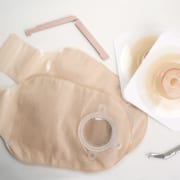
The surgery for a j-pouch almost always involves two or three steps. The first step, and usually the more major surgery, is to remove the large intestine. At the same time, an ileostomy is created that will be used until the small intestine is reattached. This will be a temporary external pouch.
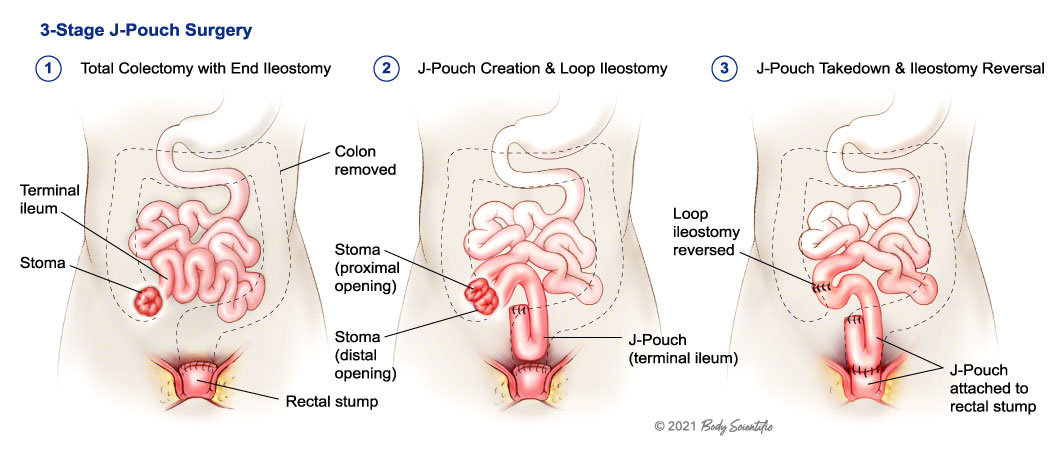
Stages of J-Pouch Surgery

Depending on individual circumstances, the first surgery can also involve removing the rectum and creating the internal j-pouch. However, it can also be its own separate procedure. But either way, the final step is to reverse the ileostomy and connect the small intestine to the anus. At this point, no external pouch is needed and the traditional route of passing stool can resume.

Be aware that the patient has the right to decide between a J-pouch or keeping the ostomy and should know not all temporary ostomies are able to be taken down and not all J-pouches are able to be connected.

Early Recovery From J-Pouch Surgery

It’s an exciting experience when you wake up from the final surgery and see that there’s no longer a need to have a pouch attached to you. What was once your stoma is now a still pretty nasty wound, but one that will heal and become just another proud scar.

Things won’t be working quite yet though. It will be a few days before you actually have a bowel movement. Sometimes it can take longer, but that’s not a big deal. When you’re in the hospital you’ll be monitored and well taken care of. You likely won’t go home until your doctors are sure everything is working correctly, including being able to eat and pass solid food.

Everything that comes out will still be liquid, though. It will be a little bit before you start passing anything even semi-solid. And you might not ever get to that point or only have it happen on rare occasions. There’s nothing unusual about that.

J-Pouch Guide

Diet Right After Going Home

The diet you follow after getting home from the hospital will be communicated to you by your doctor and you’ll probably go home with many guides and resources. Mainly, staying hydrated is very important and avoid raw fruits or vegetables, nuts, whole grain, seeds, or anything else that doesn’t digest in around two hours. Since you no longer have a large intestine, food has much less time to be processed and if you eat a handful of nuts they’re going to come out the same way they went down.

Check the Eating with an Ostomy Guide for a much more complete diet guideline.

But, even worse, it can cause a blockage. Blockages are the bane of a j-pouch’s existence. You need to be careful about what you eat (typically called a “low residue” diet) and chew your food thoroughly. Chew extra. And then some more. Take small bites and don’t take any risks right away. Introduce new foods slowly.

NOTE: Your doctor or dietician will know the best foods to eat and what to avoid for your specific needs. Always follow their directions before anything you read on the internet.

Getting To Know Your J-Pouch

It can take a while after surgery to completely adjust to your new plumbing. You’ll learn what foods are “safe foods” and which to avoid. You’ll also learn about how your j-pouch behaves and how it affects your daily life.

For example, you’ll start to get an idea of how many times per day you’ll go to the bathroom and what consistency you can expect. You’ll also learn what each sense of urgency means and when you need to go to the bathroom right away and when you can hold it. It will feel like you need to go to the bathroom a lot and you’ll probably actually need to at the beginning. But, over time, your j-pouch will stretch and grow to be able to hold more before needing to be emptied.

Ideally, after everything settles down, you will only go to the bathroom 4 to 8 times a day and it will be a simple and quick emptying process.

You’ll Experience Butt Burn

Speaking of going to the bathroom a lot, you may experience what is known as “butt burn.” This is because, on top of going to the bathroom more often, without a large intestine your stool will be much more acidic from digestive enzymes.
It’s necessary to take special care and make sure everything is extra clean. A bidet is a great idea because rubbing with toilet paper can also cause irritation. There are also many creams and lotions you can use to soothe and protect. Zinc-based lotions are a good place to start. And get some disposable gloves while you’re at it.

You may go to the bathroom up to 20 times a day (or more) and experience irritation from going so much. But, it will get better as you learn more about your j-pouch and develop processes that work best for you. In the end (no pun intended), you’ll get to a point where you’re comfortable and know how to manage it like an expert.

Ideally, after everything settles down, you will only go to the bathroom 4 to 8 times a day and it will be a simple and quick emptying process.

It’s Not Always Easy

As mentioned, j-pouch recovery is a process. At the beginning, there will be accidents (typically nighttime) and discomfort. It’s a whole new way of digesting food and your body needs time to adjust. And you will need time to adjust to it too. It’s a major change.

Be aware of possible complications such as pouchitis and tell your doctor if you have more frequent or blood in your bowel movements.If you have a j-pouch or need one, you’ve already been through a lot. You know you’re resilient and can make it through almost anything. This is just another step in your journey.

Don’t let any of this discourage you. There’s a reason you decided to get a j-pouch and there’s a wealth of resources and support out there to help. Everything you will experience has been experienced before and the j-pouch community is always ready to help. But keep in mind that social media is often a place to vent so you might see more negative than positive posts.

So focus on the good, be patient, and look forward to enjoying pooping out of your butt again!


Robin Glover is a writer based in the Houston area. He has a permanent ostomy after being diagnosed with Crohn’s Disease in 2017.


Related

February 28, 2022
Tags: colon cancer, colorectal cancer, diversion, Ileal Pouch Anal Anastomosis, ileostomy, internal ostomy, IPAA, J-Pouch, jpouch, jpoucher, ostomy, pouchitis, reversal, reversals, small intestine, temp ostomy, Temporary ostomy, ulcerative colitis
Share this entry
  • Share on Facebook
  • Share on X
  • Share on WhatsApp
  • Share on Pinterest
  • Share on LinkedIn
  • Share on Tumblr
  • Share on Vk
  • Share on Reddit
  • Share by Mail
https://www.ostomy.org/wp-content/uploads/2022/02/J-Pouch-Recovery-twists-and-turns.jpeg 924 1640 Contributor https://www.ostomy.org/wp-content/uploads/2017/02/UOAAlogofinal2.png Contributor2022-02-28 12:36:302022-03-01 14:33:39Twists and Turns of J-Pouch Recovery
You might also like
When an Ostomy Reversal Plan Takes A U-Turn
UOAA Recognizes Colonel Justin Blum
Relationships, Sex & Intimacy with an Ostomy or IBD
Swimming with an Ostomy
Facts About Ostomy Reversals
working with an ostomy Alan Thompson: A Law Enforcement Career Not Deterred
30 replies
  1. Joseph M Clark
    Joseph M Clark says:
    May 6, 2022 at 3:59 pm

    My experience with a jpouch for nearly 20 years was much as Robin describes above, including pouchitis. If I had it to do over again I would have kept the original ileostomy.

    A jpouch is difficult to live with.

    All those surgeries to have the jpouch installed and eventually removed also leaves scar tissue which can make any further abdominal surgery more complicated.

Comments are closed.

Our Categories

Advocacy (78) Caregivers (19) Colorectal Cancer (19) Colostomy (138) Continent Diversions (8) Digital Sponsor (77) Disaster Preparation (4) Emotional Health (61) Events (32) Exercise/Sports (47) Fashion/Clothing (11) Healthcare (21) IBD (52) Ileostomy (181) J-Pouch (7) jejunostomy (7) Membership (3) Nutrition (19) Ostomy 5k (19) Ostomy 5k (15) Ostomy Awareness (55) Ostomy Basics (55) Ostomy News (94) Ostomy Nurse (13) ostomy reversals (12) Ostomy Supplies (2) Ostomy Tips (93) Ostomy Videos (4) Patient Stories (96) Pediatric Ostomy (4) Personal (63) Research (3) Sexuality (12) Short Bowel Syndrome (16) Skin Care (9) Social Life (5) Support Group News (12) Support Resources (15) Teens (3) Travel (11) UOAA Conference (17) UOAA History (3) UOAA Volunteers (3) Urostomy (111) Young Adult (7)

Support Us:

Your Donation Funds UOAA Educational Programs:

DONATE TODAY
SUSTAINING GIFT
BECOME A MEMBER
UOAA E-NEWS SIGN UP
Get updates on events, national advocacy and important topics in the ostomy and continent diversion community.

Contact Us


United Ostomy Associations of America
P.O. Box 2293
Biddeford, ME 04005-2293

Virtual Ostomy Clinic

Contact UOAA

Donate Your Supplies

Call us toll-free at: 1-800-826-0826.
Our Information Line hours are Monday-Friday, 9am to 3pm EST. If you have an emergency, please dial 911 or contact your local medical professional.

Please understand that UOAA is a private, nonprofit, advocacy and informational organization. We are not a medical facility and we do not have medical or legal professionals on staff. Therefore, UOAA does not provide Medical, Mental Health, Insurance or Legal Advice. Visit UOAA Virtual Ostomy Clinic provided by The Wound Company for non-emergency, virtual ostomy support.

Privacy Policy

Get Involved

UOAA is the leading organization proactively advocating on behalf of the ostomy community. Recognizing that we are always stronger together, we encourage everyone to get involved by joining our Advocacy Network. We’ve also created several Advocacy Tools and Resources to help you successfully advocate on behalf of the ostomy community to ensure every ostomate receives quality care.

UOAA Run for Resilience Logo

UOAA does not and shall not discriminate on the basis of race, color, religion (creed), gender, gender expression, age, national origin (ancestry), disability, marital status, sexual orientation, or military status, in any of its activities or operations.

Digital Health Award
© 2005-2026, UOAA. All Rights Reserved l Design by Tap House Media
  • Link to Facebook
  • Link to X
  • Link to Pinterest
  • Link to LinkedIn
  • Link to Youtube
  • Link to Mail
  • Link to Instagram
Link to: Your Ostomy is Just the Beginning- Part 2 Link to: Your Ostomy is Just the Beginning- Part 2 Your Ostomy is Just the Beginning- Part 2 Link to: Sixty Years with an Ostomy Link to: Sixty Years with an Ostomy Sixty Years with an Ostomy
Scroll to top Scroll to top Scroll to top