Dehydration
This can occur along with diarrhea and intestinal blockages.

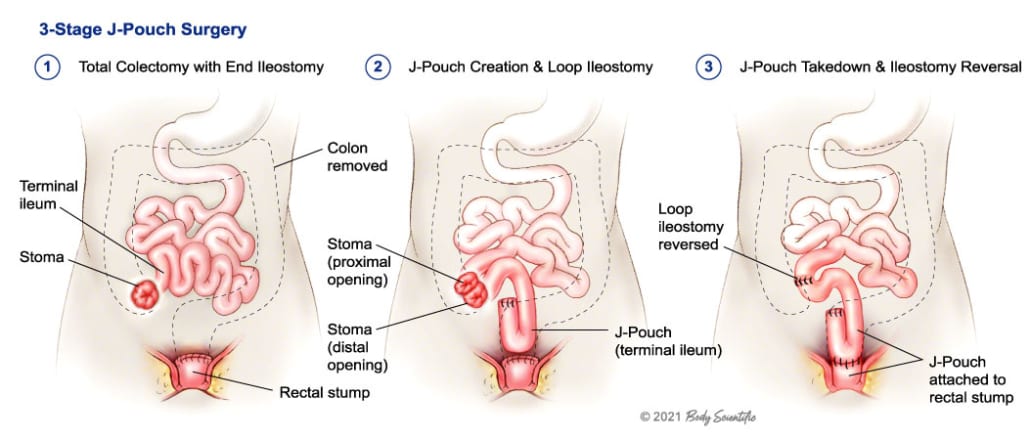
A J-Pouch (also known as Ileal Pouch Anal Anastomosis (IPAA)) is an internal pouch (J, S, or W-shaped) that is fashioned out of the small intestine upon a proctocolectomy, allowing the patient to defecate via the anus and avoid a permanent ostomy.
J-Pouch/IPAA surgery is rarely done in Crohn’s disease patients, as disease can present in the j-pouch itself. However, IPAA may be an option should the patient not want an ostomy. Crohn’s disease patients may also need to be optimized on medication (usually biologics) if J-pouch/IPAA surgery is done. It is always best for patients with Crohn’s disease to discuss the best routes offering the best prognosis with their gastroenterologist and surgeon.
J-Pouch surgery is commonly done in cases of refractory ulcerative colitis where there is no disease in the small intestine.
J-Pouch surgery may be done in cases of colorectal cancer, dysplasia, severe pancolitis, toxic megacolon and/or a bowel perforation which may lead to an ostomy temporarily.
See Figure 7 above to better understand J-pouch anatomy and the stages of surgery.
J-Pouch surgery is usually done in 3 stages with a period of approximately 12 weeks between surgeries, depending on how sick the patient is entering surgery. (Actual number of stages may vary based on the surgeon’s recommendations and the patient’s health)
Remove the colon and most of the rectum, leaving behind only approximately 1cm of a rectal cuff. The patient is given an end ileostomy to allow the bowel to heal and the body to recover.
Create the J-pouch out of the small intestine. The patient is usually given a loop ileostomy and the J-pouch is allowed to heal.
Connect the J-pouch to the rectal cuff, creating an ileoanal anastomosis. This connection allows the patient to defecate normally through the bottom.
However, J-pouch surgery is NOT a cure for ulcerative colitis. Sometimes patients develop complications:
the patient has the right to decide to move forward with the J-pouch or keep the ostomy upon removal of the colon. Also, not all temporary ostomies are able to be taken down and not all J-pouches are able to be connected. It would be best to discuss your particular situation with your surgeon prior to moving forward.

Written by Tina Aswani Omprakash. Medically reviewed and validated by Jordan Axelrad, MD, MPH. These webpages are funded by a grant from The Leona M. and Harry B. Helmsley Charitable Trust.

United Ostomy Associations of America
P.O. Box 2293
Biddeford, ME 04005-2293
Call us toll-free at: 1-800-826-0826.
Our Information Line hours are Monday-Friday, 9am to 3pm EST. If you have an emergency, please dial 911 or contact your local medical professional.
Please understand that UOAA is a private, nonprofit, advocacy and informational organization. We are not a medical facility and we do not have medical or legal professionals on staff. Therefore, UOAA does not provide Medical, Mental Health, Insurance or Legal Advice. Visit UOAA Virtual Ostomy Clinic provided by The Wound Company for non-emergency, virtual ostomy support.