Preparing for Ostomy Surgery
with Inflammatory Bowel Disease

As much as we often like to prepare ourselves for surgery, sometimes ostomy surgery is done emergently in extreme situations. Nevertheless, whether it is before or after surgery, we can still do our best to acquaint ourselves with the ins and outs of our ostomy.

Emergency surgery vs. Planned Ostomy Surgery

Sometimes patients end up having ostomy surgery unexpectedly due to certain complications of inflammatory bowel disease. These may include toxic megacolon, fistula, stricture, and bowel obstruction, among other issues that may lead to emergency surgery and placement of an ostomy.

It can also be planned in advance when dysplasia or cancer develops as a result of long-standing IBD. When surgery is planned, it’s important to be surgically marked by a Wound, Ostomy, Continence Nurse (WOCN) to ensure proper placement of the ostomy.

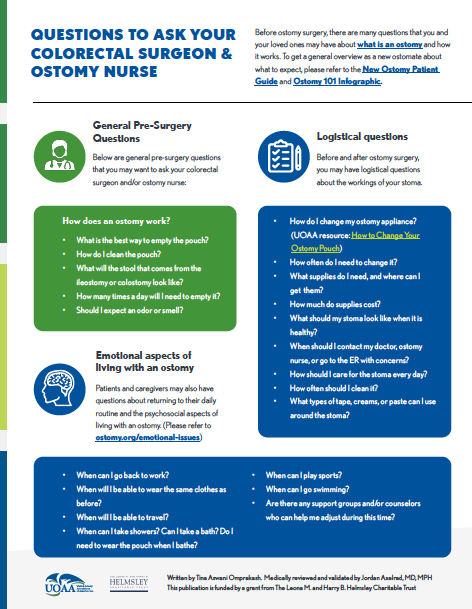
Questions to Ask Your Colorectal Surgeon & Ostomy Nurse

Before ostomy surgery, there are many questions that you and your loved ones may have about what is an ostomy and how it works. To get a general overview as a new ostomate about what to expect, please refer to the New Ostomy Patient Guide and Ostomy 101 Infographic.

General Pre-Surgery Questions

Below are general pre-surgery questions that you may want to ask your colorectal surgeon and/or ostomy nurse:

How does an ostomy work?
  • What is the best way to empty the pouch?
  • How do I clean the pouch?
  • What will the stool that comes from the ileostomy or colostomy look like?
  • How many times a day will I need to empty it?
  • Should I expect an odor or smell?
Logistical questions:

Before and after ostomy surgery, one may have logistical questions about the workings of their stoma.

  • How do I change my ostomy appliance? (UOAA resource: How to Change Your Ostomy Pouch)
  • How often do I need to change it?
  • What supplies do I need, and where can I get them?
  • How much do supplies cost?
  • What should my stoma look like when it is healthy?
  • How should I care for the stoma every day?
  • How often should I clean it?
  • What types of tape, creams, or paste can I use around the stoma?
  • How do I prevent skin breakdown?
Psychosocial aspects of living with an ostomy:

Patients and caregivers may also have questions about returning to their daily routine and the psychosocial aspects of living with an ostomy. (Please refer to New Ostomy Patient Guide)

  • Can I go back to work? If so, when can I return?
  • Will I be able to wear the same clothes as before?
  • Will I be able to travel?
  • Can I take showers? Can I take a bath? Do I need to wear the pouch when I bathe?
  • Can I still play sports? Can I still go swimming?
  • Are there any support groups and/or counselors who can help me adjust during this time?

Specific Post-Surgery Questions

Below are specific questions about life with inflammatory bowel disease post-surgery:

Questions for your surgeon or gastroenterologist:

Every patient’s situation is unique so it is best to discuss with your surgeon and/or gastroenterologist:

  • What are the potential complications of having stoma surgery? 
  • Is there still a risk of IBD continuing after ostomy surgery?
  • Will I face issues with malabsorption and/or dehydration after ostomy surgery?
  • Do I need to change the medicines I am taking to liquid or injectable forms?
  • Will birth control pills still work?
  • How do I prevent dehydration?
Diet and nutrition with an ostomy:

Please consult with a registered dietician who will be able to advise on how to maximize one’s nutrition and gut absorption: (Please refer to the UOAA’s Eating With an Ostomy Guide)

  • What changes do I need to make in my diet?
  • How do I make sure I’m getting the nutrition I need?
  • What can I do if my stools are too loose? Are there foods that will make my stools more firm?
  • What can I do if my stools are too hard? Are there foods that will make my stools looser or more watery? Do I need to drink more liquids?
  • Are there foods that may cause blockage of the stoma or opening? How can I change my diet to prevent this problem?
Sexual intercourse, family planning and pregnancy:

Patients and their partners may also have concerns about sexual intercourse, family planning, and pregnancy with an ostomy. It’s always best to bring these questions forward to help alleviate any concerns. (Please refer to the Intimacy after Ostomy Surgery Guide for additional information)

  • When I can start having intercourse again after ostomy surgery?
  • Does having stoma surgery affect fertility? 
  • Will my partner or I be able to conceive and carry a pregnancy after ostomy surgery?

When To Contact Your Healthcare Provider

Many times patients and caregivers don’t know when it’s appropriate to reach out to their healthcare providers. There are certain situations when it might be very important to contact your specialist(s):

  • Infection/Fever

    When you have a fever over 100.4 degrees Fahrenheit.

  • Bowel Obstruction

    When nothing is coming out of the stoma into the pouch and you’re feeling nauseous.

  • Stoma Prolapse

    When you suspect your stoma is elongating and the color of your stoma may be changing.

  • Hernia

    When you see areas of your abdomen bulging.

  • Skin Issues

    When there are persistent skin issues or rashes around the stoma that do not seem to be healing. And if/ when you see severe necrotic skin lesions forming near your stoma (pyoderma gangrenosum, hidradenitis suppurativa at the stoma site).

  • Bloody Diarrhea

    When there is blood coming from the stoma or there are sore spots on the stoma that are bleeding.

  • Lots of Stool and Blood

    When you have lots of stool and blood passing through the bottom in spite of ostomy (Please note that mucus passing through the bottom after ostomy surgery is normal.)

  • Abscess and/or Fistula

    When you see an unusual boil, growth, tunnel forming or drainage at the stoma site or perianally (outside the anus and/or around the groin region).

Questions to Ask Your Colorectal Surgeon & Ostomy Nurse

Before ostomy surgery, there are many questions you and your loved ones may have about what is an ostomy and how it works. Download our FREE guide to help guide you through this process.

Helmsley Charitable Trust Logo

Written by Tina Aswani Omprakash. Medically reviewed and validated by Jordan Axelrad, MD, MPH. These webpages are funded by a grant from The Leona M. and Harry B. Helmsley Charitable Trust.