United Ostomy Associations of America
  • HOME
  • OSTOMY INFORMATION
    • Ostomy Information
      • What Is An Ostomy?
      • Living with an Ostomy: FAQs
      • Diet + Nutrition
      • Ostomy Skin Care
      • Sexuality
      • Bill Of Rights
      • New Ostomy Patient Guide
    • My Ostomy
      • Ileostomy
      • Colostomy
      • Urostomy
      • J-Pouch
      • Continent Diversions + Other Ostomy Types
      • Temporary Ostomy
      • Short Bowel Syndrome
      • Español
    • Children to Young Adults with Ostomies
      • Infant/Toddler (0-3 Years)
      • Preschool (3-5 Years)
      • Elementary School (6-9 Years)
      • Pre-Adolescent (10-13 Years)
      • Adolescent (14-18 Years)
      • Young Adult (18-25 Years)
      • Parents & Clinicians Resources
      • Know Your Rights
      • What To Expect After Surgery
      • Odor Control
      • Fast Facts
      • Ostomy Game
    • Crohn’s Disease & Ulcerative Colitis Information
      • Defining, Caring and Treating
      • Preparing for Ostomy Surgery
      • Common Issues, Managing Diet, Mental Health
      • Intimacy, Fertility and Pregnancy
      • Resources
    • General Information
      • UOAA Ostomy Marketplace
      • Product + Supply Information
      • UOAA Resources Library
      • Resources for Nurses/Home Health
      • Travel Tips + TSA
      • Donate Your Ostomy Supplies
      • Emergency Supplies
      • Related Links
      • UOAA Virtual Ostomy Clinic
      • Outpatient Ostomy Services Locator
  • SUPPORT
      • discussion
        Ostomy 101:
        Easily communicate “What is an ostomy?" with our infographic.

        Read More

    • Find Support
      • Support Group Finder
      • Support Group Websites
      • UOAA Virtual Ostomy Clinic
      • Online Peer and Ostomy Support Programs
      • Outpatient Ostomy Services Locator
      • Find a Mental Health Provider
      • Find an Ostomy Nurse
      • Online Discussion Board
      • Apps for Ostomates
      • Emotional Concerns
    • Connect With Us
      • Start/Affiliate Your Group With UOAA
      • Resources For ASGs
      • National Membership
      • Sign Up for Our E-Newsletter
    • Participate
      • Attend An Event
      • Become An Advocate
      • Join Us for a Conference
      • Make A Donation
      • Become a Member of The Phoenix Society
      • Donate Your Ostomy Supplies
      • Take A Survey
  • ADVOCACY
      • portal
        Roadmap to Establishing Outpatient Ostomy Services
        Documents that are available as PDFs to download and print.

        Read More

    • About
      • Advocacy Program
      • Advocacy Priorities
      • 10 Questions to Help You Speak Up and Self-Advocate
    • Get Involved
      • Understanding the Medicare Competitive Bidding Program 2025 Ruling
      • Take Action
      • Join Advocacy Network
      • How to Be An Ostomy Champion
      • Ostomy Awareness Day
      • Roadmap to Establishing Outpatient Ostomy Services
    • Tools and Resources Library
      • Non-Medical Switching Resources
      • Ostomy and Continent Diversion Patient Bill of Rights
      • Restroom Access Self-Advocacy Tools
      • Travel Tips + TSA Communication Card
      • Swimming with an Ostomy
      • Mythbusters Infographic
      • Workplace Resources
      • Aging with an Ostomy or CD
    • Take Control of your Healthcare
      • UOAA Virtual Ostomy Clinic
      • Know Your Ostomy Checklist
      • Know Your Ostomy Supplies Checklist
      • Physician Visit Checklist
      • Know Your Health Care Insurance
      • Know Your Pouching System
      • Know What’s in Your Medical Record
  • WHO WE ARE
      • Have a Question for Us?
        UOAA is a 501(c)(3) nonprofit organization that supports, empowers, and advocates for people who have had or who will have ostomy or continent diversion surgery.

        Contact Us

    • About Us
      • Our Mission + History
      • Our Leaders
      • National Sponsors + Partners
      • National Membership
      • Contact Us
    • How We Help
      • Advocacy
      • Awareness
      • Support
      • National Conference
      • Ostomy Nurse Scholarship
    • Get Involved
      • Volunteer
      • Become A Leader
      • Join A Committee
      • Career Opportunities
      • Sign Up for Our E-Newsletter
  • LATEST
  • EVENTS
    • Ostomy Awareness Day
    • Run For Resilience 5K
    • Ostomy Academy
    • Educational Webinars
    • 2025 National Conference
    • Calendar
  • GIVE NOW
  • SEARCH
  • Menu Menu

Kidney Stones and Ileostomies

Ileostomy, jejunostomy, Nutrition, Ostomy Nurse, Ostomy Tips

By Joyce Moss, RN, MS, MNM, COCN, CWCN

Kidney stones develop when crystals anchor to plaque formations or crystalline deposits develop within the inner medullary collecting ducts of the kidneys. Research has shown that kidney stone formation is a known complication of inflammatory bowel diseases and the surgical procedures used to manage these conditions.

Ileostomy surgery significantly increases the risk of kidney stones primarily due to fluid and electrolyte losses. Patients with an ileostomy lose substantial amounts of fluid through their stoma, which can easily lead to dehydration. When dehydration occurs, urine becomes more concentrated, increasing the likelihood that stone-forming substances will crystallize.

Concentrated urine leads to supersaturation, meaning that minerals such as calcium, oxalate, and uric acid are present at levels high enough to form crystals. These crystals can attach to plaques in the kidneys or plug the tubules and gradually grow into kidney stones.

Changes in Urine Chemistry After Ileostomy

The colon normally plays a significant role in reabsorbing water, sodium, and other electrolytes. When the colon is removed or bypassed during ileostomy surgery, this reabsorption is lost. As a result, the kidneys often produce urine that is:

  • Low in volume
  • Acidic (low pH)
  • Low in sodium and calcium

This combination creates an environment that favors kidney stone formation.

Types of Kidney Stones Common in Ileostomy Patients

The two most common kidney stones seen in patients with ileostomies are:

Calcium Oxalate Stones

  • These are the most common type of kidney stones overall.
  • Dehydration and concentrated urine increase calcium oxalate supersaturation.
  • Excess dietary sodium increases calcium excretion in urine, further raising risk.

Uric Acid Stones

  • Uric acid levels in urine are naturally higher than oxalate levels.
  • When urine pH is low (acidic), uric acid crystallizes rapidly.
  • Unlike calcium oxalate stones, uric acid stones do not attach to plaques or plugs; they form freely within the urinary tract.

Management Strategies

Hydration Goals

Adequate hydration is the single most important strategy to reduce kidney stone risk.

  • A minimum urine output of 1,200 mL per day is needed to protect kidney function.
  • For individuals with a history of kidney stones, urine output should be increased to at least 1,500 mL per day.
  • If tolerated and not contraindicated by a physician, an ideal goal is fluid intake of 2-3 liters/day based on age, climate, activity level, and health conditions.

Monitoring urine output, not just ostomy output, is essential. Urine output and color are more reliable indicators of kidney hydration and stone risk.

Dietary Considerations

  • Limit oxalate-rich foods, including: Spinach and other leafy greens, Rhubarb, Almonds, Beets, Navy beans, Okra, French fries and baked potatoes, Soy products, Strawberries, Tea, Chocolate
  • Ensure adequate calcium intake, as calcium binds oxalate in the gut and helps to reduce oxalate absorption in the urine.
  • Limit excess sodium intake, as high sodium intake increases calcium excretion in urine.
  • Reduce animal protein and increase plant-based protein sources, which can help lower acid load and reduce uric acid stone risk.

Monitoring and Follow-Up

  • Regular medical follow-ups and urine testing are important to assess kidney function and stone risk.
  • Both ostomy output and urine output should be monitored routinely to ensure adequate hydration.

Prevention Strategies

Daily Prevention

  • Stay well hydrated throughout the day.
  • Use oral rehydration solutions when needed.
  • Follow a lower-fiber diet if recommended to help manage high ileostomy output.

Medication Considerations

Consult your physician if you experience vomiting, infection, or high stoma output—especially if you routinely take medications such as:

  • Blood pressure medications
  • NSAIDs
  • Diabetes medications
  • Kidney or heart medications
  • Diuretics

Ask if and when these medications should be temporarily paused and when they should be safely resumed.

When to Seek Urgent Medical Care

Seek immediate emergency care if you experience:

  • Drowsiness or confusion
  • Muscle cramps
  • Rapid heart rate
  • Ankle swelling
  • Severe abdominal pain or low back pain
  • Foul urine odor
  • Blood in urine
  • Frequent or painful urination
  • Nausea, vomiting

Key Takeaways

  • Ileostomy patients are at increased risk for kidney stones due to dehydration and acidic, low-volume urine.
  • Calcium oxalate and uric acid stones are the most common types.
  • Maintaining adequate urine output is essential for prevention.
  • Diet, hydration, and medication awareness play a critical role in kidney protection.
  • Early recognition of warning signs can prevent serious complications.


For more on the importance of hydration and diet for your ostomy type visit UOAA’s Diet and Nutrition Page and Eating with an Ostomy Guide. 


References

·Ileostomy and Kidney Stones, Kidney Stone Program, University of Chicago, High Output Ileostomies: Preventing Acute Kidney Injury, Practical Gastroenterology, Maintaining Kidney Health with an Ileostomy or Internal Pouch, IA Support

Joyce Moss, ADN, BSN, MNM, MSc Wound Healing & Tissue Repair, RN, CWS, CWCN, COCN

January 13, 2026


May 5, 2026
https://www.ostomy.org/wp-content/uploads/2026/05/47049-scaled.jpg 2111 2560 Contributor https://www.ostomy.org/wp-content/uploads/2017/02/UOAAlogofinal2.png Contributor2026-05-05 09:43:252026-05-05 09:43:25Kidney Stones and Ileostomies

Going Out with IBD and an Ostomy: Finding Confidence Through Solo Activities

Digital Sponsor, Emotional Health, IBD, Ileostomy, Nutrition, Ostomy Basics, Ostomy Tips, Social Life

Before my Inflammatory Bowel Disease (IBD) diagnosis at age 17, I always wanted to go to live events: concerts, listening parties, book signings, etc. But as a teen, I knew I held myself back. I didn’t want to look silly by showing up alone, and I’m extremely socially awkward. What if I say the wrong things? Even putting myself back in the thought process makes my skin crawl.

Post-diagnosis and at the beginning of my ostomy surgery process, some of my medical trauma began to manifest as not wanting to be alone. Combined with the social discomfort that fluctuates with an ostomy, like apprehension around leaks, clogged filters, and farts, I created the perfect recipe for opting out of things if I didn’t have a companion.

The summer of 2022 changed things.

I remember being extremely low mentally, in pain, and constantly in and out of the hospital due to a fistula that my doctors hadn’t been able to detect on scans. In that period of isolation, rumination, and reflection, I made a promise to myself that if I ever felt better, I’d take advantage of it and figure out ways to do the things I’ve always wanted to do.

When I was finally healed and ready, I was excited to enjoy some live events, but that didn’t stop the fear and anxiety.

What if I had an emergency? What if I didn’t bring enough ostomy supplies? What if I couldn’t contact my family if I needed them?

I wanted to be safe and really listen to my body. I knew the only way I’d enjoy the experience was if I felt safe and prepared.

Here are some things I find myself consistently doing before, during, and after events that increase my comfort.

My Top Tips for Going Out with IBD or an Ostomy

1. Plan Ahead & Ask Questions

Before making any plans, I have conversations with my medical team and family. Often, they give me insight, reassure me I am physically ok to do certain things, and help me find out more information.

  • ADA Accommodations: I reach out to venues & organizers for ADA (Americans with Disabilities Act) accommodations to have plans & contacts in place if I’m not feeling the best.
    • ADA accommodations can look like:
      • Medical/bigger bag allowance
      • Safe snacks & water from home
      • Priority access to seated spaces
      • Chairs while waiting in line
      • & more! I’m still discovering them myself!
  • Safe Foods: I look into food venues and menus to make sure there are safe options for my IBD and ostomy-friendly eats.
    • To avoid gas/cramping/bloating, I generally don’t eat lots of candy, fried/breaded foods, and carbonated beverages.
    • Raw fruits, veggies, popcorn & nuts, if it’s during the morning & I’m not returning home/to my hotel for an extended period.
    • I don’t consume alcohol at all.
  • Bathroom Access: You can map out restrooms when you get to the venue, but if you can find a venue map online, bathrooms should be listed! Having an official bathroom access card from an IBD or ostomy organization like UOAA is helpful, too!

It’s also always nice to have names to reference staff members you’ve been in communication with, especially to build relationships if this is a place you’ll be frequenting. Repeating this process helped build the foundation of my concert review series on social media!

2. Bring What You Need 

I’ve made several videos documenting what I keep in my concert bag, but I’m never leaving without:

  • Supplies to do at least one ostomy bag change, including a fresh pouch, a barrier, adhesive remover spray, and deodorant
  • Hydration drops
  • Pill container
  • Portable charger
  • Wireless earbuds

The earbuds may seem a little odd because they’re not medically related, but in a crowded, noisy area, or if your hands are full, it’s always nice to just pop an earbud in to make a call. Depending on the temperature and venue rules, I also alternate between a handheld fan and hand warmers.

3. Listen To Your Body

For me, having an ostomy didn’t completely resolve my symptoms or “cure” my IBD. While I completely support research that recommends surgeries that may leave patients with a temporary ostomy and increase remission outcomes, I don’t support surgery being described as “the cure.”

Extraintestinal manifestations or “non-gut related symptoms” can still occur, most of which I’m still managing with a combination of medications and mental and physical therapies.

Fatigue, joint aches, dehydration, etc., are all common with IBD, and I’ve learned that a lot of the “prep” happens long before you decide to go somewhere.

  • Dehydration: Hydrate, hydrate, hydrate. I know it’s annoying to hear it, but I always feel better if I’m properly hydrated.
  • Joint Aches: If there’s prolonged standing, walking, or sitting, I’m usually opting for some type of compression support on my hands, legs, and arches of my feet to combat any swelling or irritation.
  • Fatigue: Getting enough rest before and after solo activities helps with recovery! Generally, I’m taking things slow 1-2 days before and after each event to support my body as much as possible.

These tips are general, but they aren’t one-size-fits-all. Tweak things to your personal needs and don’t feel bad if you make a few mistakes along the way; you’re human! You should always consult your doctors if you have any questions about anything that could affect your treatment or health.

Embracing solo activities isn’t about being alone constantly. Years into this process, I’ve met some of the coolest people during my solo adventures, and I’m so thankful that I’m working towards being comfortable with just myself.

Having self-confidence that helps strengthen this type of exploration still doesn’t always come naturally to me as someone with IBD and a permanent ostomy, but I feel a lot better knowing I’m prepared!

Kaylaa’ is a Coloplast product user who received compensation from Coloplast to provide this information. Each person’s situation is unique, so your experience may not be the same. Talk to your healthcare professional about which product might be right for you.

Coloplast develops products and services that make life easier for people with intimate healthcare needs. Working closely with the people who use our products, we create solutions that are sensitive to their special needs. Our business includes ostomy care, continence care, advanced wound care, interventional urology, and voice & respiratory care.

Follow Coloplast on Instagram, Facebook, and YouTube, or visit us online at https://www.coloplast.us/


Editor’s note: This blog is from a UOAA digital sponsor, Coloplast. Sponsor support along with donations from readers like you help to maintain our website and the free trusted resources of UOAA, a 501(c)(3) nonprofit organization.


April 7, 2026
https://www.ostomy.org/wp-content/uploads/2026/04/UOAA-blog-photo-Kaylaa.png 550 1000 Contributor https://www.ostomy.org/wp-content/uploads/2017/02/UOAAlogofinal2.png Contributor2026-04-07 15:23:282026-04-08 16:02:55Going Out with IBD and an Ostomy: Finding Confidence Through Solo Activities

Bruce’s Ostomy Journey with Moldable Technology

Colostomy, Digital Sponsor, Ileostomy, Ostomy Products, Ostomy Supplies, Ostomy Tips, Ostomy Videos, Personal, Uncategorized

Bruce Levinson shares his personal ostomy journey — from diagnosis and early challenges with leaks to discovering solutions that helped restore his confidence and lifestyle. In this first episode of Convatec’s Ostomy Real Stories series, Bruce talks about:

✔ Adjusting to life after his ostomy surgery

✔ The challenges he faced with leaks and pouching reliability

✔ Discovering Convatec Moldable Technology through the me+™ support program

✔ How the unique turtle-neck seal helped improve fit and extend wear time to 7–8 days

✔ Staying active and confident during water activities

✔ Using ostomy accessories and Ostomy Secrets® products for comfort and confidence

✔ Why personalized support programs like me+™ can help ostomates troubleshoot challenges

At Convatec, we believe every ostomy journey is unique. Through real patient stories, we aim to share practical experiences, education, and support that help people live life on their own terms. If you found Bruce’s story helpful, subscribe to our channel to hear more real ostomy experiences, expert insights from healthcare professionals, and practical education.


Editor’s note: This blog is from one of our digital sponsors, Convatec. Sponsor support along with donations from readers like you help to maintain our website and the free trusted resources of UOAA, a 501(c)(3) nonprofit organization.

March 31, 2026
https://www.ostomy.org/wp-content/uploads/2026/03/Blog-Bruces-Ostomy-Journey-with-Moldable-Technology.png 550 1000 Contributor https://www.ostomy.org/wp-content/uploads/2017/02/UOAAlogofinal2.png Contributor2026-03-31 16:00:182026-03-31 16:00:18Bruce’s Ostomy Journey with Moldable Technology

Smashing Cancer and Stoma Stigma

Colorectal Cancer, Colostomy, Emotional Health, Exercise/Sports, Ileostomy, Ostomy Awareness, Ostomy Tips, Ostomy Videos, Patient Stories, Personal

By Kevin Smets

I never imagined that one of the most defining chapters of my life would begin just one month before my daughter was born.

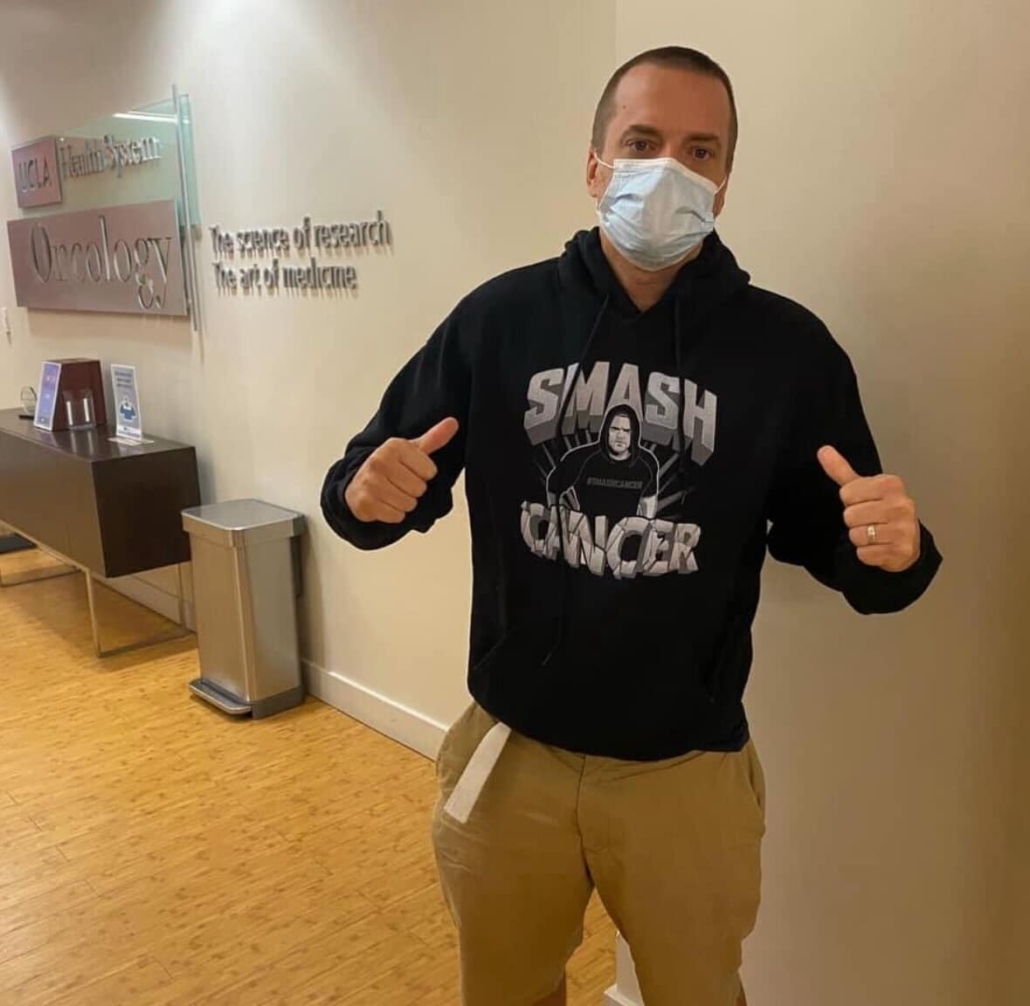
In 2020, I was diagnosed with stage 3 colorectal cancer. A few weeks later, as my family was preparing to welcome my daughter into the world, I was preparing for something entirely different. I started chemotherapy and radiation the very same week she was born. While most new dads are figuring out diapers and sleep schedules, I was learning how to fight for my life at the same time I was learning how to be a father.

Through it all, my wife Dasha was the backbone of our family. She took care of both of us, stepping into a role that no one ever expects to have to play. Watching her carry that weight with strength and love is something I’ll never forget.

Before everything changed, I was part of something truly special called The Schmoedown – it was like WWE meets movie trivia, where larger-than-life characters and real competition collided. I stepped into that world as “The Smasher,” and what started as a persona quickly became something the fans rallied behind in a very real way. They even started a #SmashCancer movement that really carried me through it all, along the way the fans even held a 24-hour stream fundraiser that literally lifted my family up financially while I couldn’t work for nearly a year.

That preparation didn’t just help me physically, it gave me control in a situation where most things felt out of my hands.

And then after nine months of fighting, under the care of such wonderful oncologists and surgeons at UCLA medical center, I underwent stoma surgery. But here’s something that made a huge difference for me mentally. About five months before the surgery, I already knew there was a strong chance I would end up with a stoma. So instead of avoiding it, I leaned in. I researched everything I could. In my research and quest to be more educated I leaned on sites like Ostomy.org and colonclub to really acquaint myself for the journey ahead, and it was a crucial part of my surgery prep.

By the time ostomy surgery came around, I was so prepared that nurses actually commented that I knew as much as they did. That preparation didn’t just help me physically, it gave me control in a situation where most things felt out of my hands.

Today, I’m proud to say I’m in remission.

But the journey didn’t stop there.

I decided to start sharing my story online, documenting my stoma and ostomy journey. The reason was simple, and honestly, a bit personal. A friend once told me their cousin said they would rather die than have an ostomy. That stuck with me. I couldn’t shake it. And I knew right then that there was a stigma that needed to be broken.

So I made it my mission to smash that stigma.

Since then, I’ve received messages from people still in their hospital beds, sometimes just waking up from emergency surgery, telling me they found my content and it helped them feel less alone. Those messages mean everything to me.

If sharing my experience can help even one person feel stronger, more prepared, or more hopeful, then it’s all worth it.

This journey isn’t just about survival. It’s about mindset. It’s about showing that life doesn’t end with an ostomy, it just changes. And sometimes, that change can lead to a purpose you never saw coming.

———

In addition to Kevin’s Youtube channel you can find him on TikTok and as @Kevsmashcancer on Instagram.

March 21, 2026
https://www.ostomy.org/wp-content/uploads/2026/03/smash-cancer-logo.jpg 958 959 Contributor https://www.ostomy.org/wp-content/uploads/2017/02/UOAAlogofinal2.png Contributor2026-03-21 22:05:182026-03-21 22:05:18Smashing Cancer and Stoma Stigma

Finding Community, Purpose, and Voice After Colorectal Cancer and Permanent Colostomy

Colorectal Cancer, Colostomy, Ostomy Tips, Ostomy Videos, Patient Stories, Personal, UOAA Conference

By: Sandra James, ACSW

Instagram.com/@colostomyforever

www.youtube.com/@SandraJames-LivingIt

When I was diagnosed, the first emotions that hit me were disappointment, confusion, and shame. I had spent months believing hemorrhoids were the only source of my problem. There were no other symptoms at first that would alert me outside of hemorrhoids, and when I saw the blood, I attributed it to hemorrhoids and something common and manageable. Cancer never crossed my mind. I never imagined that something as serious as colorectal cancer was there quietly invading my body without my knowing. When the diagnosis came, it felt disorienting. I kept replaying the past in my head, wondering how I missed it, how something so big could have been there while I carried on with my life.

When people asked what kind of cancer I had, I struggled to say the words out loud. Saying it was in my rectum felt heavy, embarrassing, and deeply shameful. I found myself wanting to deflect, minimize, or avoid the conversation altogether. That shame added another layer to the confusion and disappointment I was already carrying—an emotional weight I never expected to come with a diagnosis.

I had no one I could sit across from, look in the eyes, and say, “Do you understand this?”

After my diagnosis, my medical team gave me pamphlets and printed materials explaining my condition and treatment such as colostomy surgery. The information was thorough and medically sound, but it wasn’t what I needed at that moment. I wasn’t looking for a curriculum or clinical language—I needed to understand what was happening to me right then, in real life. What helped me most was hearing from real people.

Sandra at UOAA’s 2025 National Conference in Orlando.

I spent long stretches of time watching videos on YouTube where people openly shared their cancer journeys, their fears, their side effects, their recoveries, and their lives beyond diagnosis. Some had their own YouTube channels. Others were featured on platforms like The Patient Story. Watching them helped me process what I was facing in a way pamphlets couldn’t.

While YouTube helped me feel less alone in the early days of my diagnosis and treatment, it didn’t fully replace the need for real, human connection. I didn’t know anyone in my immediate community who had an ostomy. I had no one I could sit across from, look in the eyes, and say, “Do you understand this?”

At some point, I came across another ostomate on social media who mentioned the United Ostomy Associations of America (UOAA) National Conference. I remember feeling something shift in me when I heard about it. It felt like an invitation — not just to an event, but to belonging. I registered, booked a flight, and went — not fully knowing what to expect, but knowing I needed to be there. Those three days became one of the most meaningful experiences of my entire cancer journey. From the moment I arrived, I felt an overwhelming sense of familiarity and ease. I was surrounded by people who felt like they had known me my whole life, even though we had just met. There was no shame, no need to explain myself, no awkwardness. Just understanding. UOAA’s conference wasn’t simply educational — it was grounding. It wasn’t just supportive — it was life-sustaining. For the first time since my diagnosis, I felt whole again. Not fixed. Not “back to normal.” But grounded in who I was becoming.

From Watching to Sharing: Why I Started My Own Channel

The realization to start my own channel came while I was writing my book, My Colorectal Cancer Journey. By the time I reached chapter two, I understood that telling my story solely through a book would take time — time that many people facing a new diagnosis surgery simply don’t have. I remembered how desperately I needed immediate connection and reassurance, and I knew I wanted to offer that same immediacy to others.

Starting a YouTube channel felt less structured, more human, and more accessible. It allowed me to speak honestly, show the realities of ostomy life, and create space for conversations that often don’t happen elsewhere — conversations about fear, shame, stigma, resilience, and growth.

My channel wasn’t created to educate in the traditional sense, even though many people now describe it that way. It was created to connect. To say, “You’re not alone,” without conditions or explanations. To show what life can look like after diagnosis, after surgery, after everything changes.

The same connection I once searched for, I now try to offer — one video, one conversation, one shared moment at a time.

View a selection of Sandra’s videos at the links below and look for her unique perspective on UOAA’s YouTube Channel soon!

Caring for My Stoma: What Works for Me

My New Travel Bag: What I Take with Me

My New Reality Bag Change: Living with a Permanent Colostomy Bag

The Truth About Living with an Ostomy Bag (Myths vs. Facts)

How to Measure Your Stoma

March 3, 2026
https://www.ostomy.org/wp-content/uploads/2026/02/Sandra-James-1-scaled.jpg 2560 1920 Contributor https://www.ostomy.org/wp-content/uploads/2017/02/UOAAlogofinal2.png Contributor2026-03-03 14:32:302026-03-04 11:32:09Finding Community, Purpose, and Voice After Colorectal Cancer and Permanent Colostomy

Tips for Choosing the Right Ostomy Supplies

Colostomy, Ileostomy, Ostomy Basics, Ostomy Supplies, Ostomy Tips, Skin Care, Urostomy

Navigating the world of ostomy products and supplies can feel overwhelming, but finding the right system and products are crucial for comfort and security.

The appropriate pouch is determined by a number of factors says certified ostomy nurse Linda Coulter. “First the pouch must be appropriate for the type of stoma and

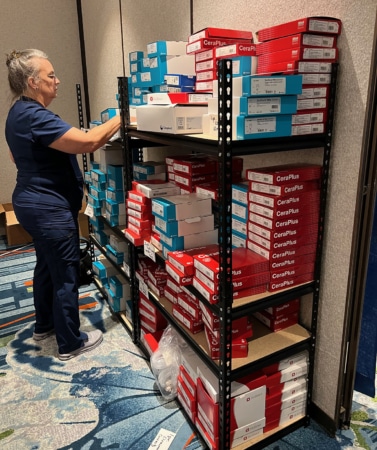
A nurse selects ostomy product samples donated by a wide variety of manufacturers for the stoma clinic at UOAA’s 9th National Conference.

output (e.g. don’t use a urostomy pouch for a colostomy/ileostomy and vice-versa). Stoma characteristics such as size, protrusion, and surrounding contour (e.g. scars, creases, bulges, etc.) also affect pouch choice.”

Other factors, such as an individual’s lifestyle and dexterity play a role.

Here’s some helpful tips whether you are just out of the hospital or you’re having new issues and wondering if you should try something new.

Get Professional Help and Sample Supplies

  • Always consult with an ostomy nurse first for information and recommendations tailored to your body and stoma type. If you’re having trouble with your current system, such as skin irritation or recurrent leaks, ask them to help you find a solution and assist in getting it prescribed. Find an ostomy nurse available in-person or virtually or an Outpatient Ostomy Clinic near you.
  • Remember that every person is different, and you need to find what works best for you. People in online discussions don’t always say their ostomy type ileostomy, colostomy, urostomy and that is key to know what type of supplies to use.
  • Expect some trial and error. It’s common to try several types of products until you find what works best. You can request product samples from manufacturers or a supplier that works with your insurance company. Talk with members of a UOAA Affiliated Support Group, many have a supply closet where members share excess supplies.

Picking an Ostomy Pouching System

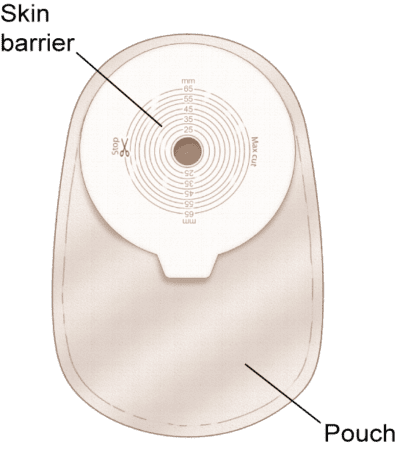
You’ll hear the terms appliance, ostomy pouch system, ostomy pouch, or ostomy bag. They are all just referring to a device consisting of pouch and a skin barrier (wafer, baseplate or faceplate) that sticks to and protects the skin around the stoma.

Understanding the terminology will help you communicate your needs effectively. “When possible, patient preference is taken into account for things like 1-piece vs 2-piece systems, clear vs opaque pouches, and pouch brand,” says Linda Coulter, BSN, RN, CWOCN.

Types of ostomy bags or pouches ileostomy

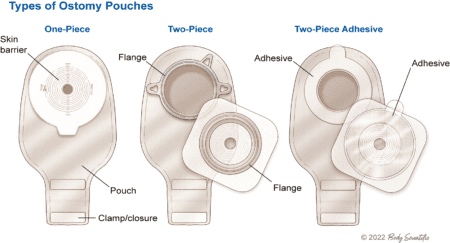
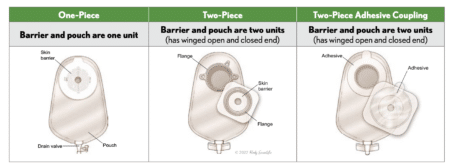
  •  One-piece system: The skin barrier/wafer and pouch are pre-attached. When you change the pouch, you change the whole thing (including the barrier).
    Why people choose it: Simple application and use, low profile under clothing, hernia or bulge near stoma, affordability.
  • Two-piece pouching system: A two-piece system lets you change the pouch while keeping the skin barrier/wafer in place. The pouch attaches to the barrier through a flange/coupling (often a snap-style ring or possibly an adhesive connection).Why people choose it: Versatility. Can easily switch between higher capacity or shorter pouch. Allows pouch to be changed more frequently than the skin barrier. Skin barrier stays in place while pouch is changed, best for higher stoma output, skin sensitivities, fast pouch changing.

Types of Urostomy Pouches

Pouch Closures

  • Drainable (open-ended): You can empty these while they are still attached. Colostomy or ileostomy pouches: use tail closures or separate plastic
    Colostomy Bag One-Piece

    Colostomy Pouch One-Piece Closed End

    clamps/clips. Urostomy pouches (urine): use a valve or “tap closure”. As the name implies, high-output pouches are designed to hold larger volume ileostomy output (rarely colostomy) and have tap closures.
    Why people may choose it: Have output throughout the day requiring pouch to be emptied 3 or more times per day, quick and easy to empty.

  • Closed-end: These are sealed at the bottom and typically discarded after one use. They are most commonly used by colostomates who have regular elimination patterns or can irrigate. Insurance usually covers up to 2-closed pouches per day.
    Why people may choose it: Can remove and throw it away, no draining or clamps.

Other Pouch Choices

Pouch options can include filtered (for automatic gas release and odor) or unfiltered (best with thick stool). Clear pouches are available to monitor output or color and opaque pouches for those who prefer not to see it. A variety of sizes are available depending on output and lifestyle. Urostomates often attach their pouch to an additional drainage bag or container at nighttime.

Skin Barriers

Picking the best skin barrier is critical since it protects the skin around the stoma and enables a secure seal and fit. Your choice depends on your stoma, output, and other factors, such as sensitivity. Frequent changers may ask about gentle adhesion options while those with liquid output may require a stronger adhesion. If your stoma size is changing or oval you may want to get cut-to-fit or moldable skin barriers while, if it is stable and round, pre-sized are a convenient option.

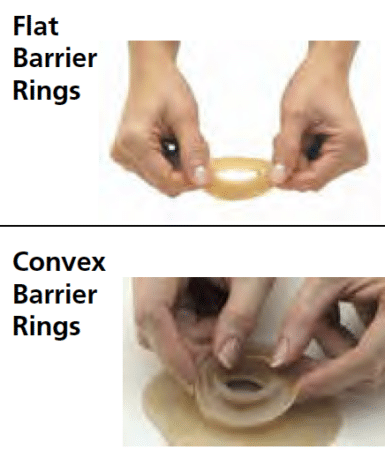
  • Flat: Flat barriers sit level on the skin. Why people may choose it: When the stoma sticks out, pouching with hernia or creases.
  • Convex: Refers to a curved skin barrier (or a system/insert that creates this curve) which helps press inward on the skin next to the stoma. This can help the stoma protrude outward, which helps output go into the pouch instead of leaking under the barrier. There are a variety of depths and flexibilities available.
    Why people may choose it: When the stoma does not stick out enough, or soft tissue, skin folds/creases.

Ostomy Accessories

Depending on the person and stoma type, accessories include products such as cleaning wipes, adhesive removers, stoma powder (pectin-based, non-medicated), stoma paste or barrier ring (provides a seal around the stoma), stoma belt, scissors, wafer extenders, skin protectant wipes, and lubricating deodorant. These products can improve wear time, skin condition, and overall pouching experience.

Ask an ostomy nurse what may be helpful for you.

As you explore different ostomy products and supplies, UOAA’s Ostomy Marketplace Directory can be a helpful place to discover ostomy-related vendors, pouching systems, accessories, clothing, support resources, and more. Browse the directory to learn about available products and connect with companies serving the ostomy community.

UOAA’s Ostomy Marketplace Directory

Keeping Track of it All

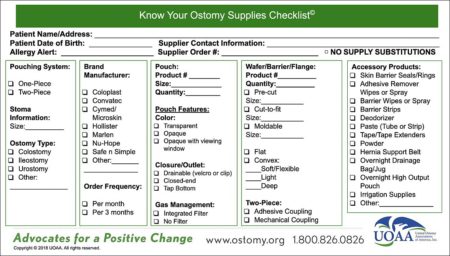
Know Your Ostomy Supplies Checklist

Know your ostomy pouching system and supplies. Once you’ve found the supplies working best for you be sure to keep track of the names, sizes and order numbers. Download the UOAA Know Your Ostomy Supplies Checklist tool to have handy as you work with your ostomy nurse, doctor, supplier or insurance to get the ostomy pouching system and accessories you need.


 Blog by Ed Pfueller, UOAA Director of Strategic Communications with medical review by Linda Coulter, BSN, RN, CWOCN

February 6, 2026
https://www.ostomy.org/wp-content/uploads/2026/02/Choosing-Ostomy-supplies-blog.png 720 1280 Contributor https://www.ostomy.org/wp-content/uploads/2017/02/UOAAlogofinal2.png Contributor2026-02-06 16:37:192026-05-27 13:44:14Tips for Choosing the Right Ostomy Supplies

The Missing Step in Abdominal Surgery Recovery (And Why It Matters)

Colostomy, Exercise/Sports, Ileostomy, Ostomy Tips, Physical Therapy, Urostomy

By Kaylene Hernandez, PT, DPT

Recently, I had the privilege of conducting a workshop with our local UOAA affiliated ostomy support group. As I looked around the room at these resilient individuals, each with their own journey of recovery and adaptation, I was struck by a common thread in their stories. Many had received excellent surgical care and post-operative medical support, yet few had been offered physical therapy as part of their recovery process.

If you’ve undergone abdominal surgery, you might be dealing with unexpected challenges like persistent pain, difficulty returning to activities you love, or new symptoms you weren’t prepared for. Perhaps you’re frustrated that your recovery feels incomplete, or you’re worried about complications like hernias that seem to be developing despite following all your surgeon’s instructions.

These concerns are valid, and more importantly, they’re often addressable.

This gap in care matters because physical therapy after abdominal surgery can truly set you up for long-term success in ways that extend far beyond initial healing. While physical therapy is standard practice after orthopedic surgeries like knee or shoulder replacements, it’s rarely considered routine care following abdominal procedures.

In this article, I’ll guide you through understanding why physical therapy is crucial for your recovery and how it can address the three most common challenges you may be facing, namely:

  • Preventing hernias
  • Managing scar tissue
  • Returning to the activities that bring meaning to your life

What is Abdominal Rehabilitation?

Abdominal rehabilitation is a musculoskeletal and movement specialty within physical therapy that focuses on abdominal and pelvic muscle function in relationship to bowel, bladder, and sexual functioning as well as lumbopelvic and hip mobility. This specialized approach recognizes that abdominal surgery affects far more than just the surgical site, it impacts your entire core system, your posture, your breathing patterns, and your movement strategies.

Unlike general physical therapy, abdominal rehabilitation specifically addresses the unique challenges that arise after procedures involving the abdominal cavity, including ostomy surgeries, hernia repairs, bowel resections, gynecological surgeries, and other abdominal procedures.

Understanding How Abdominal Surgery Impacts Your Body

The effects of abdominal surgery extend far beyond the incision site. Understanding these impacts helps explain why comprehensive rehabilitation is so important for your recovery.

Adhesion Formation: The Hidden Challenge

One of the most significant and often overlooked consequences of abdominal surgery is adhesion formation.

Adhesions are internal scars that form naturally as the body heals from tissue damage caused by surgery, infection, injury, or radiation. While they’re a normal part of healing, they can become a source of pain and dysfunction.

The statistics are sobering: 90% of abdominal surgeries and nearly 100% of open pelvic surgeries cause adhesions. What makes adhesions particularly challenging is that they cannot be diagnosed through standard imaging or diagnostic testing.

Diagnosis is only possible through direct observation during surgery, but this is typically avoided to prevent further adhesive processes.

Adhesions can lead to:

  • Chronic abdominal or pelvic pain
  • Bowel obstruction requiring emergency surgery
  • Reduced organ mobility affecting digestive function
  • Fertility issues in reproductive-aged individuals
  • Need for additional surgical procedures

Changes in Posture, Breathing, and Movement Patterns

After abdominal surgery, your body naturally adopts protective postures and movement strategies. While these serve an important purpose during early healing, they often persist longer than necessary, leading to:

  • Postural changes: Forward trunk lean, rounded shoulders, and protective guarding
  • Breathing alterations: Shallow breathing patterns that reduce diaphragm excursion
  • Movement compensations: Altered lifting mechanics and transfer strategies
  • Core system dysfunction: Disruption of the coordinated system involving your diaphragm, pelvic floor, abdominal muscles, and spine stabilizers

The Comprehensive Benefits of Physical Therapy after Abdominal Surgery

Evidence-based abdominal rehabilitation offers numerous benefits that can significantly improve your recovery and long-term outcomes:

Physical Benefits

  • Decreased pain through targeted interventions and movement optimization
  • Improved muscle recruitment in abdominal, spine, and pelvic muscles
  • Enhanced range of motion in affected areas
  • Reduced excessive scarring through manual techniques and scar management
  • Prevention of ileus (intestinal blockage) through early mobility strategies
  • Less noticeable scars through specialized scar treatment techniques

Functional Benefits

  • Restored visceral mobility improving organ function and digestive health
  • Improved peristalsis supporting healthy bowel function
  • Faster return to prior activity levels with reduced risk of re-injury
  • Enhanced quality of life through comprehensive symptom management

Understanding Hernia Prevention: It’s All About Pressure Management

Hernias, including stomal hernias that can occur after ostomy placement, are often symptoms of poor intra-abdominal pressure management rather than simply surgical complications.

When you hold your breath during daily activities, something that happens unconsciously throughout the day, intra-abdominal pressure increases dramatically and seeks the path of least resistance.

Unfortunately, your recent surgical site often becomes that path.

Through physical therapy, you can learn new breathing strategies and movement patterns that help manage intra-abdominal pressure more effectively. These aren’t just theoretical techniques, they’re practical skills you can apply when lifting groceries, playing with grandchildren, or returning to your favorite exercises.

Key Strategies for Hernia Prevention

  • Coordinated breathing patterns during lifting and exertion
  • Progressive loading techniques to strengthen your abdominal wall safely
  • Activity modification strategies that protect your surgical site while maintaining independence
  • Recognition of warning signs that indicate you need to adjust your approach

Addressing Scar Tissue and Adhesions: A Proactive Approach

Surgical scar tissue affects how your core muscles function and increases the risk of adhesive disease, a condition that can lead to chronic pain, bowel obstruction, and additional surgeries. The challenge with adhesions is that while surgery can sometimes address severe cases, additional surgery often introduces more scar tissue, creating a frustrating cycle.

Physical therapy offers a non-invasive alternative through evidence-based techniques that can significantly improve how scar tissue behaves, reducing its impact on your daily function and potentially preventing the need for revision surgeries.

Evidence-Based Scar Management Techniques

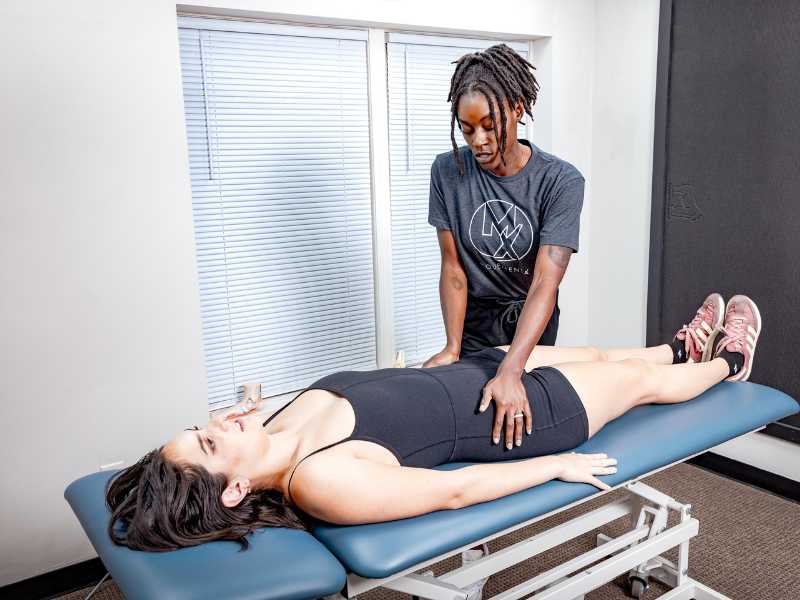
  • Manual scar massage to improve tissue mobility and reduce restrictions
  • Myofascial mobilization targeting the abdominal wall and surrounding tissues
  • Visceral mobilization to optimize organ mobility and reduce internal adhesions
  • Dry needling to address trigger points and scar tissue limitations when appropriate
  • Instrument Assisted Soft Tissue Mobilization (IASTM) techniques for soft tissue mobilization and scar remodeling

Restoring Functional Mobility: Beyond Basic Movement

After abdominal surgery, your body naturally adopts protective postures to guard the surgical site. While this guarding serves an important purpose in early healing, it often persists longer than necessary, contributing to abdominal wall stiffness, loss of spinal mobility, decreased ribcage expansion, and compensatory movement patterns that can lead to pain.

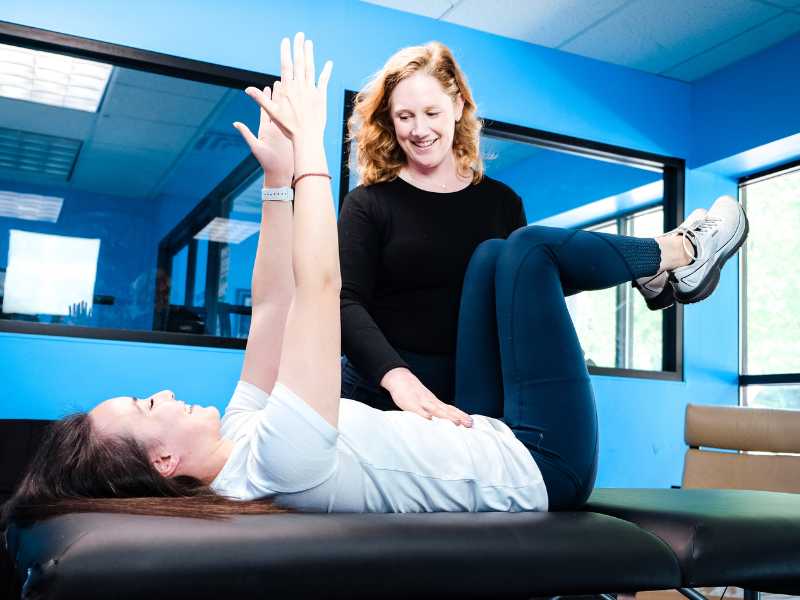
Physical therapists are uniquely qualified to assess these movement compensations and prescribe specific exercises to address them. The goal isn’t just to restore basic function, but to help you return to activities you love, whether that’s caring for family members, returning to running, or getting back to gardening.

Personalized Activity Return

The key is individualization. A physical therapist can get creative with exercise progressions that are specific to your goals and interests, making rehabilitation both meaningful and sustainable. This might include:

  • Sport-specific training for athletes returning to competition
  • Workplace ergonomics for those with physical job demands
  • Grandparent preparation for those wanting to lift and play with grandchildren
  • Hobby-related movements like gardening, crafting, or musical instruments

The Core System Connection: Addressing Unexpected Symptoms

One aspect of abdominal surgery recovery that often surprises patients is the potential impact on bowel and bladder function. This occurs because abdominal surgery disrupts the “deep core” system, a coordinated network including the diaphragm, pelvic floor, abdominal wall muscles, and spine stabilizers.

These muscles must work as an integrated system for optimal function. The pelvic floor, in particular, plays crucial roles in continence control, pelvic organ support, and efficient bowel and bladder emptying.

When the Core System Is Disrupted

When surgery disrupts one component of this system, you may experience new onset symptoms such as:

  • Urinary or fecal incontinence
  • Constipation or changes in bowel patterns
  • Pelvic organ prolapse symptoms (feelings of pelvic heaviness)
  • Pelvic pain or discomfort

Physical therapists trained in pelvic health can help restore core system coordination and address these symptoms through targeted interventions, often eliminating the need for additional medical treatments or procedures.

The Three Phases of Rehabilitation after Abdominal Surgery

Effective abdominal surgery rehabilitation typically progresses through three distinct phases, each with specific goals and interventions tailored to your healing timeline and individual needs.

Phase 1: Incision Healing, Protection, Bowel and Bladder Health

Typical Time in Phase: Days to Weeks

Scar Healing Focus

  • Following your medical team’s instructions for incision care
  • Monitoring for signs of infection including redness, drainage, warmth, improper closure, fever, or excessive swelling
  • Learning proper wound care techniques and when to contact your healthcare provider

Healthy Bowel and Bladder Habits

  • Maintaining adequate hydration to support healing and digestive function
  • Learning to listen to natural urges rather than delaying or forcing
  • Identifying potential bowel and bladder irritants that may affect your recovery
  • Establishing healthy bathroom postures and techniques

Safe Body Mechanics

  • Pain management techniques that reduce reliance on medications
  • Early mobility strategies to prevent complications like blood clots
  • Education on safe posture and movement for daily activities
  • Guidance on self-care activities and adaptive techniques

Phase 2: Scar Tissue and Visceral Mobility, Restoring Range of Motion

Typical Time in Phase: Weeks to Months

  • Progressive strength restoration that respects healing tissues
  • Comprehensive scar tissue management through manual techniques
  • Spine, hip, and ribcage range of motion improvement
  • Myofascial mobilization of the abdominal wall and surrounding structures
  • Visceral mobilization to restore organ mobility and function
  • Breathing pattern optimization for pressure management
  • Introduction of functional movement patterns

Phase 3: Strengthening and Returning to Functional Mobility

Typical Time in Phase: Months and beyond

Advanced Core Strengthening and Stability Training

  • Balance training to reduce fall risk and improve confidence
  • Return to full functional mobility and previous activity levels
  • Activity-specific training for work, sport, and recreational pursuits
  • Long-term maintenance strategies for ongoing health
  • Independence in home exercise programs and self-management techniques

Your Path Forward

Abdominal surgery represents a significant event in your body’s history, but it doesn’t have to define the limits of your recovery.

With proper rehabilitation, you can not only return to your previous level of function but often exceed it by learning better movement strategies, developing stronger core stability, and gaining a deeper understanding of your body’s needs.

The key is recognizing that recovery is an active process that extends well beyond surgical healing, and seeking out qualified professionals who understand the unique challenges you’re facing.

Whether you’re dealing with persistent pain, concerned about hernia prevention, struggling with scar tissue restrictions, or experiencing unexpected symptoms, specialized abdominal rehabilitation can provide the roadmap to help you reclaim your life and activities with confidence.

About the Author: Kaylene Hernandez, PT, DPT is a doctor of physical therapy with MovementX, proudly serving Northwest Indianapolis specialized in pelvic health across the lifespan. Her advanced training covers male and female pelvic floor dysfunction, pediatric pelvic health, oncology rehabilitation, lymphedema, and dry needling. With an approach to care that is to listen deeply, treat holistically, and empower constantly, Dr. Hernandez is committed to helping you thrive in every season of life.

Citations

  1. Svensson-Raskh A, Schandl A, Holdar U, Fagevik Olsén M, Nygren-Bonnier M. “I Have Everything to Win and Nothing to Lose”: Patient Experiences of Mobilization Out of Bed Immediately After Abdominal Surgery. Phys Ther. 2020 Dec 7;100(12):2079-2089. doi: 10.1093/ptj/pzaa168. PMID: 32941610; PMCID: PMC7720638.​
  2. Okabayashi K, Ashrafian H, Zacharakis E, Hasegawa H, Kitagawa Y, Athanasiou T, Darzi A. Adhesions after abdominal surgery: a systematic review of the incidence, distribution and severity. Surg Today. 2014 Mar;44(3):405-20. doi: 10.1007/s00595-013-0591-8. Epub 2013 May 9. PMID: 23657643.​
  3. Broek RP, Issa Y, van Santbrink EJ, Bouvy ND, Kruitwagen RF, Jeekel J, Bakkum EA, Rovers MM, van Goor H. Burden of adhesions in abdominal and pelvic surgery: systematic review and met-analysis. BMJ. 2013 Oct 3;347:f5588. doi: 10.1136/bmj.f5588. PMID: 24092941; PMCID: PMC3789584.​
  4. Lubczyńska A, Garncarczyk A, Wcisło-Dziadecka D. Effectiveness of various methods of manual scar therapy. Skin Res Technol. 2023 Mar;29(3):e13272. doi: 10.1111/srt.13272. PMID: 36973982; PMCID: PMC10155853.​
  5. Chmielewska D, Malá J, Opala-Berdzik A, Nocuń M, Dolibog P, Dolibog PT, Stania M, Kuszewski M, Kobesova A. Acupuncture and dry needling for physical therapy of scar: a systematic review. BMC Complement Med Ther. 2024 Jan 2;24(1):14. doi: 10.1186/s12906-023-04301-4. PMID: 38167051; PMCID: PMC10759514.​
  6. Sinclair M. The use of abdominal massage to treat chronic constipation. J Bodyw Mov Ther. 2011 Oct;15(4):436-45. doi: 10.1016/j.jbmt.2010.07.007. Epub 2010 Aug 25. PMID: 21943617.​
  7. Zia Z, Riaz H, Imtiaz I. Effect of early physical therapy interventions on post-operative ileus following abdominal hysterectomy. J Pak Med Assoc. 2023 Mar;73(3):650-652. doi: 10.47391/JPMA.5447. PMID: 36932773.​
  8. Barral, Jean-Pierre. Visceral Manipulation. Vista CA: Eastland Press, 1993. ​
  9. Arung W, Meurisse M, Detry O. Pathophysiology and prevention of postoperative peritoneal adhesions. World J Gastroenterol. 2011 Nov 7;17(41):4545-53. doi: 10.3748/wjg.v17.i41.4545. PMID: 22147959; PMCID: PMC3225091.


December 9, 2025
https://www.ostomy.org/wp-content/uploads/2025/12/blog-kaylene-post-ab-surgery-img-2-1.jpg 600 800 Contributor https://www.ostomy.org/wp-content/uploads/2017/02/UOAAlogofinal2.png Contributor2025-12-09 12:26:382025-12-09 12:26:38The Missing Step in Abdominal Surgery Recovery (And Why It Matters)

Learning from Leaks: Tips for Staying Prepared and Positive on Your Ostomy Journey

Colostomy, Digital Sponsor, Ileostomy, Ostomy Basics, Ostomy Tips, Travel

It happens…Speaking with Ostomates in many stages of their Ostomy journey is the best part of my role at Ostomysecrets®. A frequent topic, and cause for concern, is the dreaded LEAK. My answer is always the same, they happen to all of us; however, they should be few and far between.

Well, it happened to me. I have had my Ostomy for over twenty years, I measure time in between leaks in years at this point, not months, days or weeks. My record is five years, and I had been on a streak of almost two years.

I live in Southern California, and my husband’s side of the family lives in Las Vegas, NV. When I was first recovering from surgery, I worked very hard with my home health nurse to independently manage my ostomy so that we could make the drive to Vegas for my first Thanksgiving as an Ostomate. I reached that goal, and we had a successful trip.

We make this journey 2-3 times a year, up the Cajon Pass, across the Mojave and into the shining city of neon in the middle of the desert. I have never had any issues with my ostomy during these travels, and we’ve had so many fun adventures through the years: swimming in fancy hotel pools, attending shows and concerts, hiking, dining, stargazing and maybe a bit of gambling too.

Last week, we made the drive to Las Vegas again. I typically get 5 days wear time, so I changed my pouch the day before we left. My plan was to change my pouch again before heading back to California. In Barstow, CA – the halfway point of the journey – we stopped for a quick dinner planning to quickly get back on the road to Las Vegas. Then our plans changed.

Something did not feel right, and I discovered that my pouch had leaked. All my ostomy confidence drained from me. I tried not to panic and to focus on finding a solution. This was not an optimal situation, but Barstow is a crossroads town featuring a number of Truck Stops. I love a road trip, and something I know to be true about Truck Stops is they have showers! We happened to be right in front of one of these truck stops, so I walked in, paid my $18 and waited my turn.

My husband helped me get my suitcase, and my trusty me+ Starter Kit that I always carry my supplies in when I travel anywhere overnight. I will always be a better safe than sorry girl, and I would never leave home overnight without my supplies.

In that moment, standing in the Truck Stop shower waiting area, I was feeling very vulnerable and had tears in my eyes. I let the attendant know I was having a medical issue, and that my husband would be coming in with me to help. She immediately opened a shower for me, and got us extra towels. I was so comforted by the kindness of strangers and their willingness to make it a little easier for me.

I showered, completed my pouch change, got myself together and we got back on the road. I was rattled and feeling all of the emotions of what had just happened. The story I share, and what I know to be true, is that my Ostomy saved my life. Even in this low moment, that truth remains. When I was battling my Ulcerative Colitis diagnosis, at my worst moment, I was going to bathroom 45 times a day. Travel, road trips and adventure were just not possible; I was just too sick.

As we finished the drive through the desert, I felt doubt and anxiety creeping in. We had a big family pool party the next day, and I was worried that the remaining supplies that I had would not be enough. Would I ruin my family’s trip?

I had to quiet those thoughts. Why would this trip be any different that the countless other trips? Why would I have pouching issues? My Convatec pouching system has served me well all these years. It helps me to feel freedom and confidence to complete the adventures I so enjoy.

We ended up having a wonderful weekend! I slept soundly in our hotel bed, I swam with all of the cousins at our family BBQ, we dined out and explored The Vegas Strip. My pouch held up, working as expected and intended, and I achieved my typical five-day wear time – even with the 110 degree desert heat and pool time.

Our ostomies don’t just save our lives; they enable us to live full and happy lives. We thrive because of our ostomies and the pouching systems we rely on, not in spite of them.

My comment still stands: leaks happen to all of us, sometimes. If you are experiencing frequent leaks, please call our Convatec me + team and certified ostomy nurses. They are available to you by phone at 1-800-422-8811.

Editor’s note: This blog is from a UOAA digital sponsor, Convatec. Sponsor support along with donations from readers like you help to maintain our website and the free trusted resources of UOAA, a 501(c)(3) nonprofit organization.
November 13, 2025
https://www.ostomy.org/wp-content/uploads/2025/11/Sarah_1.png 550 1000 Contributor https://www.ostomy.org/wp-content/uploads/2017/02/UOAAlogofinal2.png Contributor2025-11-13 13:53:092026-02-11 15:40:20Learning from Leaks: Tips for Staying Prepared and Positive on Your Ostomy Journey

Finding Your Way: The Journey Forward with an Ostomy

Colostomy, Emotional Health, Ileostomy, Ostomy Basics, Ostomy Tips, Urostomy

By Ted Leamy

This piece is adapted from my closing talk at the 2025 UOAA Conference held in Orlando Florida. Think of it as a last walk around the conference neighborhood before we all went home — with a few of my own observations.

I’m Ted. I’ve been living with an ostomy 43 years. I work in live production events — sound engineering & sound design for concerts and large sporting venues. My career has taken me all over the country and around the world.

At the start of the conference, I talked about how much it means to keep moving forward — even when the rules of the game seem to have changed. How our stomas are not just physical. They change how we see ourselves. Our sense of Self.

Having an ostomy doesn’t disqualify you from much. It demands a different kind of presence to lead the life you want. And that’s what I think we’ve all seen this week in the sessions and in conversations.

For me, the heartbeat of this conference is in the quiet moments — in the hallways, at breakfast, sitting in the lounge between presentations. That’s where appreciation happens — not just of new facts, but of each other.

Body Literacy

Many people get to move through their day without thinking much about their body — grab coffee, rush to work, sit in meetings. That seems normal if your body is working fine. We ostomates don’t get that option.

With an ostomy, you’re pulled into your body constantly. You are checking, you are aware. You know exactly what you ate recently.

This is sometimes referred to as ‘body literacy’ – the ability to read your own body’s signals and patterns. It’s a skill that gets better with practice. You learn to recognize subtle signs before they turn into problems. You understand your personal normal.

Medical stability is the foundation everything else builds on. Without it, you’re just trying to survive. With it, you can start thinking about what comes next.

I used to think this constant awareness was just another burden. Needless to say, I wrong. Now I think body literacy is one of my most valuable life skills. I notice things now I would have missed before… the taste of good coffee, a great conversation, the feeling of a successful day where everything just worked.

Presence and Appreciation

When you have experienced uncertainty through the lens that we have, you gain appreciation for ordinary moments. Not because you’re trying to be grateful – because you actually are.

People talk about mindfulness like it’s something you have to work toward. For us, it’s just another day. We live it by necessity, not by choice. No expensive spiritual retreat with gurus required.

This kind of presence can get exhausting at times, even border on hyper-vigilance. But kept under control, that presence is valuable body literacy — lessons we can transfer to all aspects of our lives.

For me: it has made me feel more alive. When asked what it’s like living with an ostomy for forty years, part of what I say is it taught me how to be present in my life instead of just racing quickly through it.

Three Stages of the Ostomy Journey

Over time I’ve noticed the journey with an ostomy isn’t one continuous road. It shifts, and it has stages. Understanding where you are in these stages can help make sense of current challenges and hint at what might be next in life.

I think of it as three stages:

1. Getting medically stable
2. Becoming functionally independent
3. Learning to flourish and thrive

First things first. You can’t do much until you’re medically stable. This is about listening carefully to your doctors, managing complications, or recovering from a procedure.

When leaving the hospital after one of my surgeries, when asked how I was feeling, I would joke: “I’m upright, I’ve got pants on, and I’m taking nourishment by mouth.”

That was my humorous way of saying I was medically stable. On my way home.

Medical stability is the foundation everything else builds on. Without it, you’re just trying to survive. With it, you can start thinking about what comes next.

Wanting to flourish is being human. It’s honoring the life you were given by actually living it fully.

Becoming functional is about being proficient in looking after your stoma and appliance. It’s creating a new daily routine that includes all your other hygiene and ‘get ready’ rituals. Getting comfortable in this whole new world.

When you are functional, you become grateful. Functional is a big deal! You can leave the house without mapping every bathroom. You can eat dinner with friends. You can sleep through the night with minimal interruptions.

But here’s what happens sometimes. You get functional, and it feels so secure that you lock yourself in. You find your safe foods, your reliable routines, your predictable schedule. Too predictable?

The problem is when functional becomes your ceiling instead of your floor. Does this make sense? Have you been there? I have. Most of us have, I think.

Flourish and Thrive

Let’s talk about moving from functional (stage 2) to flourishing (stage 3).

Flourishing is what you want out of your life — not in spite of your ostomy but in fact because of your ostomy and the life-saving consequences that got you this far.

Flourishing is when you stop asking “Can I do this with my ostomy?” and start asking “Do I want to do this?”

It’s when your ostomy becomes just one part of your life, not the organizing principle of your existence. It’s when you stop apologizing for your limitations and start celebrating your capabilities. It’s when you stop planning around your ostomy – and start planning around what you want out of life.

Sounds easier than it is to do! When we get functional, there are loud applause from friends, family, and doctors. We too are excited. Except we are people. And just being stable, then functional, is not enough. We want to thrive and flourish and become the person we imagine ourselves being.  That’s where the gap shows up — the space between functional and flourishing.

Mind the Gap

There is a gap between being functional and flourishing. We can be so pleased with being functional that we decide to stay in that mode — never pushing forward, never trying new things, never creating new adventures that self-doubt warns against.

Sometimes we get lost in that gap. You’re no longer a patient, but you’re not quite thriving either. It’s easy to feel disoriented, questioning if wanting more is worth the risk.

If we want more, are we ungrateful for what we have? Deep question. I say no.

Thriving is the aspiration. However it looks for each of us, that’s the direction forward.

Being grateful for your medical stability and functional independence doesn’t mean you have to stop there. You can be thankful for what you’ve achieved AND still want to grow, explore, and push your boundaries.

Wanting to flourish is being human. It’s honoring the life you were given by actually living it fully.

The ostomy journey is not a straight line. Circumstances will sometimes force you backward. What matters is finding your way back — regaining functionality, and taking that leap of faith toward flourishing again.

Inspiration Without Comparison

It’s things like this conference that show us what life could look like. Encourages us to keep moving forward. Whatever stage of the journey you find yourself.

When you see someone else thriving — really thriving — it expands your sense of what’s possible for yourself. But careful about comparing. We are all on a unique journey, each of us at different stages — not just in our ostomy journey but in our life journey.

The 19th century playwright Oscar Wilde said: “Be yourself, everyone else is already taken.”

Closing Reflections

Each of us knows our own life better than anyone else.  We’ve already been carrying our courage forward every day — showing up here only made it more visible. That same courage is what lets us reach for more. Thriving is the aspiration. However it looks for each of us, that’s the direction forward. And whatever tomorrow brings, we already carry what it takes to keep moving toward it.  Thanks for spending time with me.

September 12, 2025
https://www.ostomy.org/wp-content/uploads/2025/09/Ted-Leamy-scaled.jpg 1669 2560 Contributor https://www.ostomy.org/wp-content/uploads/2017/02/UOAAlogofinal2.png Contributor2025-09-12 08:34:332025-09-12 09:00:57Finding Your Way: The Journey Forward with an Ostomy

Resilience Story: Matt Marra

Continent Diversions, Exercise/Sports, IBD, Ileostomy, J-Pouch, Ostomy 5k, Ostomy Tips, Patient Stories

A couple years ago, I wasn’t thinking much about my health. I was a little overweight, but nothing alarming. Life was busy working full-time while chasing around two wild but wonderful kids under five.

Then in November 2023, everything changed. I started bleeding when I used the bathroom. Over time, the urgency and frequency increased, and I found myself going 6–8 times a day. After bouncing between urgent care, my primary doctor, and a GI specialist, I was diagnosed with ulcerative colitis in January 2024.

Those three months waiting for a diagnosis were a mental warzone. Googling symptoms like “dark red blood in stool” returns a fun list: hemorrhoids, IBD, and cancer. While I was relieved to finally have a diagnosis, IBD wasn’t something I ever imagined dealing with.

At first, I managed with diet. I avoided trigger foods and even used ChatGPT to check what I could safely eat when dining out. But during a vacation in February I flared badly. What was supposed to be a beautiful cruise celebrating my brother’s and sister-in-law’s marriage ended up being an endless visit to excursions on the toilet and lying in bed. On the flight home, I had to abandon my 3-year-old in his seat four separate times to rush to the bathroom. It was a rude awakening to how terrible ulcerative colitis and iBD in general could be, and created a new fear constantly in the back of my mind that the next thing I eat or do may make me sick for weeks at a time. Things did not get better when we got back.

On Monday, March 4th, I went to the ER thinking I’d get some medication and go home. Instead, I was admitted. “Steroids always help! You’ll be out in a few days,” they said. But by the weekend, I was even worse.

Then I tried biologics. “Infusions never fail,” they told me about 30 minutes before I failed my first one.

After multiple failed treatments, and now two weeks into my hospital stay, I was transferred overnight to a hospital in the city. Surgery was mentioned early on as a worst-case scenario, just in case. My brother had questions for the surgical team at that time, but I brushed them off: “We’re so far from that! There’s no way it’s going to happen.”

Flash forward to the third week. I was exhausted, nauseated, and in pain. Surgery stopped being the last resort. I wanted it. I told the surgeon I wished the decision would be made for me, because mentally, I wasn’t strong enough to choose that road on my own.

On Friday, March 22nd, after continued lack of progress, my care team made the call: it was time. My colon had perforated. I was rushed into emergency surgery for a total colectomy. I woke up with an ileostomy and a new chapter ahead.

Adjusting to a stoma was overwhelming. Seeing a piece of your intestine, or stoma, outside your body doesn’t exactly quickly become “normal.” I hadn’t even realized, 30+ years into life, that people pooped out of their stomachs. My wife and I were told we were brave during ostomy training, since many people can’t even bear to look at themselves post-surgery. I didn’t feel brave, just dazed. But I found ways, through products and routine, to feel okay in my own skin.

At the 5k, I met people who had lived with ostomies for years, people who got it. That sense of community grounded me. Seeing others thrive helped me believe I could, too.

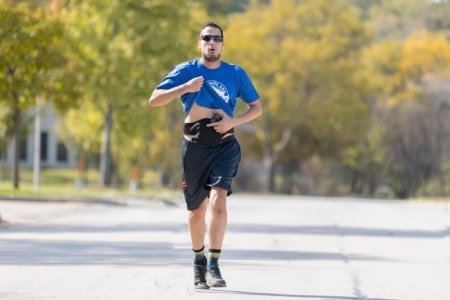
Matt Marra showing his ostomy belt while running the Run for Resilience Ostomy 5k in Illinois, his first year after surgery. Photo by Anne Marra.

Discovering My Resilience

Managing leaks, mastering appliance changes, showering without disaster, sleeping through the night without anxiety, all of it took time. There were 3 a.m. blowouts. There were tears. There was grief and anger.

But I adapted. The stoma became a part of me. Most of the time, I didn’t notice it — and neither did anyone else. I could eat again. I didn’t obsess over bathroom access. I had energy. I had my life back.

And most importantly — my ostomy saved my life.

I spent 30 nights in the hospital. On the worst days, walking three laps around the floor felt like running a marathon. I told myself: just make it to the next milestone. So when I saw the UOAA’s 2024 Run for Resilience Ostomy 5k in Downers Grove, Illinois, I signed up, not just to raise awareness, but to prove something to myself.

Crossing that finish line in just my second-ever 5k was emotional. It felt like a full-circle moment. I was back. Maybe not the same. But just as strong.

Support made all the difference. My wife Anne helped with bag changes, middle-of-the-night cleanups, and the emotional weight of it all. My brothers, Nick and Joe, made sure I was never alone during those long hospital nights.

At the 5k, I met people who had lived with ostomies for years — people who got it. That sense of community grounded me. Seeing others thrive helped me believe I could, too.

From March 2024 to June 2025, I lived a very full life with my ostomy. I traveled to weddings in Mexico and Colorado. I climbed mountains. I flew to Austria and Slovakia for a week-long work trip. Ten-hour flights used to terrify me. Now? No problem. My ostomy didn’t hold me back. If anything, it gave me freedom.

I continue to push myself, no matter the challenges. To show my kids what resilience means.

To every UC patient I’ve talked to about surgery: no, I don’t get a commission. I just know what my ostomy did for me. How UC wrecked my life, and how surgery gave me peace, physically and mentally. I know my path was fast: diagnosis to surgery in five months. But in some ways, I’m grateful. I didn’t suffer for years. I got my life back sooner. For as mentally draining as it was to constantly worry about my health, what I was eating, and where the closest bathroom were – I can only imagine what that is like for those that have been through this for decades battling their chronic IBD.

My ostomy was temporary, though it felt like a permanent part of me. I had two more surgeries, in March and June 2025, to transition to a J-pouch. The stoma is gone, but the scar remains. A battle scar. A reminder. And something I’ll always be thankful for.

For most of my time with an ostomy, I asked: “Why me?” What were the odds? Could I have avoided this if one treatment had worked?

But near the end of my journey, that shifted. I started thinking: “Wow… I’m glad I had an ostomy.” Because it taught me I could not just survive with it but that I could live a full life with it. Looking back on those early conversations in the hospital, when the idea of pooping out of your stomach felt surreal, I never imagined I’d feel that way just one year later.

I continue to push myself, no matter the challenges. To show my kids what resilience means. That no matter what knocks you down, you get back up.

And this October, I’ll lace up again for the 2025 Run for Resilience for yet another milestone. Another chance to prove I’m still standing and thriving.


Visit Matt’s Run for Resilience fundraiser at https://runsignup.com/marra to support the nonprofit programs and services of UOAA. To learn more or sign-up for a Run for Resilience Ostomy 5k near you or virtually visit ostomy.org/5k. 

August 7, 2025
https://www.ostomy.org/wp-content/uploads/2025/08/5k-3.jpg 1365 2048 Contributor https://www.ostomy.org/wp-content/uploads/2017/02/UOAAlogofinal2.png Contributor2025-08-07 11:52:212025-08-07 13:39:43Resilience Story: Matt Marra

Navigating Body Image After Ostomy Surgery

Body Image, Colostomy, Digital Sponsor, Emotional Health, Ileostomy, Ostomy Tips, Teens, Urostomy, Young Adult

When you get an ostomy, most of the advice you’ll hear is practical. It comes in boxes and routines: bags and baseplates, barrier strips and rings. There’s talk of wear time and skin prep, of what to eat and when to empty. These logistics matter, of course; they’re a necessary first step after a major surgery. But beneath this adjustment is often another layer of healing, one that goes beyond the physical.

An ostomy doesn’t just change how your body works. It can also change how you feel inside. It can shift how you see your body, yourself, and your worth, affecting everything from what you wear, to where you go, to how close you let others get. Amid all this change, you might even start to wonder: How could I ever accept myself like this?

For many, life with an ostomy involves the ongoing work of making peace with your body—to meet it not with shame, but with patience, gentleness, and ultimately acceptance. It’s about rebuilding trust with a body that may suddenly feel unfamiliar and allowing that body to once again feel like home.

Body image after ostomy surgery

More than just how you look, body image is about comfort, confidence, and feeling like yourself. Ostomy surgery can profoundly disrupt that sense of self-connection.

A 2018 research review found that poor body image is one of the most common emotional challenges after ostomy surgery. Even when recovery is technically going well—when a WOCN nurse smiles and says, “You’re doing great”—you might hear a voice inside that replies, “Yeah, right,” as waves of self-consciousness or grief roll in.

For many, social stigma only adds weight. Harmful myths that say ostomies are dirty or shameful can take root internally. One study found that nearly half of people with permanent colostomies experience this kind of stigma, which can erode emotional well-being and self-worth.

Even when surrounded by love, you might find yourself hiding. The shirt once worn with pride might get folded away, replaced by oversized clothes chosen more for camouflage than comfort. You might avoid mirrors, not out of vanity, but out of grief for a body that once felt like yours. Intimacy may feel distant, shadowed by the fear of being seen, touched, or rejected.

In all of this, you’re not alone.

What factors shape body image after ostomy surgery?

Body image isn’t fixed; it’s shaped by your history, current circumstances, and how you emotionally process change. Several key factors can influence how someone adjusts:

1. Age and stage of life: Research shows that younger adults often experience greater body image distress after ostomy surgery. This is a time when identity, sexuality, and self-expression are still being shaped—when you’re still learning who you are and how you want to be seen.

In this context, everyday moments can take on new complexity. You may find yourself doing quiet check-ins throughout the day: Is the bag visible? Is it full? Is it leaking? These small, repeated considerations can influence how you move through the world, especially in a culture where bodies with ostomies are rarely represented.

2. Reason for surgery. The reason behind an ostomy may also impact how you adjust to life with it. Even with the same procedure, the emotional meaning is shaped by the life story it enters—and that story can be the lens through which the body is seen.

Research suggests that people who undergo ostomy surgery due to cancer, for instance, may report lower levels of body image distress. While an ostomy can be life-saving in many contexts, cancer survivors may be more likely to see it that way: as a visible mark of survival and strength.

For others, the emotional meaning may feel more complex. When surgery follows years of chronic illness, misdiagnosis, or medical trauma, for example, the experience can carry different associations. Perhaps it’s not triumph, but relief, fatigue, or even resignation. One study found that some participants with inflammatory bowel disease (IBD) viewed their stoma as an embarrassing complication of their condition—something tied more to shame than strength.

But meaning isn’t fixed. With time, support, and self-compassion, your relationship with your ostomy can evolve, no matter the reason behind it.

3. Temporary vs. permanent ostomy. Research also shows that temporary stomas can lead to greater body image distress. When your ostomy isn’t permanent, it can feel like you’re living in a body that doesn’t quite belong to you—just a version you’re passing through. This in-between state can create a kind of psychological limbo: it’s hard to fully grieve what’s been lost and hard to fully accept what is.

While permanent ostomies can bring their own grief, they may also bring a sense of clarity that limbo does not. When you know this is your body now, you may be better equipped to make peace with it.

What can help: Tips for navigating body image after ostomy surgery

1. Find the right ostomy products for you. It’s hard to feel at ease in your body when the products meant to support it don’t feel reliable. Worrying about leaks, irritation, or a poor fit can quietly wear on your confidence. But when your pouching system truly works for you, it can create space for deeper healing and acceptance.

If the medical look or rustling sound of your ostomy pouch makes you feel more self-conscious, know this: not all pouches are the same. Some are designed to move with your body, to bend and stretch as you do. Some fold into a smaller shape that tucks easily under clothes. Some come in colors like black or gray, offering an alternative to a medical beige. Pair these ostomy bags with supporting products like barrier strips and moldable rings, as needed, and you can find a system that fits both your ostomy and your life.

2. Remember what your body is for. After ostomy surgery—after the shock, the healing, and the slow return to everyday life—it’s easy to forget what your body is still doing for you.

It breathes without asking. It heals, even when you’re not watching. It adapts in ways you never expected, creating space for you to live the life you want. Your body allows you to laugh, cry, rest, move, connect, and wake up to a new day. Again and again, that is something worth honoring.

3. Focus on what lights you up. On tough body image days, it can help to shift your focus away from your body. Try asking:

  • What reminds me that I’m still me, despite all I’ve been through?
  • Who or what helps me feel seen beyond how I look?
  • What brings me joy, even for a moment?

Maybe it’s the warmth of your morning tea. A dog’s thumping tail when you pass through the door. A text that says, I get it.

These small lights matter. They can remind you that your life is bigger than managing a stoma, and that you’re here to live in ways that have nothing to do with appearance.

4. Let go of the timeline. Healing isn’t linear. There is no “right” time to feel okay in your body again. No checklist or countdown—just you, moving through it all in your own way, in your own time.

Some days might feel lighter, like body acceptance is just within reach. Other days may stir up discomfort or grief in places you thought had healed. That doesn’t mean you’re failing; it means you’re human. Release the pressure to arrive somewhere quickly and trust that just showing up for yourself is its own kind of progress.

Your body is still worthy after ostomy surgery

After ostomy surgery, your body is not broken. It is changed. It is not less worthy, just newly shaped.

You don’t have to love every part of it. You don’t have to feel grateful all the time. But your body, with its stoma and its pouch, is still here.

It’s still breathing. Still yours. And still deserving of care and peace.

References

Ayaz-Alkaya S. (2019). Overview of psychosocial problems in individuals with stoma: A review of literature. International wound journal, 16(1), 243–249. https://doi.org/10.1111/iwj.13018

Guo, L., Rohde, J., & Farraye, F. A. (2020). Stigma and disclosure in patients with inflammatory bowel disease. Inflammatory Bowel Diseases, 26(7), 1010–1016. https://doi.org/10.1093/ibd/izz260

Jayarajah, U., & Samarasekera, D. N. (2017). Psychological adaptation to alteration of body image among stoma patients: A descriptive study. Indian Journal of Psychological Medicine, 39(1), 63–68. https://doi.org/10.4103/0253-7176.198944

Mahjoubi, B., Mirzaei, R., Azizi, R., Jafarinia, M., & Zahedi-Shoolami, L. (2012). A cross-sectional survey of quality of life in colostomates: A report from Iran. Health and Quality of Life Outcomes, 10, 136. https://doi.org/10.1186/1477-7525-10-136

Simmons, K. L., Smith, J. A., Bobb, K. A., & Liles, L. L. (2007). Adjustment to colostomy: Stoma acceptance, stoma care self-efficacy and interpersonal relationships. Journal of Advanced Nursing, 60(6), 627–635. https://doi.org/10.1111/j.1365-2648.2007.04446.x

Yuan, J. M., Zhang, J. E., Zheng, M. C., & Bu, X. Q. (2018). Stigma and its influencing factors among Chinese patients with stoma. Psycho-Oncology, 27(6), 1565–1571. https://doi.org/10.1002/pon.4695

Coloplast develops products and services that make life easier for people with intimate healthcare needs. Working closely with the people who use our products, we create solutions that are sensitive to their special needs. Our business includes ostomy care, continence care, advanced wound care, interventional urology, and voice & respiratory care.

Follow Coloplast on Instagram, Facebook, and YouTube, or visit us online at https://www.coloplast.us/

Editor’s note: This blog is from a UOAA digital sponsor, Coloplast. Sponsor support along with donations from readers like you help to maintain our website and the free trusted resources of UOAA, a 501(c)(3) nonprofit organization.
July 30, 2025
https://www.ostomy.org/wp-content/uploads/2025/07/Blog-image-Body-Image-After-Ostomy-Surgery-Coloplast.png 550 1000 Contributor https://www.ostomy.org/wp-content/uploads/2017/02/UOAAlogofinal2.png Contributor2025-07-30 11:06:512025-07-30 11:06:51Navigating Body Image After Ostomy Surgery

Ostomy Anxiety: Horror in the Grocery Store?

Colostomy, Emotional Health, Ileostomy, Ostomy Basics, Ostomy Tips, Personal, Urostomy, Young Adult

By Robin Glover

Wallet, cell phone, keys…I’ve always had my essentials when I leave the house. But for the past several years, I’ve added something else to my checklist: ostomy supplies.

When you have an ostomy, you have to be ready for anything. The instant fill, the gas attack, and of course, the leak. Oh, the dreaded leak. It can happen anytime. Or, so it seems. But does it really?

I have this image in my head of catastrophe. There I am, in the middle of the grocery store aisle, my bag has completely fallen off as I stand in a puddle of stool that’s splashed across the floor while output shoots out of me like an over-the-top 80’s horror movie as I stand petrified, children crying out and everyone staring and pointing in disgust.

It always seems to be fear that holds me back more than my ostomy.

I mean, pretty worst-case-scenario stuff. But, it’s hard not to go there. Imagine, worrying about poop (or pee for urostomates) coming out of a hole in your stomach. Like, your front. Where everybody sees. This isn’t some “oopsie” you can pretend never happened. This is a big ol’ brown or yellow stain on the front of your shirt. And nobody’s been drinking coffee.

But is this image even real? I do have a tendency to imagine the worst. Some may even say it’s a talent. My therapist calls it a “cognitive distortion.”

In reality, I’ve had leaks in public. And that’s all they’ve ever been – leaks. Small little leaks that can be covered with tape until I’m able to get to a good spot. In the rare case (two times), it’s been a bigger leak, I was still able to get home and take care of it.

So, it’s fear more than reality. I’m scared of being embarrassed in public due to my ostomy bag. It’s a common fear. Everyone is afraid of being embarrassed. It’s a deep-rooted fear. But my ostomy seems to add a lack of control. I can control things like what I wear and how I act, but I have this stoma with a mind of its own.

It’s like having that “one friend.” Sure, they’re great at home when no one else is around, but take them out in public and you have to constantly worry about what they say. Or, perhaps what they ”blurt out” without warning. (However, unlike a loud friend, you are allowed to use tape to control ostomy pouch leaks).

My ostomy (ileostomy) is permanent. I will have it for life. I need to improve my relationship with it. One way I’m doing that is by being prepared. That’s really all I can do. Before I go somewhere, I check to make sure it’s good. Check the seal. Check the stoma. I now use ostomy pouches with a see-through window just for peace of mind.

I try to carry tape with me everywhere I go. It’s simple athletic tape, but it seals leaks and I can add a lot if need be. That I put in my pocket.

In a smaller bag/sweet fanny pack, I have extra precut ostomy bags, disposable bed pads (brand new, out-of-the-box, they’re very thin and easy to fit into a small bag), ostomy paste, paper towels (I use blue Scott Shop Towels because they’re soft and extra absorbent), and extra trash bags (the ones that come with the pouches). I have everything I need for a quick change. If I’m going somewhere where I’m a little worried I might not be able to find a place to change fast, I carry a backpack with more supplies and a complete change of clothes.

I try to carry tape with me everywhere I go.

More than that, I’ve been working on “decatastrophizing” before I even leave the house. Instead of simply imagining the worst, I think about the realistic possibility of it actually happening. I’ve worn an ostomy pouch for over four years and have never come close to the disaster I envision. It’s basically physically impossible for the bag to simply fall off. Every part of the wafer would have to come loose at once. Plus, I typically wear an ostomy wrap (and just got an ostomy belt). So…not going to happen.

There might be a leak. But I’ve got that handled. I’ve handled it before. It’s not a big deal.

It always seems to be fear that holds me back more than my ostomy. That’s good news, though. Because while I can’t control what comes out of me and when, I can control how I deal with my anxiety about it.

Robin Glover is a writer based in the Houston area. He has a permanent ostomy after being diagnosed with Crohn’s Disease in 2017.

July 8, 2025
https://www.ostomy.org/wp-content/uploads/2025/07/Ostomy-Anxiety-blog.png 1260 2240 Contributor https://www.ostomy.org/wp-content/uploads/2017/02/UOAAlogofinal2.png Contributor2025-07-08 14:18:122025-07-08 14:18:12Ostomy Anxiety: Horror in the Grocery Store?

Meet Christina & Molly – Two Friends, One Mission

Emotional Health, Exercise/Sports, IBD, Ileostomy, Ostomy News, Ostomy Tips, Ostomy Videos, Patient Stories

We’re Christina and Molly — best friends who both have Crohn’s disease and ileostomies. Over the years, we’ve come to realize what a gift it is to have each other’s support on this journey, and now we want to share that gift with others.

Christina is 43 and has lived with Crohn’s for 24 years. She’s had her ileostomy for 13 years and lives in Texas with her husband and their 7-year-old son. Her son was conceived and delivered while she had her ileostomy, proving that yes, a successful pregnancy can be done!

Molly is 38 and has had Crohn’s for 21 years and an ileostomy for 18. Born and raised on the island of Oahu, Hawaii, she now splits her time between California and Hawaii. Thanks to her ileostomy, she has a great quality of life — she wakesurfs, does hot yoga, plays pickleball, and, best of all, no longer has to plan her life around bathroom trips.

We’ve partnered with UOAA to create videos and share resources that provide honest, uplifting, and helpful support for ostomates — whether you’re newly adjusting or have had your ostomy for years. Your life isn’t over– you’re just simply learning your new normal. We are hoping to help you thrive in your new normal living with an ostomy.

Christina and Molly started sharing their health journeys on YouTube at Crohn’s Talk: Belly Laughs and Battles where you can find more of their videos. Stay tuned to @TheUOAAInc on YouTube to discover new videos by them for the ostomy community in the weeks ahead. Feel free to comment and let us know what topics  you would like to see discussed. Disclaimer: They are not providing medical advice, but sharing to help others. 

June 5, 2025
https://www.ostomy.org/wp-content/uploads/2025/06/Molly-and-Christina-friends-1.jpg 1859 1788 Contributor https://www.ostomy.org/wp-content/uploads/2017/02/UOAAlogofinal2.png Contributor2025-06-05 12:34:492025-06-05 12:34:49Meet Christina & Molly – Two Friends, One Mission

Fears, Faux Pas and Fulfillment

Emotional Health, Ostomy Tips, Patient Stories, Personal, Support Group News, UOAA Conference, Urostomy

My Ostomy Story

Hello! My name is Marcia Benedict. I have a urostomy due to bladder cancer.

Facing an ostomy and what life would be after surgery can be overwhelming and I found myself repeating, “I never expected this”.  I was dumbfounded, speechless; and at first, all I could do was cry. I hope my story will give you the strength, support, and desire to thrive beyond expectations.

My Journey

After retiring to Tucson, AZ in 2019, I remembered hearing, “if you ever find yourself in need of medical attention and don’t know who or where to turn, search for the nearest teaching hospital”. I sought medical attention at Banner University Medical Center. The support from doctors and their care team, my Ostomy nurse (CWOCN) and our local Ostomy Support Group has been invaluable.

Despite the initial fear and challenges, I adapted to my new normal by being my own best advocate. I needed to speak up, be determined and resilient.Through it all: Urogram, cystoscopy, cytology, TURBT (transurethral resection of bladder tumor).  Diagnosis: T2/T3 tumor of the bladder invading the vaginal wall. Treatment: chemotherapy, radical cystectomy and hysterectomy. Recovery: one day at a time. Time for emotional and physical healing, following doctors’ orders, being kind and patient with myself. I survived each step, repeating each as needed along the way, and so can you!

Be Prepared – a Few Hints and Hacks

As I was living alone and my cat was not proficient in nursing duties, I requested skilled nursing rehab (SKF) upon hospital discharge. Though my surgeon recommended recovery with home health, he understood my dilemma and helped make those arrangements through his nurse navigator and case manager, followed by home health services (visiting nurse, PT/OT, nutritionist) when I returned home.

Support was such a lifeline in helping me better understand and cope,

Before surgery, I ensured I had a waterproof mattress pad, chux (puppy pads) for my bed and bathroom. Upon discharge from SKF and home health therapy, I preordered my ostomy supplies with the help of my WOC nurse. Over time, I became efficient in changing my pouching system, reducing the time from over an hour to now 15 minutes. Practice makes perfect (most of the time). Despite initial challenges, I adapted with determination. I set alarms on my phone to remind me to empty my pouch and avert potential leaks. Just in case, I always carry a puppy pad under the front seat of my car. To this day, I have repeat calendar schedules to change my pouch. Once, driving on the Interstate, I improvised with an empty water bottle as a makeshift urinal when restrooms were closed during the pandemic. I also keep an empty disposable water bottle (with the cap) in my car and a complete pouch change packet in my purse or backpack. These experiences taught me valuable lessons and have helped me manage with confidence.

You Are Not Alone

Two days before my surgery at the suggestion of my WOC nurse, I went to an Ostomy Support Group, a local affiliate of UOAA. To my surprise, I walked into a roomfull of ostomates of all types. They were welcoming. In a roundtable setting, they talked about the facts, the foibles and the freedom of living with an ostomy. They gave me strength to face what was coming and faith that there was life after ostomy surgery.

That first meeting led me to fulfill one of my retirement goals: …to give back by helping  others facing similar journeys. Recovering during the pandemic, in-person meetings were cancelled. Support was such a lifeline in helping me better understand and cope, I signed up as a phone contact. The Local Group initiated monthly Zoom meetings; and when restrictions were lifted, in-person monthly meetings reconvened.

I’m excited to be attending for the first time this year’s UOAA National Conference in Orlando. I’ve heard from previous attendees the information is educational, inspiring and a good time is had by all. I look forward to meeting some of the wonderful UOAA personnel who have helped me along my journey. Enough can’t be said about their resources: tips, educational publications, particularly the “Living with a Urostomy” guide online, supportive Ostomy Academy discussions and video sessions. If you haven’t tapped into the website www.ostomy.org or the UOAA Facebook page, I encourage you to check it out.

The Future

Initially, everything was daunting, but my expectations for retirement and recovery have exceeded my dreams. I’m healthy, happy and fearless.

Despite the initial fear and challenges, I adapted to my new normal by being my own best advocate.

Surrounded by family and friends, I’m active. I play golf, swim, and dance again. I travel by car, plane, and train in the U.S and internationally. Supplies and all, I braved a 26-day cruise. I even rode a camel!

Wherever I go, my “Bathroom Access Card” is in my wallet, and translated in 2 foreign languages on my phone. In recovery, I found the time and strength to redesign and renovate my kitchen. Made time to socialize. I recently attended my oldest granddaughter’s college graduation and all the festivities. I’m looking forward to it all over again with my second granddaughter who is studying medicine. Since my surgery, I feel blessed indeed, going on 6 years NED (no evidence of disease).

And I’m no longer single! I have a wonderful relationship with a man who adores me for who I am, including my ostomy. There is little to keep me from a fulfilling life, and you shouldn’t let a pouch stop you either.

You’ve Got This!

May 29, 2025
https://www.ostomy.org/wp-content/uploads/2025/05/Marcia-benedict-cat.jpg 961 960 Contributor https://www.ostomy.org/wp-content/uploads/2017/02/UOAAlogofinal2.png Contributor2025-05-29 15:07:072025-05-29 15:07:07Fears, Faux Pas and Fulfillment

Help Others Help You! Ostomy and Continent Diversion Personal Health Preparedness

Advocacy, Colostomy, Continent Diversions, Disaster Preparation, Healthcare, Ileostomy, jejunostomy, Ostomy Tips, Urostomy

Why a Medical Alert ID Matters

By Ellyn Mantell with Jeanine Gleba UOAA Advocacy Manager

It’s a fact; ostomies and continent diversions save lives. Most people are very private about having a fecal or urinary diversion and only share information with people to whom they are most close. Living with a diversion is often considered an “invisible disability”. The concern is, what would happen with these individuals if they were in an accident, unconscious or unable to speak for themselves? They would be unable to notify an emergency responder of the unique needs of the diversion. For example, a Kock pouch is an internal pouch/reservoir that has a stoma that needs to be catheterized throughout the day to empty it. If an emergency responder were not aware of this need, it could result in over filling of the reservoir and damage to the reservoir. 

There is a simple non-verbal way of communicating health issues and medical conditions in emergencies that deserves attention and should be considered. According to the Centers for Disease and Control Prevention (CDC), for personal health preparedness “help others help you” by wearing a medical alert ID bracelet or necklace engraved with important information for emergency responders and healthcare providers. By wearing a form of medical identification people living with an ostomy or continent diversion can effectively advocate for their health and safety protection when they are unable to speak up for themselves. It provides peace of mind should the worst-case scenario happen.  

A real life example shared with UOAA may explain the efficacy of saving time in an emergency situation. An ileostomate was crossing the street and hit by a car. He was not terribly injured, but the force of hitting the ground caused his pouch to explode, causing the first responders to assume his abdomen had been perforated. They spent valuable time cutting clothing to find the cause of the seepage, an unnecessary waste of what could have been life-saving time. Had this gentleman been wearing a medical alert bracelet or dog tag necklace, he would have been assessed differently, and certainly more quickly. 

Wearing a medical alert ID is far more effective than carrying a card in one’s wallet or handbag, or counting on another person to provide vital information. If there is an accident or incident, one may be thrown from a car, their wallet lost or removed, or one may be separated from a person who can advocate. Additionally, a family member or friend may also be incapacitated in some way, or in shock, unable to provide this lifesaving information.

It is suggested by paramedics that a medical alert bracelet be worn on the left wrist, since that is where they reach first for a pulse. A medical icon in red is an attention-grabber, but whatever form of ID you choose be sure it includes the universal medical alert symbol.  Include as much information as possible and be specific. If there are medical instructions, spell them out. A sample inscription might say: Continent Urostomy Catheterize every 4-6 hours with a 1 4Fr. Catheter.

If there are other medical conditions, state them for emergency responders. Include such information as diabetes, allergies. This is no time to be vague. Include a cell phone number of a family member if there is room, and DO NOT FORGET TO ADD YOUR NAME TO THE FIRST LINE!

The most notable and recognized medical alert IDs are from the companies Medic Alert Foundation and American Medical ID. These companies can also keep on record more specific details of your medical history and current care with QR codes and ID cards in addition to the wearable ID.

For those who simply don’t like the look and style of the standard medical alert bracelet there are many more fashionable forms of ID. Other medical alert jewelry may be found on websites such as Lauren’s Hope, and Meridian Medical/Ostomy Supply Company sells a specific bracelet for ostomies. Although first responders tend to look for medical alert bracelets, for those who don’t want to wear jewelry, there are other types of IDs available including: Apple Watch slides, dog tags, and cell phone tags. Your ostomy nurse, primary care physician’s office and most pharmacies can also provide guidance.  

Some people may be uncomfortable wearing something that tells others they have an ostomy or continent diversion. Don’t let stigma stop you from being emergency-prepared!  Consider if you would wear medical alert identification if you had life-threatening allergies. When it comes to one’s health, it should never be associated with shame. 

Ostomies and medical alert IDs go hand in hand saving lives.


Disclaimer: UOAA does not endorse particular products, manufacturers, or suppliers.

April 2, 2025
https://www.ostomy.org/wp-content/uploads/2025/04/cdc_80881_DS1.jpeg 300 300 Contributor https://www.ostomy.org/wp-content/uploads/2017/02/UOAAlogofinal2.png Contributor2025-04-02 16:28:052025-04-02 16:28:05Help Others Help You! Ostomy and Continent Diversion Personal Health Preparedness

4 things everyone should know about ostomy bags

Caregivers, Colostomy, Digital Sponsor, Ileostomy, Ostomy Awareness, Ostomy Basics, Ostomy News, Ostomy Tips, Urostomy

You’ve heard the myths about ostomy bags. They’re smelly. Leaky. A dreaded last resort no one would ever choose.

These myths—old, untrue, and stubborn—keep stigma alive. They tell a story that says ostomy bags are something to hide. Something to be ashamed of. Something to avoid or pity. Fueling careless jokes and bleak portrayals, the myths strip away the complexity of ostomy life and reduce it to a sad, lonely struggle.

But ostomy bags are not tragedies. They are not cheap punchlines or secrets to carry in shame. For 725,000 to 1 million people in the United States alone, ostomies are lifelines—tools of survival and symbols of strength. Ostomies make it possible for people to keep living when illness, injury, or pain have tried to take that away.

It’s time to change the conversation. Here are four things everyone should know about ostomy bags and the people wearing them.

1) Myth: An ostomy is a worst-case scenario.
Truth: An ostomy may save and improve lives in ways people don’t often expect.

Ostomy surgery is often framed as a tragedy. Some say they’d rather die than have one. Others insist they could never live like that. Others still tilt their heads with misplaced sympathy: I’m so sorry you have to wear that. Is it temporary?

Underneath these comments is the unspoken belief that an ostomy is a fate so grim, it should be avoided at all costs.

But here’s what people don’t see: An ostomy can give life back. For so many, it means meals without pain or fear. Days without the clench of needing a bathroom now. The relief of a body no longer ruled by urgency, accidents, and the constant worry that public outings will end in embarrassment.

For those with Crohn’s disease or ulcerative colitis, an ostomy may be what breaks the relentless cycle of flares, medications, and hospital stays. For those with colorectal or bladder cancer, it can be a turning point in removing disease and reclaiming the body. For these and so many other people—those with diverticulitis, traumatic injuries, congenital conditions—an ostomy can be a doorway to fully living.

This isn’t about pretending that life with an ostomy is perfect. It’s about telling the whole truth. Yes, an ostomy can change things. Yes, there may be moments of frustration, doubt, or grief. But for so many ostomates, there is also freedom, relief, and possibility.

And that is anything but the worst.

2) Myth: Ostomies are only for older people.
Truth: Ostomies are for anyone who needs them, from babies to the elderly.

When people hear the word ostomy, they may picture this: an older person in a hospital gown, frail and confined to a bed. But ostomies aren’t just for old age, and they certainly aren’t just for hospitals.

They are for living—for anyone whose body needs a different way forward.

Ostomies are for:

  • The baby born with a condition requiring immediate intervention
  • The toddler whose parents mastered ostomy bag changes before potty training
  • The child with a backpack of homework, snacks, and ostomy supplies
  • The teenager balancing WOC appointments with school, friendships, and first dates
  • The new parent learning to care for a baby while relearning to care for themselves
  • The professional navigating a medical curveball at the height of their career
  • The grandparent chasing after grandkids, refusing to slow down
  • And yes, older individuals who have lived through it all

Ostomies belong to every age and every stage of life. When we widen the lens, we find them at playgrounds and in boardrooms, at first dates and family vacations, in classrooms and grocery store aisles.

We create space for anyone with an ostomy who wonders if there’s someone out there like them. We show them the truth: no matter their age, no matter where they are in life, they are not alone.

3) Myth: No one will love you with an ostomy.
Truth: Love is so much bigger than a bag.

Many ostomates fear they’ll never find someone who sees beyond their ostomy bag. The questions linger between swipes, dates, and hesitant disclosures. When do I bring it up? How will they react? They wonder if the moment they say ostomy bag, there will be an awkward pause and silent calculation that it’s just too much.

Some wish they had fallen in love before surgery—so they wouldn’t have to explain. So the love would already be there, solid and secure. So they wouldn’t have to brace for the moment someone sees the bag and decides whether they can “handle it.”

Even those in relationships may wrestle with doubt. Will my partner still want me? Still find me attractive? Can I trust when they say that this doesn’t change anything?

An ostomy adds another layer to intimacy and relationships. Some potential partners do flinch. Some hesitate. Some don’t know what to say, or they say the wrong thing, or they give a look that stings. (This is stigma in action.)

But love—the kind worth having—is not that fragile. It is not scared of an ostomy bag. And there’s more of that love out there than people think.

People find love at every stage of their ostomy journey. Some before surgery, with partners who sit beside them in hospital rooms, proving that for better or worse isn’t just a phrase. Others after, when they are finally well enough to show up fully in their lives—embracing a love that doesn’t come despite the ostomy, but because of the space it created for healing and wholeness.

Bag or no bag, love is about connection—truly seeing and being seen. And the partners of ostomates prove every day that it’s actually not about looking past the bag at all. They see the bag. They honor it. Not as an obstacle, but as a mark of their partner’s resilience, vulnerability, courage, and strength.

And those are qualities worth loving.

4) Myth: You can tell if someone has an ostomy bag.
Truth: With the right products and care, ostomies often go unnoticed.

People with ostomies are everywhere: at work, at the gym, on dates, in line at the coffee shop. Chances are, most people have met someone with an ostomy without ever realizing it. They’ve stood next to them, shook their hands, shared a laugh—and never knew.

That’s because ostomy bags are not what people think. They’re not open or exposed. They’re not constantly leaking odor or waste in public. In fact, many ostomy bags don’t even resemble the crinkly, medical-looking pouches of the past. Today, there are options designed for discretion and comfort. Sight, sound, scent? All covered. Most of the time, an ostomy is invisible unless the person wearing it chooses to share.

For those who do experience leakage or complications with their ostomy, or just prefer an extra layer of discretion, there are options. A change in products or routine, a wardrobe shift—adjustments that restore comfort and control because people with ostomies aren’t meant to live in constant worry. If someone wants discretion, it can be theirs.

The truth about ostomy myths

Ostomy myths don’t just mislead; they shape lives. They seep into conversations, assumptions, and even the way people see themselves. They chip away at confidence, making it harder for those with ostomies to fully show up in their lives. They feed fear in those facing surgery, delaying care and prolonging suffering. And for everyone else, they can reinforce the dangerous idea that some bodies are more worthy than others.

An ostomy bag doesn’t shrink a person’s worth. It doesn’t make them any less strong, less capable, or less deserving of love and respect.

Because a person with an ostomy is not their bag. No matter who they are—no matter when, how, or why they got their ostomy—they are so much more.


Coloplast develops products and services that make life easier for people with intimate healthcare needs. Working closely with the people who use our products, we create solutions that are sensitive to their special needs. Our business includes ostomy care, continence care, advanced wound care, interventional urology, and voice & respiratory care.

Follow Coloplast on Instagram, Facebook, and YouTube, or visit us online at https://www.coloplast.us/

Author’s note: This blog primarily uses the term “ostomy bag” to reflect how the author describes her own pouching system—a functional, everyday part of her life. While the intent is to reclaim the word “bag” from its negative associations, we recognize that others advocate for alternative terms like “ostomy pouch.” Whenever possible, please ask those with ostomies about the language they prefer. 

Editor’s note: This blog is from a UOAA digital sponsor, Coloplast. Sponsor support along with donations from readers like you help to maintain our website and the free trusted resources of UOAA, a 501(c)(3) nonprofit organization.

 

February 7, 2025
https://www.ostomy.org/wp-content/uploads/2025/02/UOAA-blog-4-things-to-know-about-ostomy-bags-photo.png 550 1000 Contributor https://www.ostomy.org/wp-content/uploads/2017/02/UOAAlogofinal2.png Contributor2025-02-07 13:17:062025-02-12 17:42:134 things everyone should know about ostomy bags
Page 1 of 6123›»

Our Categories

Advocacy (78) Body Image (3) Caregivers (20) Colorectal Cancer (19) Colostomy (139) Continent Diversions (8) Digital Sponsor (77) Disaster Preparation (4) Emotional Health (63) Events (32) Exercise/Sports (48) Fashion/Clothing (11) Healthcare (22) IBD (56) Ileostomy (186) J-Pouch (8) jejunostomy (7) Membership (3) Nutrition (19) Ostomy 5k (20) Ostomy 5k (16) Ostomy Awareness (55) Ostomy Basics (55) Ostomy News (94) Ostomy Nurse (13) ostomy reversals (12) Ostomy Tips (93) Ostomy Videos (4) Patient Stories (100) Pediatric Ostomy (5) Personal (66) Research (3) Sexuality (12) Short Bowel Syndrome (17) Skin Care (9) Social Life (5) Support Group News (13) Support Resources (15) Teens (4) Travel (11) UOAA Conference (18) UOAA History (3) UOAA Volunteers (5) Urostomy (112) Young Adult (8)

Support Us:

Your Donation Funds UOAA Educational Programs:

DONATE TODAY
SUSTAINING GIFT
BECOME A MEMBER
UOAA E-NEWS SIGN UP
Get updates on events, national advocacy and important topics in the ostomy and continent diversion community.

Contact Us


United Ostomy Associations of America
P.O. Box 2293
Biddeford, ME 04005-2293

Virtual Ostomy Clinic

Contact UOAA

Donate Your Supplies

Call us toll-free at: 1-800-826-0826.
Our Information Line hours are Monday-Friday, 9am to 3pm EST. If you have an emergency, please dial 911 or contact your local medical professional.

Please understand that UOAA is a private, nonprofit, advocacy and informational organization. We are not a medical facility and we do not have medical or legal professionals on staff. Therefore, UOAA does not provide Medical, Mental Health, Insurance or Legal Advice. Visit UOAA Virtual Ostomy Clinic provided by The Wound Company for non-emergency, virtual ostomy support.

Privacy Policy

Get Involved

UOAA is the leading organization proactively advocating on behalf of the ostomy community. Recognizing that we are always stronger together, we encourage everyone to get involved by joining our Advocacy Network. We’ve also created several Advocacy Tools and Resources to help you successfully advocate on behalf of the ostomy community to ensure every ostomate receives quality care.

UOAA Run for Resilience Logo

UOAA does not and shall not discriminate on the basis of race, color, religion (creed), gender, gender expression, age, national origin (ancestry), disability, marital status, sexual orientation, or military status, in any of its activities or operations.

Digital Health Award
© 2005-2026, UOAA. All Rights Reserved l Design by Tap House Media
  • Link to Facebook
  • Link to X
  • Link to Pinterest
  • Link to LinkedIn
  • Link to Youtube
  • Link to Mail
  • Link to Instagram
Scroll to top Scroll to top Scroll to top