Bruce Levinson shares his personal ostomy journey — from diagnosis and early challenges with leaks to discovering solutions that helped restore his confidence and lifestyle. In this first episode of Convatec’s Ostomy Real Stories series, Bruce talks about:
✔ Adjusting to life after his ostomy surgery
✔ The challenges he faced with leaks and pouching reliability
✔ Discovering Convatec Moldable Technology through the me+™ support program
✔ How the unique turtle-neck seal helped improve fit and extend wear time to 7–8 days
✔ Staying active and confident during water activities
✔ Using ostomy accessories and Ostomy Secrets® products for comfort and confidence
✔ Why personalized support programs like me+™ can help ostomates troubleshoot challenges
At Convatec, we believe every ostomy journey is unique. Through real patient stories, we aim to share practical experiences, education, and support that help people live life on their own terms. If you found Bruce’s story helpful, subscribe to our channel to hear more real ostomy experiences, expert insights from healthcare professionals, and practical education.
Editor’s note: This blog is from one of our digital sponsors, Convatec. Sponsor support along with donations from readers like you help to maintain our website and the free trusted resources of UOAA, a 501(c)(3) nonprofit organization.
https://www.ostomy.org/wp-content/uploads/2026/03/Blog-Bruces-Ostomy-Journey-with-Moldable-Technology.png5501000Contributorhttps://www.ostomy.org/wp-content/uploads/2017/02/UOAAlogofinal2.pngContributor2026-03-31 16:00:182026-03-31 16:00:18Bruce’s Ostomy Journey with Moldable Technology
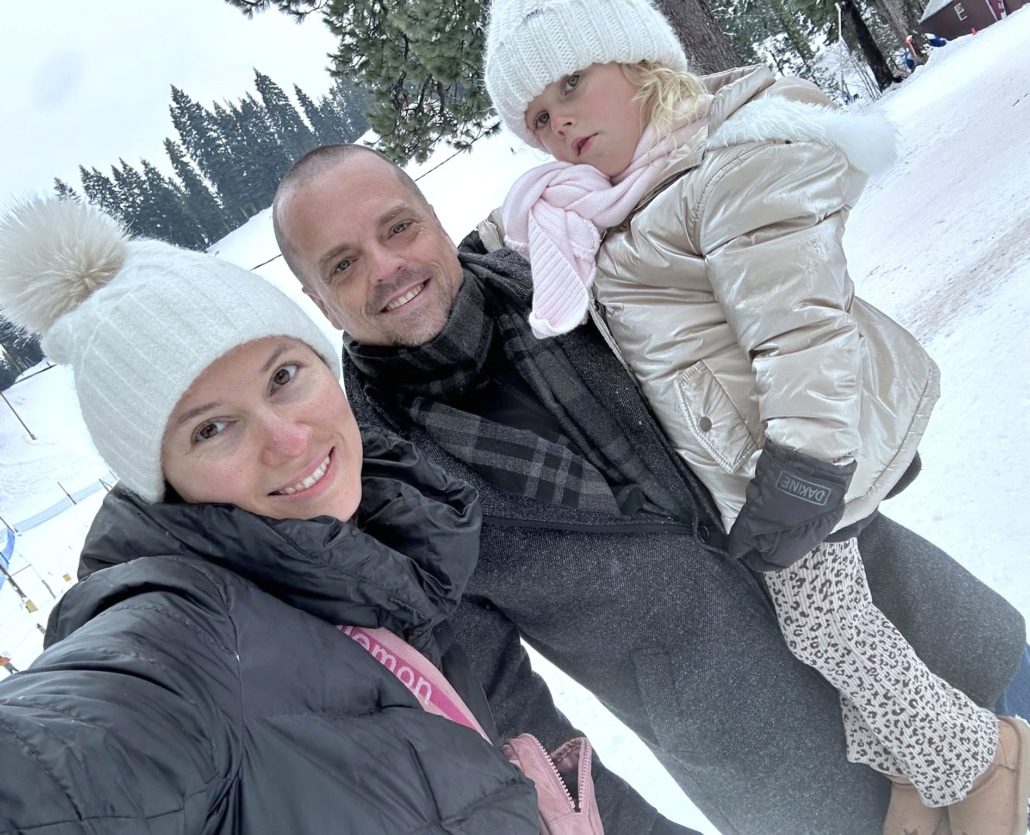
I never imagined that one of the most defining chapters of my life would begin just one month before my daughter was born.
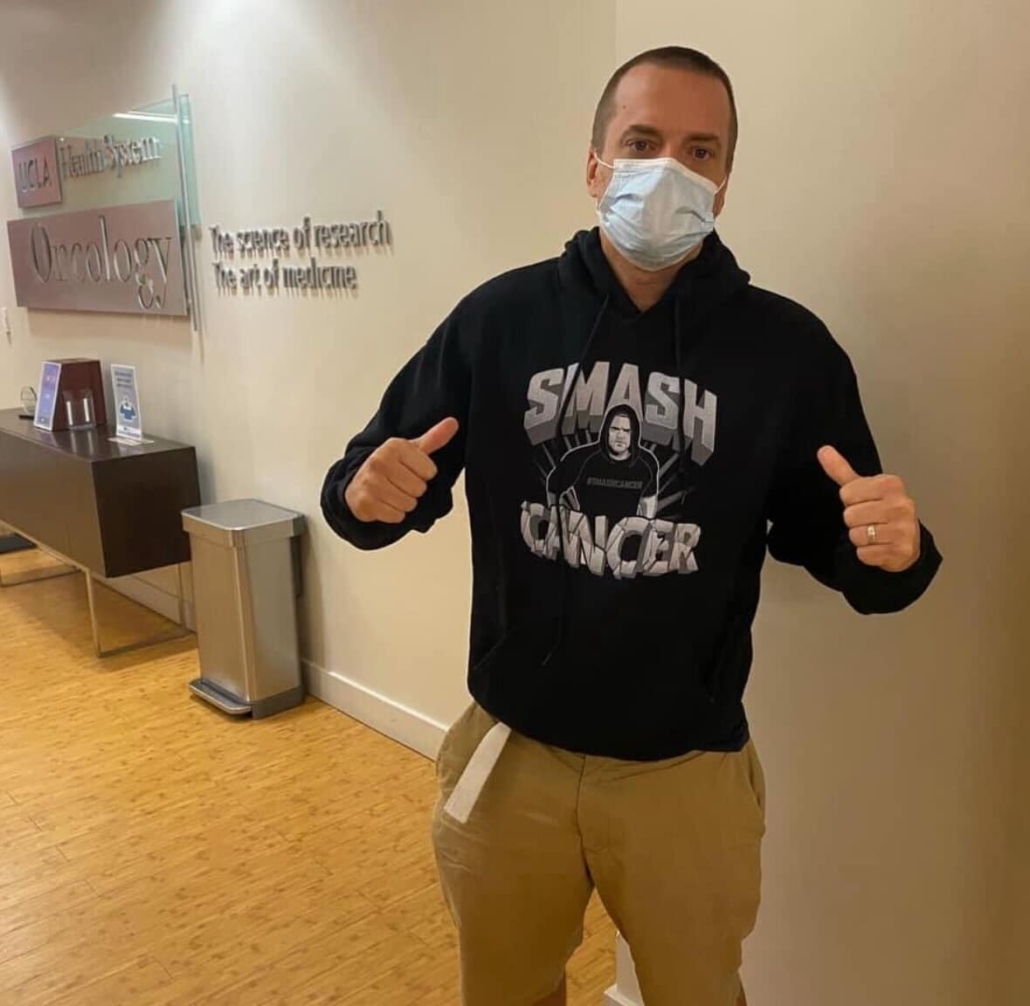
In 2020, I was diagnosed with stage 3 colorectal cancer. A few weeks later, as my family was preparing to welcome my daughter into the world, I was preparing for something entirely different. I started chemotherapy and radiation the very same week she was born. While most new dads are figuring out diapers and sleep schedules, I was learning how to fight for my life at the same time I was learning how to be a father.
Through it all, my wife Dasha was the backbone of our family. She took care of both of us, stepping into a role that no one ever expects to have to play. Watching her carry that weight with strength and love is something I’ll never forget.
Before everything changed, I was part of something truly special called The Schmoedown – it was like WWE meets movie trivia, where larger-than-life characters and real competition collided. I stepped into that world as “The Smasher,” and what started as a persona quickly became something the fans rallied behind in a very real way. They even started a #SmashCancer movement that really carried me through it all, along the way the fans even held a 24-hour stream fundraiser that literally lifted my family up financially while I couldn’t work for nearly a year.
That preparation didn’t just help me physically, it gave me control in a situation where most things felt out of my hands.
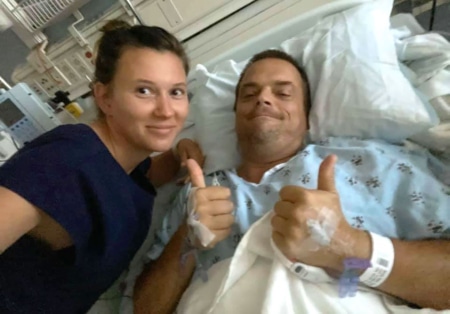
And then after nine months of fighting, under the care of such wonderful oncologists and surgeons at UCLA medical center, I underwent stoma surgery. But here’s something that made a huge difference for me mentally. About five months before the surgery, I already knew there was a strong chance I would end up with a stoma. So instead of avoiding it, I leaned in. I researched everything I could. In my research and quest to be more educated I leaned on sites like Ostomy.org and colonclub to really acquaint myself for the journey ahead, and it was a crucial part of my surgery prep.
By the time ostomy surgery came around, I was so prepared that nurses actually commented that I knew as much as they did. That preparation didn’t just help me physically, it gave me control in a situation where most things felt out of my hands.
Today, I’m proud to say I’m in remission.
But the journey didn’t stop there.
I decided to start sharing my story online, documenting my stoma and ostomy journey. The reason was simple, and honestly, a bit personal. A friend once told me their cousin said they would rather die than have an ostomy. That stuck with me. I couldn’t shake it. And I knew right then that there was a stigma that needed to be broken.
So I made it my mission to smash that stigma.
Since then, I’ve received messages from people still in their hospital beds, sometimes just waking up from emergency surgery, telling me they found my content and it helped them feel less alone. Those messages mean everything to me.
If sharing my experience can help even one person feel stronger, more prepared, or more hopeful, then it’s all worth it.
This journey isn’t just about survival. It’s about mindset. It’s about showing that life doesn’t end with an ostomy, it just changes. And sometimes, that change can lead to a purpose you never saw coming.
https://www.ostomy.org/wp-content/uploads/2026/03/smash-cancer-logo.jpg958959Contributorhttps://www.ostomy.org/wp-content/uploads/2017/02/UOAAlogofinal2.pngContributor2026-03-21 22:05:182026-03-21 22:05:18Smashing Cancer and Stoma Stigma
When I was diagnosed, the first emotions that hit me were disappointment, confusion, and shame. I had spent months believing hemorrhoids were the only source of my problem. There were no other symptoms at first that would alert me outside of hemorrhoids, and when I saw the blood, I attributed it to hemorrhoids and something common and manageable. Cancer never crossed my mind. I never imagined that something as serious as colorectal cancer was there quietly invading my body without my knowing. When the diagnosis came, it felt disorienting. I kept replaying the past in my head, wondering how I missed it, how something so big could have been there while I carried on with my life.
When people asked what kind of cancer I had, I struggled to say the words out loud. Saying it was in my rectum felt heavy, embarrassing, and deeply shameful. I found myself wanting to deflect, minimize, or avoid the conversation altogether. That shame added another layer to the confusion and disappointment I was already carrying—an emotional weight I never expected to come with a diagnosis.
I had no one I could sit across from, look in the eyes, and say, “Do you understand this?”
After my diagnosis, my medical team gave me pamphlets and printed materials explaining my condition and treatment such as colostomy surgery. The information was thorough and medically sound, but it wasn’t what I needed at that moment. I wasn’t looking for a curriculum or clinical language—I needed to understand what was happening to me right then, in real life. What helped me most was hearing from real people.
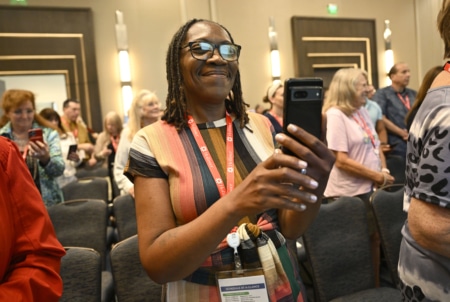
Sandra at UOAA’s 2025 National Conference in Orlando.
I spent long stretches of time watching videos on YouTube where people openly shared their cancer journeys, their fears, their side effects, their recoveries, and their lives beyond diagnosis. Some had their own YouTube channels. Others were featured on platforms like The Patient Story. Watching them helped me process what I was facing in a way pamphlets couldn’t.
While YouTube helped me feel less alone in the early days of my diagnosis and treatment, it didn’t fully replace the need for real, human connection. I didn’t know anyone in my immediate community who had an ostomy. I had no one I could sit across from, look in the eyes, and say, “Do you understand this?”
At some point, I came across another ostomate on social media who mentioned the United Ostomy Associations of America (UOAA) National Conference. I remember feeling something shift in me when I heard about it. It felt like an invitation — not just to an event, but to belonging. I registered, booked a flight, and went — not fully knowing what to expect, but knowing I needed to be there. Those three days became one of the most meaningful experiences of my entire cancer journey. From the moment I arrived, I felt an overwhelming sense of familiarity and ease. I was surrounded by people who felt like they had known me my whole life, even though we had just met. There was no shame, no need to explain myself, no awkwardness. Just understanding. UOAA’s conference wasn’t simply educational — it was grounding. It wasn’t just supportive — it was life-sustaining. For the first time since my diagnosis, I felt whole again. Not fixed. Not “back to normal.” But grounded in who I was becoming.
From Watching to Sharing: Why I Started My Own Channel
The realization to start my own channel came while I was writing my book, My Colorectal Cancer Journey. By the time I reached chapter two, I understood that telling my story solely through a book would take time — time that many people facing a new diagnosis surgery simply don’t have. I remembered how desperately I needed immediate connection and reassurance, and I knew I wanted to offer that same immediacy to others.
Starting a YouTube channel felt less structured, more human, and more accessible. It allowed me to speak honestly, show the realities of ostomy life, and create space for conversations that often don’t happen elsewhere — conversations about fear, shame, stigma, resilience, and growth.
My channel wasn’t created to educate in the traditional sense, even though many people now describe it that way. It was created to connect. To say, “You’re not alone,” without conditions or explanations. To show what life can look like after diagnosis, after surgery, after everything changes.
The same connection I once searched for, I now try to offer — one video, one conversation, one shared moment at a time.
View a selection of Sandra’s videos at the links below and look for her unique perspective on UOAA’s YouTube Channel soon!
https://www.ostomy.org/wp-content/uploads/2026/02/Sandra-James-1-scaled.jpg25601920Contributorhttps://www.ostomy.org/wp-content/uploads/2017/02/UOAAlogofinal2.pngContributor2026-03-03 14:32:302026-03-04 11:32:09Finding Community, Purpose, and Voice After Colorectal Cancer and Permanent Colostomy
We’re Christina and Molly — best friends who both have Crohn’s disease and ileostomies. Over the years, we’ve come to realize what a gift it is to have each other’s support on this journey, and now we want to share that gift with others.
Christina is 43 and has lived with Crohn’s for 24 years. She’s had her ileostomy for 13 years and lives in Texas with her husband and their 7-year-old son. Her son was conceived and delivered while she had her ileostomy, proving that yes, a successful pregnancy can be done!
Molly is 38 and has had Crohn’s for 21 years and an ileostomy for 18. Born and raised on the island of Oahu, Hawaii, she now splits her time between California and Hawaii. Thanks to her ileostomy, she has a great quality of life — she wakesurfs, does hot yoga, plays pickleball, and, best of all, no longer has to plan her life around bathroom trips.
We’ve partnered with UOAA to create videos and share resources that provide honest, uplifting, and helpful support for ostomates — whether you’re newly adjusting or have had your ostomy for years. Your life isn’t over– you’re just simply learning your new normal. We are hoping to help you thrive in your new normal living with an ostomy.
Christina and Molly started sharing their health journeys on YouTube at Crohn’s Talk: Belly Laughs and Battles where you can find more of their videos. Stay tuned to @TheUOAAInc on YouTube to discover new videos by them for the ostomy community in the weeks ahead. Feel free to comment and let us know what topics you would like to see discussed. Disclaimer: They are not providing medical advice, but sharing to help others.
https://www.ostomy.org/wp-content/uploads/2025/06/Molly-and-Christina-friends-1.jpg18591788Contributorhttps://www.ostomy.org/wp-content/uploads/2017/02/UOAAlogofinal2.pngContributor2025-06-05 12:34:492025-06-05 12:34:49Meet Christina & Molly – Two Friends, One Mission