United Ostomy Associations of America
  • HOME
  • OSTOMY INFORMATION
    • Ostomy Information
      • What Is An Ostomy?
      • Living with an Ostomy: FAQs
      • Diet + Nutrition
      • Ostomy Skin Care
      • Sexuality
      • Bill Of Rights
      • New Ostomy Patient Guide
    • My Ostomy
      • Ileostomy
      • Colostomy
      • Urostomy
      • J-Pouch
      • Continent Diversions + Other Ostomy Types
      • Temporary Ostomy
      • Short Bowel Syndrome
      • Español
    • Children to Young Adults with Ostomies
      • Infant/Toddler (0-3 Years)
      • Preschool (3-5 Years)
      • Elementary School (6-9 Years)
      • Pre-Adolescent (10-13 Years)
      • Adolescent (14-18 Years)
      • Young Adult (18-25 Years)
      • Parents & Clinicians Resources
      • Know Your Rights
      • What To Expect After Surgery
      • Odor Control
      • Fast Facts
      • Ostomy Game
    • Crohn’s Disease & Ulcerative Colitis Information
      • Defining, Caring and Treating
      • Preparing for Ostomy Surgery
      • Common Issues, Managing Diet, Mental Health
      • Intimacy, Fertility and Pregnancy
      • Resources
    • General Information
      • UOAA Ostomy Marketplace
      • Product + Supply Information
      • UOAA Resources Library
      • Resources for Nurses/Home Health
      • Travel Tips + TSA
      • Donate Your Ostomy Supplies
      • Emergency Supplies
      • Related Links
      • UOAA Virtual Ostomy Clinic
      • Outpatient Ostomy Services Locator
  • SUPPORT
      • discussion
        Ostomy 101:
        Easily communicate “What is an ostomy?" with our infographic.

        Read More

    • Find Support
      • Support Group Finder
      • Support Group Websites
      • UOAA Virtual Ostomy Clinic
      • Online Peer and Ostomy Support Programs
      • Outpatient Ostomy Services Locator
      • Find a Mental Health Provider
      • Find an Ostomy Nurse
      • Online Discussion Board
      • Apps for Ostomates
      • Emotional Concerns
    • Connect With Us
      • Start/Affiliate Your Group With UOAA
      • Resources For ASGs
      • National Membership
      • Sign Up for Our E-Newsletter
    • Participate
      • Attend An Event
      • Become An Advocate
      • Join Us for a Conference
      • Make A Donation
      • Become a Member of The Phoenix Society
      • Donate Your Ostomy Supplies
      • Take A Survey
  • ADVOCACY
      • portal
        Roadmap to Establishing Outpatient Ostomy Services
        Documents that are available as PDFs to download and print.

        Read More

    • About
      • Advocacy Program
      • Advocacy Priorities
      • 10 Questions to Help You Speak Up and Self-Advocate
    • Get Involved
      • Understanding the Medicare Competitive Bidding Program 2025 Ruling
      • Take Action
      • Join Advocacy Network
      • How to Be An Ostomy Champion
      • Ostomy Awareness Day
      • Roadmap to Establishing Outpatient Ostomy Services
    • Tools and Resources Library
      • Non-Medical Switching Resources
      • Ostomy and Continent Diversion Patient Bill of Rights
      • Restroom Access Self-Advocacy Tools
      • Travel Tips + TSA Communication Card
      • Swimming with an Ostomy
      • Mythbusters Infographic
      • Workplace Resources
      • Aging with an Ostomy or CD
    • Take Control of your Healthcare
      • UOAA Virtual Ostomy Clinic
      • Know Your Ostomy Checklist
      • Know Your Ostomy Supplies Checklist
      • Physician Visit Checklist
      • Know Your Health Care Insurance
      • Know Your Pouching System
      • Know What’s in Your Medical Record
  • WHO WE ARE
      • Have a Question for Us?
        UOAA is a 501(c)(3) nonprofit organization that supports, empowers, and advocates for people who have had or who will have ostomy or continent diversion surgery.

        Contact Us

    • About Us
      • Our Mission + History
      • Our Leaders
      • National Sponsors + Partners
      • National Membership
      • Contact Us
    • How We Help
      • Advocacy
      • Awareness
      • Support
      • National Conference
      • Ostomy Nurse Scholarship
    • Get Involved
      • Volunteer
      • Become A Leader
      • Join A Committee
      • Career Opportunities
      • Sign Up for Our E-Newsletter
  • LATEST
  • EVENTS
    • Ostomy Awareness Day
    • Run For Resilience 5K
    • Ostomy Academy
    • Educational Webinars
    • 2025 National Conference
    • Calendar
  • GIVE NOW
  • SEARCH
  • Menu Menu

Tag Archive for: convexity

Tips for Choosing the Right Ostomy Supplies

Colostomy, Ileostomy, Ostomy Basics, Ostomy Supplies, Ostomy Tips, Skin Care, Urostomy

Navigating the world of ostomy products and supplies can feel overwhelming, but finding the right system and products are crucial for comfort and security.

The appropriate pouch is determined by a number of factors says certified ostomy nurse Linda Coulter. “First the pouch must be appropriate for the type of stoma and
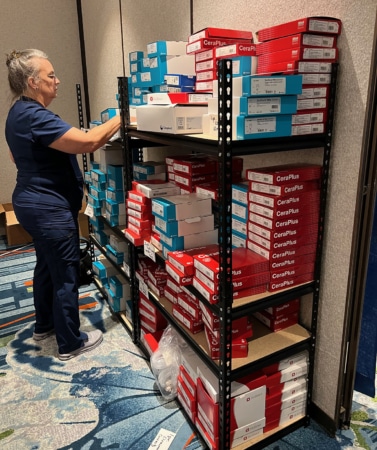
A nurse selects ostomy product samples donated by a wide variety of manufacturers for the stoma clinic at UOAA’s 9th National Conference.

output (e.g. don’t use a urostomy pouch for a colostomy/ileostomy and vice-versa). Stoma characteristics such as size, protrusion, and surrounding contour (e.g. scars, creases, bulges, etc.) also affect pouch choice.”

Other factors, such as an individual’s lifestyle and dexterity play a role.

Here’s some helpful tips whether you are just out of the hospital or you’re having new issues and wondering if you should try something new.

Get Professional Help and Sample Supplies

  • Always consult with an ostomy nurse first for information and recommendations tailored to your body and stoma type. If you’re having trouble with your current system, such as skin irritation or recurrent leaks, ask them to help you find a solution and assist in getting it prescribed. Find an ostomy nurse available in-person or virtually or an Outpatient Ostomy Clinic near you.
  • Remember that every person is different, and you need to find what works best for you. People in online discussions don’t always say their ostomy type ileostomy, colostomy, urostomy and that is key to know what type of supplies to use.
  • Expect some trial and error. It’s common to try several types of products until you find what works best. You can request product samples from manufacturers or a supplier that works with your insurance company. Talk with members of a UOAA Affiliated Support Group, many have a supply closet where members share excess supplies.

Picking an Ostomy Pouching System

You’ll hear the terms appliance, ostomy pouch system, ostomy pouch, or ostomy bag. They are all just referring to a device consisting of pouch and a skin barrier (wafer, baseplate or faceplate) that sticks to and protects the skin around the stoma.

Understanding the terminology will help you communicate your needs effectively. “When possible, patient preference is taken into account for things like 1-piece vs 2-piece systems, clear vs opaque pouches, and pouch brand,” says Linda Coulter, BSN, RN, CWOCN.
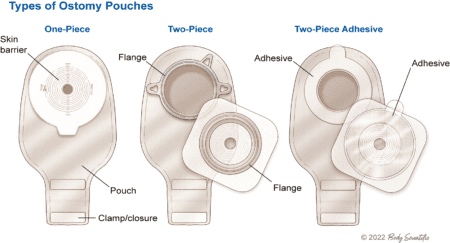
Types of ostomy bags or pouches ileostomy

  •  One-piece system: The skin barrier/wafer and pouch are pre-attached. When you change the pouch, you change the whole thing (including the barrier).
    Why people choose it: Simple application and use, low profile under clothing, hernia or bulge near stoma, affordability.
  • Two-piece pouching system: A two-piece system lets you change the pouch while keeping the skin barrier/wafer in place. The pouch attaches to the barrier through a flange/coupling (often a snap-style ring or possibly an adhesive connection).Why people choose it: Versatility. Can easily switch between higher capacity or shorter pouch. Allows pouch to be changed more frequently than the skin barrier. Skin barrier stays in place while pouch is changed, best for higher stoma output, skin sensitivities, fast pouch changing.
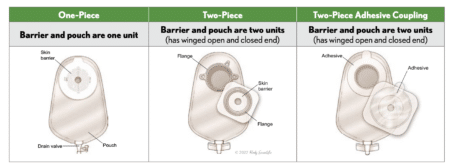
Types of Urostomy Pouches

Pouch Closures

  • Drainable (open-ended): You can empty these while they are still attached. Colostomy or ileostomy pouches: use tail closures or separate plastic
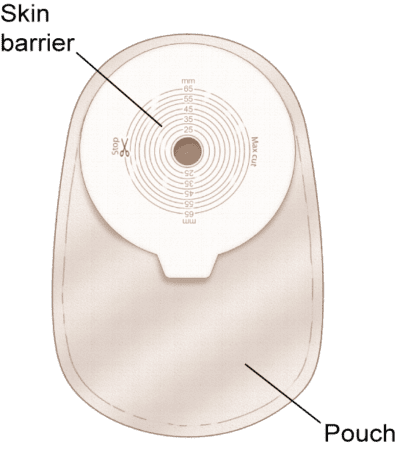
    Colostomy Bag One-Piece

    Colostomy Pouch One-Piece Closed End

    clamps/clips. Urostomy pouches (urine): use a valve or “tap closure”. As the name implies, high-output pouches are designed to hold larger volume ileostomy output (rarely colostomy) and have tap closures.
    Why people may choose it: Have output throughout the day requiring pouch to be emptied 3 or more times per day, quick and easy to empty.

  • Closed-end: These are sealed at the bottom and typically discarded after one use. They are most commonly used by colostomates who have regular elimination patterns or can irrigate. Insurance usually covers up to 2-closed pouches per day.
    Why people may choose it: Can remove and throw it away, no draining or clamps.

Other Pouch Choices

Pouch options can include filtered (for automatic gas release and odor) or unfiltered (best with thick stool). Clear pouches are available to monitor output or color and opaque pouches for those who prefer not to see it. A variety of sizes are available depending on output and lifestyle. Urostomates often attach their pouch to an additional drainage bag or container at nighttime.

Skin Barriers
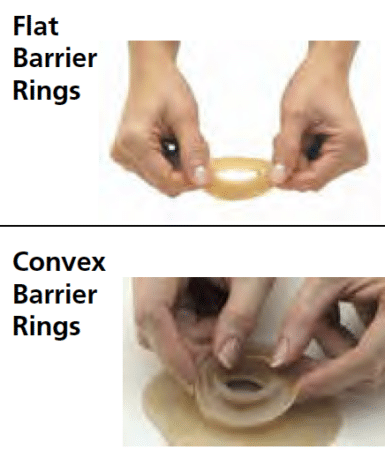
Picking the best skin barrier is critical since it protects the skin around the stoma and enables a secure seal and fit. Your choice depends on your stoma, output, and other factors, such as sensitivity. Frequent changers may ask about gentle adhesion options while those with liquid output may require a stronger adhesion. If your stoma size is changing or oval you may want to get cut-to-fit or moldable skin barriers while, if it is stable and round, pre-sized are a convenient option.

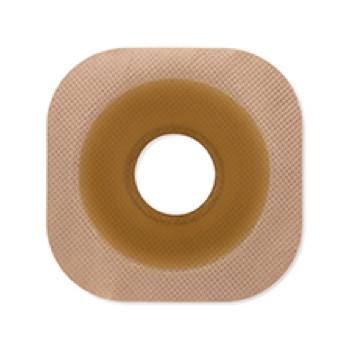
  • Flat: Flat barriers sit level on the skin. Why people may choose it: When the stoma sticks out, pouching with hernia or creases.
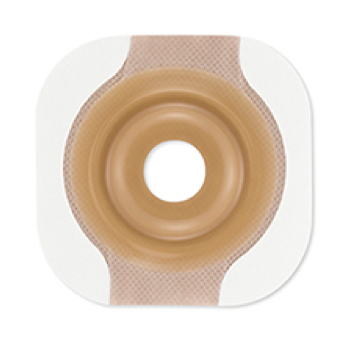
  • Convex: Refers to a curved skin barrier (or a system/insert that creates this curve) which helps press inward on the skin next to the stoma. This can help the stoma protrude outward, which helps output go into the pouch instead of leaking under the barrier. There are a variety of depths and flexibilities available.
    Why people may choose it: When the stoma does not stick out enough, or soft tissue, skin folds/creases.

Ostomy Accessories

Depending on the person and stoma type, accessories include products such as cleaning wipes, adhesive removers, stoma powder (pectin-based, non-medicated), stoma paste or barrier ring (provides a seal around the stoma), stoma belt, scissors, wafer extenders, skin protectant wipes, and lubricating deodorant. These products can improve wear time, skin condition, and overall pouching experience.

Ask an ostomy nurse what may be helpful for you.

As you explore different ostomy products and supplies, UOAA’s Ostomy Marketplace Directory can be a helpful place to discover ostomy-related vendors, pouching systems, accessories, clothing, support resources, and more. Browse the directory to learn about available products and connect with companies serving the ostomy community.

UOAA’s Ostomy Marketplace Directory

Keeping Track of it All
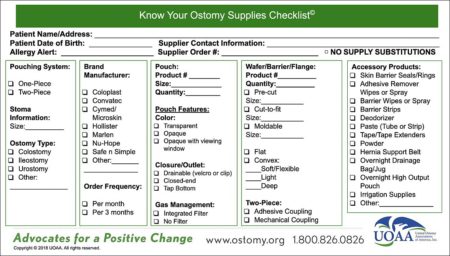
Know Your Ostomy Supplies Checklist

Know your ostomy pouching system and supplies. Once you’ve found the supplies working best for you be sure to keep track of the names, sizes and order numbers. Download the UOAA Know Your Ostomy Supplies Checklist tool to have handy as you work with your ostomy nurse, doctor, supplier or insurance to get the ostomy pouching system and accessories you need.


 Blog by Ed Pfueller, UOAA Director of Strategic Communications with medical review by Linda Coulter, BSN, RN, CWOCN
February 6, 2026
https://www.ostomy.org/wp-content/uploads/2026/02/Choosing-Ostomy-supplies-blog.png 720 1280 Contributor https://www.ostomy.org/wp-content/uploads/2017/02/UOAAlogofinal2.png Contributor2026-02-06 16:37:192026-05-27 13:44:14Tips for Choosing the Right Ostomy Supplies

Nurse Shares 4 Common Convex Ostomy Skin Barrier Myths

Colostomy, Digital Sponsor, Ileostomy, Ostomy Basics, Ostomy Tips, Urostomy

A convex ostomy skin barrier can help prevent output leakage and skin issues. Unfortunately, some misconceptions about convexity may keep people with ostomies from using it.

A convex pouching system refers to the shape of the back of the ostomy skin barrier – the side that goes against your skin. A convex skin barrier is not flat, rather it is curved or dome shaped. Using an integrated convex skin barrier is often referred to as “adding convexity” to a pouching system. This convexity provides a gentle push on the belly, allowing the stoma to protrude up and outward. This can help output go directly into the pouch and not under the skin barrier (which can cause a leak).

Common reasons for using convexity are to prevent leakage and related skin issues, and to avoid having to change the pouching system more frequently. If your pouching routine or body weight has changed, chances are it’s time to consider using a convex skin barrier.

Flat Skin Barrier

Convex Skin Barrier


Below are a few myths or misconceptions about using convexity:

  1. All convexity is the same

Convexity should be chosen and customized based on your specific stoma and body shape. There are two main types of convexity: soft and firm. Soft convexity is flexible and conforms to your body as you move. Firm convexity is rigid and provides firm support around your stoma to help it stick out. In most cases, soft convex skin barriers are used on firmer abdomens, and firm convex skin barriers work best on softer abdomens. Someone may have a bad experience with convexity, only to learn that it was the wrong type for their stoma, body shape, or output. It’s important to know that the convex skin barrier opening needs to be close to the stoma in order to help the stoma protrude. This will also help reduce the possibility of leakage.

  1. A convex skin barrier is uncomfortable or even painful

If your convex skin barrier is causing pain or discomfort, you are not wearing the right type of convexity. Based on your needs, and with guidance from a healthcare professional, consider trying some of the many convex barrier options available and see if they make a difference. The importance of addressing leakage should outweigh the fear of trying something different. Use the health of the skin around your stoma as a barometer. If your skin looks good, and you are not leaking, you’ll know you’re using the right type of ostomy skin barrier for a good fit.

  1. I have to wait to use convexity

You don’t need to wait a certain amount of time before using a convex skin barrier. Each person is different. Some may need to add convexity immediately after surgery, while others may not need to add it at all. There is no concrete rule, and it depends on the type of stoma you have and how well it protrudes. If your belly is soft enough, you can start right away. Again, it’s important to prevent leakage while keeping the skin around your stoma healthy, and trying convexity could help accomplish both goals.

  1. If my stoma is level with my skin, I need a convex skin barrier

In most cases this is true, but choosing a type of convexity can depend on your stoma output. There are always exceptions and everyone has different experiences. For example, someone who has a colostomy with formed stool and regular bowel habits may not need to use convexity, even if their stoma is flush to the skin. That’s because formed stool is unlikely to leak underneath the skin barrier. On the other hand, more liquid output can increase the chances of leakage.

Consider trying a convex ostomy skin barrier to see if it will help prevent leakage and skin issues, and increase your pouching system wear time (i.e., how long you can wear your skin barrier before it fails). Convex skin barriers come in both pre-cut and cut-to-fit options and are covered by most insurance plans. An ostomy nurse can help determine which type of convexity is right for you and when you should use it.


For more information on skin barrier convexity and other resources, visit the Hollister Ostomy Learning Center.


Terri Cobb earned her RN degree in 1991 and became a board-certified CWOCN in 2011. Currently on staff at the Cleveland Clinic in Cleveland, Ohio, her responsibilities include caring for ostomy patients of all age groups from the neonate and beyond. Terri interacts with patients in all phases of their journey from pre-op, to immediate post-op and through follow-up care. Financial Disclosure: Terri received compensation from Hollister Incorporated for her contributions to this article.


Editor’s note: This article is from one of our digital sponsors, Hollister Incorporated. Sponsor support along with donations from readers like you help to maintain our website and the free trusted resources of UOAA, a 501(c)(3) nonprofit organization.


January 11, 2021
https://www.ostomy.org/wp-content/uploads/2021/01/Hollister-featured-convex.jpg 1160 2200 Contributor https://www.ostomy.org/wp-content/uploads/2017/02/UOAAlogofinal2.png Contributor2021-01-11 14:57:102021-01-11 14:57:10Nurse Shares 4 Common Convex Ostomy Skin Barrier Myths

Our Categories

Advocacy (78) Body Image (3) Caregivers (20) Colorectal Cancer (19) Colostomy (140) Continent Diversions (8) Digital Sponsor (78) Disaster Preparation (4) Emotional Health (63) Events (32) Exercise/Sports (48) Fashion/Clothing (11) Healthcare (22) IBD (56) Ileostomy (188) J-Pouch (8) jejunostomy (7) Membership (3) Nutrition (19) Ostomy 5k (20) Ostomy 5k (16) Ostomy Awareness (55) Ostomy Basics (56) Ostomy News (94) Ostomy Nurse (13) ostomy reversals (13) Ostomy Supplies (3) Ostomy Tips (94) Ostomy Videos (4) Patient Stories (101) Pediatric Ostomy (5) Personal (67) Sexuality (12) Short Bowel Syndrome (17) Skin Care (10) Social Life (5) Support Group News (13) Support Resources (15) Teens (4) Travel (11) UOAA Conference (18) UOAA History (3) UOAA Volunteers (5) Urostomy (113) Young Adult (8)

Support Us:

Your Donation Funds UOAA Educational Programs:

DONATE TODAY
SUSTAINING GIFT
BECOME A MEMBER
UOAA E-NEWS SIGN UP
Get updates on events, national advocacy and important topics in the ostomy and continent diversion community.

Contact Us


United Ostomy Associations of America
P.O. Box 2293
Biddeford, ME 04005-2293

Virtual Ostomy Clinic

Contact UOAA

Donate Your Supplies

Call us toll-free at: 1-800-826-0826.
Our Information Line hours are Monday-Friday, 9am to 3pm EST. If you have an emergency, please dial 911 or contact your local medical professional.

Please understand that UOAA is a private, nonprofit, advocacy and informational organization. We are not a medical facility and we do not have medical or legal professionals on staff. Therefore, UOAA does not provide Medical, Mental Health, Insurance or Legal Advice. Visit UOAA Virtual Ostomy Clinic provided by The Wound Company for non-emergency, virtual ostomy support.

Privacy Policy

Get Involved

UOAA is the leading organization proactively advocating on behalf of the ostomy community. Recognizing that we are always stronger together, we encourage everyone to get involved by joining our Advocacy Network. We’ve also created several Advocacy Tools and Resources to help you successfully advocate on behalf of the ostomy community to ensure every ostomate receives quality care.

UOAA Run for Resilience Logo

UOAA does not and shall not discriminate on the basis of race, color, religion (creed), gender, gender expression, age, national origin (ancestry), disability, marital status, sexual orientation, or military status, in any of its activities or operations.

Digital Health Award
© 2005-2026, UOAA. All Rights Reserved l Design by Tap House Media
  • Link to Facebook
  • Link to X
  • Link to Pinterest
  • Link to LinkedIn
  • Link to Youtube
  • Link to Mail
  • Link to Instagram
Scroll to top Scroll to top Scroll to top