United Ostomy Associations of America
  • HOME
  • OSTOMY INFORMATION
    • Ostomy Information
      • What Is An Ostomy?
      • Living with an Ostomy: FAQs
      • Diet + Nutrition
      • Ostomy Skin Care
      • Sexuality
      • Bill Of Rights
      • New Ostomy Patient Guide
    • My Ostomy
      • Ileostomy
      • Colostomy
      • Urostomy
      • J-Pouch
      • Continent Diversions + Other Ostomy Types
      • Temporary Ostomy
      • Short Bowel Syndrome
      • Español
    • Children to Young Adults with Ostomies
      • Infant/Toddler (0-3 Years)
      • Preschool (3-5 Years)
      • Elementary School (6-9 Years)
      • Pre-Adolescent (10-13 Years)
      • Adolescent (14-18 Years)
      • Young Adult (18-25 Years)
      • Parents & Clinicians Resources
      • Know Your Rights
      • What To Expect After Surgery
      • Odor Control
      • Fast Facts
      • Ostomy Game
    • Crohn’s Disease & Ulcerative Colitis Information
      • Defining, Caring and Treating
      • Preparing for Ostomy Surgery
      • Common Issues, Managing Diet, Mental Health
      • Intimacy, Fertility and Pregnancy
      • Resources
    • General Information
      • UOAA Ostomy Marketplace
      • Product + Supply Information
      • UOAA Resources Library
      • Resources for Nurses/Home Health
      • Travel Tips + TSA
      • Donate Your Ostomy Supplies
      • Emergency Supplies
      • Related Links
      • UOAA Virtual Ostomy Clinic
      • Outpatient Ostomy Services Locator
  • SUPPORT
      • discussion
        Ostomy 101:
        Easily communicate “What is an ostomy?" with our infographic.

        Read More

    • Find Support
      • Support Group Finder
      • Support Group Websites
      • UOAA Virtual Ostomy Clinic
      • Online Peer and Ostomy Support Programs
      • Outpatient Ostomy Services Locator
      • Find a Mental Health Provider
      • Find an Ostomy Nurse
      • Online Discussion Board
      • Apps for Ostomates
      • Emotional Concerns
    • Connect With Us
      • Start/Affiliate Your Group With UOAA
      • Resources For ASGs
      • National Membership
      • Sign Up for Our E-Newsletter
    • Participate
      • Attend An Event
      • Become An Advocate
      • Join Us for a Conference
      • Make A Donation
      • Become a Member of The Phoenix Society
      • Donate Your Ostomy Supplies
      • Take A Survey
  • ADVOCACY
      • portal
        Roadmap to Establishing Outpatient Ostomy Services
        Documents that are available as PDFs to download and print.

        Read More

    • About
      • Advocacy Program
      • Advocacy Priorities
      • 10 Questions to Help You Speak Up and Self-Advocate
    • UOAA Action Center
      • Take Action
      • Competitive Bidding
      • Ostomy and Continent Diversion Patient Bill of Rights Campaign
      • Non-Medical Switching Campaign
      • Join Advocacy Network
      • Find Your Legislator
      • Advocate Tools
    • Other Ways to Get Involved
      • Ostomy Awareness Day
        • Tools
        • Who’s Raising Awareness?
      • Roadmap to Establishing Outpatient Ostomy Services
      • Share Your #MyAccessMatters Story
    • Tools and Resources Library
      • Restroom Access Self-Advocacy Tools
      • Travel Tips + TSA Communication Card
      • Swimming with an Ostomy
      • Workplace Resources
      • Aging with an Ostomy or CD
      • Home Health Tools
      • Webinars
        • Ostomy Supplies and Insurance
        • How to Navigate Insurance and Get Supplies Affordably
    • Take Control of your Healthcare
      • UOAA Virtual Ostomy Clinic
      • Expect More Series & Checklists
      • Additional Advocacy Resources
        • The Americans with Disabilities Act (ADA)
        • Long-Term Care Ombudsman
        • Quality of Care Complaints
        • Medicare Rights Center
  • WHO WE ARE
      • Have a Question for Us?
        UOAA is a 501(c)(3) nonprofit organization that supports, empowers, and advocates for people who have had or who will have ostomy or continent diversion surgery.

        Contact Us

    • About Us
      • Our Mission + History
      • Our Leaders
      • National Sponsors + Partners
      • National Membership
      • Contact Us
    • How We Help
      • Advocacy
      • Awareness
      • Support
      • National Conference
      • Ostomy Nurse Scholarship
    • Get Involved
      • Volunteer
      • Become A Leader
      • Join A Committee
      • Career Opportunities
      • Sign Up for Our E-Newsletter
  • LATEST
  • EVENTS
    • Ostomy Awareness Day
    • Run For Resilience 5K
    • Ostomy Academy
    • Educational Webinars
    • 2025 National Conference
    • Calendar
  • GIVE NOW
  • SEARCH
  • Menu Menu

Tag Archive for: marriage

How an ostomy can bring couples closer together

Bladder Cancer, Caregivers, Emotional Health, Social Life, Support Resources, Urostomy

While managing a serious illness and ostomy surgery can be a brutal reality, many couples find the experience transforms their relationships for the better, replacing trivial arguments with deep appreciation and forging an unbreakable bond built on acceptance.

By H. Dennis Beaver, Esq.

Suppose we were having a cup of coffee in my office, and I asked you, “Can you think of something really good about having bladder cancer?” You would probably look at me as if I had a screw loose.

Well, the response I’ve received from couples who read our recent article We’ve Survived Bladder Cancer, But Live With the Effects of Surgery. Tough Love Isn’t What We Need is proof that something indeed very good can result despite the tragedy of experiencing this life-altering disease.

Within hours of the article being online, emails and phone calls arrived from people affected by bladder cancer, including the spouses of attorneys (lots of attorneys), business executives, retired military, law enforcement — people used to being in charge — who had the same message:

Having bladder cancer made them — or me, depending on who reached out — a better spouse. The readers talked about how their spouse stopped being their work self at home, arguing over little, stupid, petty things. They were more appreciative of their spouse than they had been in years.

“Mr. Beaver,” one woman said, “bladder cancer brought us closer, and we both had a lot to learn. Would you please address these important issues?”

So I spoke with Dr. Patricia Pedreira, a postdoctoral associate at Duke University School of Medicine specializing in psycho-oncology. She works with cancer patients and their families, navigating the psychological impact of diagnosis, treatment and survivorship. This is a summary of our interview. (Have a box of Kleenex nearby. I’m glad that I did.)

Bringing couples closer together

The daily realities of living with a urostomy can either drive couples apart or bring them closer together. The difference often comes down to how the partner responds in their spouse’s most vulnerable moments.

High-achieving spouses frequently tell me the same thing: I realized my behavior was hurting my spouse at a time when that was the last thing I wanted to do.

How small things suddenly matter

Bladder cancer recalibrates what’s considered worthy conflict. Couples describe how arguments that used to dominate their relationship (finances, household tasks, who said what) suddenly feel absurdly trivial.

When you’re dealing with the daily reality of an ostomy, who forgot to take out the trash doesn’t register anymore.

Also, small kindnesses become massive. Such as when a spouse keeps extra supplies stocked without being asked. Or warms the bathroom before a pouch change in winter. Or doesn’t wrinkle their nose or look away.

These gestures communicate acceptance and love more powerfully than any words.

Partners also notice what you don’t do. Such as not complaining about middle-of-the-night accidents. Not making a big deal about canceled plans because of not feeling well. What a spouse doesn’t say speaks volumes.

Identity and dignity

Losing bladder function strips away dignity in a way that’s hard to describe if you haven’t experienced it. The person may feel like less of an adult, less of a partner, less attractive, less capable. These feelings are real and valid.

As their spouse, it’s not your job to talk them out of these feelings. It’s to show them through your actions that you still see them as your partner, not a patient. You still find them attractive. You still respect them. You still want to build a life with them.

This means maintaining aspects of your relationship that have nothing to do with cancer or the ostomy.

  • Keep watching your show together
  • Keep your Sunday morning coffee ritual
  • Keep planning for the future
  • Don’t let “bladder cancer patient” become their entire identity in your eyes or in the relationship.

How bladder cancer can strengthen a marriage

Shared vulnerability creates connection. When your spouse responds with compassion instead of disgust at your most vulnerable moments, you realize they aren’t going anywhere. That acceptance builds trust that many couples never experience.

Trivial conflicts disappear. Arguments about money or household tasks feel absurd when you’re dealing with real problems. This clarity leads to less conflict and more appreciation.

You become a team. Managing ostomy care together as a shared challenge creates a genuinely collaborative partnership.

Crisis reveals character. Watching your spouse show up for accidents and breakdowns without resentment shows you who they really are. Many people fall in love all over again.

You stop taking each other for granted. Facing mortality makes couples more present, more grateful and less interested in grudges. When time feels finite, you stop wasting it on pettiness.

The challenges are real and brutal. But many couples find the “bladder cancer experience” strengthened their marriage. They become more honest, more compassionate and more certain of each other.

When to seek professional support

For the person with bladder cancer, watch for signs that your grief and adjustment have shifted into clinical depression or anxiety:

  • Persistent sadness that doesn’t lift even briefly
  • Loss of interest in things that used to bring comfort
  • Pervasive hopelessness
  • Significant changes in sleep or appetite beyond what treatment explains
  • Constant intrusive worry about the ostomy failing or people noticing

For partners, watch for the following in yourself:

  • Resentment that won’t go away
  • Constant irritation with your spouse
  • Avoiding physical closeness
  • Feeling trapped or overwhelmed by caregiver responsibilities

These are signs that you need support.

Mental health care is part of comprehensive cancer care, not a luxury or admission of weakness. Most cancer centers have psycho-oncology services or social workers who can refer you to therapists experienced in helping people adjust to life with an ostomy.

Both patients and caregivers benefit from this support.

Therapy gives you tools to process the grief, anger, fear and adjustment challenges that you can’t get from well-meaning friends or support groups alone.

It’s a space to be honest about how hard the situation is without worrying about burdening anyone.

What I tell couples

You don’t have to be inspirational. Some days, you’ll cope well with the ostomy. Other days, you won’t. Both are okay.

Practice self-compassion. Treat yourself with the same kindness you’d offer a friend navigating this. Don’t beat yourself up for feeling grief, frustration or anger about losing normal bladder function.

These feelings don’t mean you’re weak or ungrateful to be alive. They mean you’re human.

For partners: Don’t beat yourself up for finding the situation difficult. Watching someone you love struggle is painful. Having your life disrupted by middle-of-the-night accidents and medical complications is legitimately difficult. Acknowledging that doesn’t make you selfish.

Find small moments of normalcy and connection even in the hardest stretches:

  • A conversation that has nothing to do with cancer
  • A meal you both enjoy
  • A moment of laughter

Something that reminds you you’re still you, still a couple, still capable of joy even in the middle of something that’s hard to deal with.

If you’re struggling, ask for help. You don’t have to figure this out alone.

Readers can contact Dr. Pedreira at pedreirp@gmail.com. Thank you for sharing about these important issues for both the caregiver and their loved one. 

H. Dennis Beaver, Esq. is in the general practice of law and writes a syndicated newspaper column, You and the Law. Through his column, he offers readers in need of down-to-earth advice his help free of charge. “I know it sounds corny, but I just love to be able to use my education and experience to help, simply to help. When a reader contacts me, it is a gift.” Thanks to the author for sharing his article with UOAA and the ostomy community!


June 2, 2026
https://www.ostomy.org/wp-content/uploads/2026/06/Caregivers-blog.png 1080 1920 Contributor https://www.ostomy.org/wp-content/uploads/2017/02/UOAAlogofinal2.png Contributor2026-06-02 13:52:272026-06-02 13:54:40How an ostomy can bring couples closer together

Destined to Love, Ostomates by Chance

Colostomy, IBD, Ileostomy, Ostomy 5k, Ostomy Awareness, Patient Stories, Personal, Urostomy

By Ed Pfueller, UOAA Communications Manager

Taylor Mitchell and Michael Ross

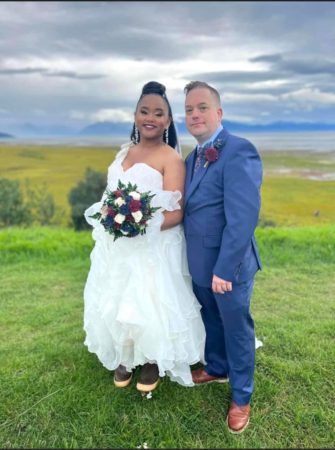
It was raining every day, for weeks, before Taylor and Michael were set to get married. But as the recently wed couple stepped out of the church for photos, only the sun was shining, a distant mountain range framed their joy – the chilly Alaskan rain held off.
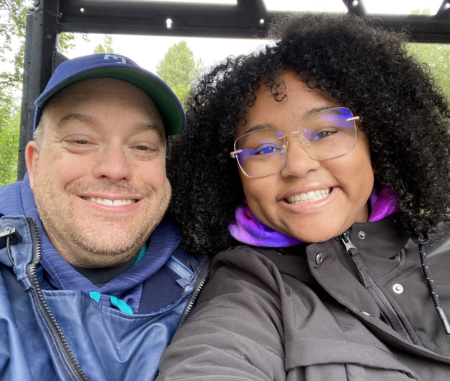
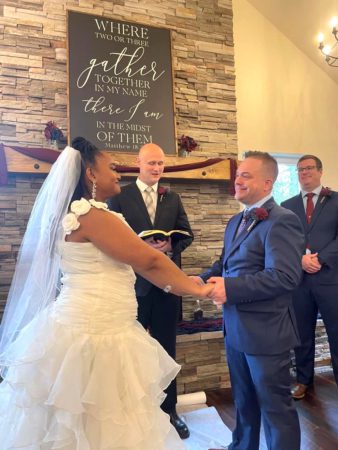
“It was an absolutely magical day,” says Taylor, the bride. “Taylor took my breath away when I saw her, she was absolutely stunning,” Michael recalls.

Even if the dark clouds had drenched their special day, it’s doubtful it would have dampened their mood. This specific couple is used to living with ostomies and chronic illness and they seem prepared to weather any storm.

Friends from the Start

Taylor and Michael first met ten years ago in a local college undergrad class. “I scanned the room, saw him, thought he was cute, and decided I wanted to sit by him and try to be friends. I didn’t know if anything would come of our friendship. We had a great connection as friends, Taylor recalls.

“She was smart, insightful, and easy on the eyes, but I would never have imagined she was interested in me beyond friendship,” Michael says.

The friendship slowly turned into dating. “We have a lot in common and also have a lot of differences. I love to plan, and she is more spontaneous. We both respect each other and can be vulnerable with each other, and the biggest thing is we trust each other,” Michael says.

Taylor says some things she loves about Michael is that he understands her and that they have a shared faith. “He always wants to help me any way he can, and he’s generous to others,” she says.

What is an Ostomy?

“While we were dating, I didn’t know Michael had an ostomy for a while and when he did tell me, I had no idea what it was,” Taylor says. “His ostomy was never an issue for me and so my experience while dating was positive! His ostomy never impacted anything in our relationship from my perspective.”

Michael has had a long ostomy journey and awareness, his mother had a urostomy. ”I had a colostomy for about two years, takedown for four, and have had a permanent ileostomy for the past fifteen years due to complications with Crohn’s disease,” he says.

“I didn’t date much before I met Taylor but had no negative experiences when I did date. Taylor was very understanding when I told her (and showed her) about my ostomy. She was very understanding and seemed eager to learn more.”

“My advice would be, if you’re a person who doesn’t have an ostomy and finds yourself dating someone with an ostomy, educate yourself and do your best to understand your partner, their limitations (if any), and then just treat them as a regular person!” Taylor says.

Taylor also advises that if you have an ostomy and find yourself with someone who doesn’t have an ostomy. “Give the partner an opportunity to accept you and make the choice for themselves on what they’re comfortable with. You’re not for everyone and that’s ok and vice versa! I think it will always be slightly nerve-wracking to have a body that isn’t “normal” by current beauty standards because of the fear of rejection and embarrassment, Taylor says. “Society tends to tell us that no one will want us if there’s something “wrong” with us. But, if you can muster the courage to put yourself out there, the outcome may be better than you ever imagined!”

I don’t think we will have any more challenges than the average couple… we just poop differently. -Michael Ross

In Sickness and in Health

Caregiving has been a consistent part of Taylor and Michael’s relationship. “When Michael had to have revision surgery, I wanted to make sure he’d have easily accessible food so he could focus on healing. I came over to his house prior to surgery and we made a few different meals to freeze. It was a great feeling for me that we got to spend time together cooking and his food would be taken care of while he recovered. He was used to taking care of himself so it meant a lot to me to do this for him.”
Meanwhile, Taylor started dealing with her own undiagnosed chronic illness. “I had to go to the Mayo Clinic while we were dating, and he took time off of work to come with me for a week. He came to all my appointments and helped me navigate all my emotions with what I was dealing with. This is the kind of thing we do for each other, we try to make the hard times easier by taking care of the small things and the big things,” she says.

Just a year and a half ago Taylor, with her health worsening Taylor had ostomy surgery as a result of chronic constipation. For better or worse they were now an ostomate couple.

A Couple of Ostomates

After her ostomy surgery, Taylor says she, “shared with him every single aspect of what I was going through. It was nice to be with someone who already knew! It felt good from my perspective to understand him better, now that we had the same appliance… I actually knew first-hand what he was dealing with.”

Michael says that one of the best parts of being with another ostomate is knowing that someone really understands what you are going through. “It’s nice to be able to compare notes on new products and understand when my partner isn’t feeling well, to have the option to share supplies, tag along to doctor’s appointments, and ask questions about care, procedures, and recovery,” he says.

In addition to a new mutual understanding of health issues, Taylor says, “We know what to do if one of us isn’t feeling well. We just understand each other on a deeper level. He accepts me as an individual and he accepts my body even as it changes with all my health challenges.”

It felt good from my perspective to understand him better, now that we had the same appliance… I actually knew first-hand what he was dealing with. -Taylor Mitchell

As for difficulties, they both dread a possible double leak at night, and can imagine the challenge of not feeling well at the same time or needing a procedure around the same time. Taylor says the most challenging part has been encouraging the other to stick to the foods that work for us, to drink water more consistently, and get our electrolytes in.” Michael concludes, “I don’t think we will have any more challenges than the average couple… we just poop differently.”

Finding Community and Support

Even with partner support, Taylor says “UOAA has been so incredibly important to me in my ostomy journey. When I first got my ostomy, I scoured the UOAA website and read every piece of information I could find which helped ease my mind and answer my questions. UOAA’s website also helped me to be able to share information about my ostomy with family and friends.”


The couple, who both work in logistics, has recently moved to Colorado but while in Alaska both say they had the good fortune of having Luella Odmark as their WOC nurse.

“Luella is an amazing individual who cares so deeply about ostomates,” Taylor says. She does a training for nurses at one of our hospitals and has invited my husband and I to speak to the class about our ostomy history, give advice on what we wish we had from nurses, doctors, and hospital staff as well as sharing some of our favorite products,” she adds.

“I enjoyed observing the transformation of two people pursuing their own interests, coming together, including getting married, now mentoring others about ostomies,” says  Odmark, a WOC Nurse and the leader of the Anchorage Ostomy Support Group. “I hope to see them continue to spread hope about living with an ostomy,” Odmark adds.

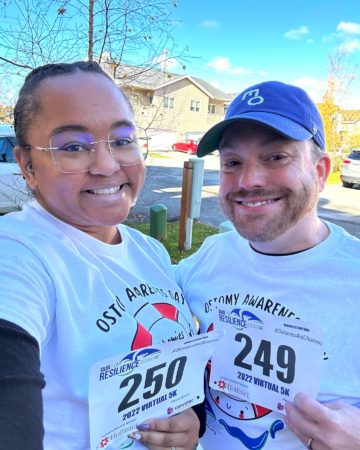
Odmark also joins the couple each Ostomy Awareness Day to walk the Run for Resilience Ostomy 5k. The experience was especially meaningful to Taylor. “The Ostomy 5k was a huge accomplishment the first time I did it because I was three months post op and it was a huge struggle for me to walk a 5k, I almost didn’t finish it and wanted to give up so many times. Taylor continues, “My second time, this year, it was still a hard thing for me to accomplish but I did so much better! I loved seeing people from all over doing their 5k however was comfortable for them. It was encouraging!”


UOAA has been so incredibly important to me in my ostomy journey. -Taylor Mitchell

Taylor is especially open about her ostomy journey and embraces Ostomy Awareness Day as a chance to connect with more people online and see their stories. “It’s such a nice feeling to know that I am not alone. I see people who are confident with their ostomy and I see people who are working to build their confidence,” Taylor says.

Taylor hopes to help even more people and nurses through UOAA outreach opportunities. “I love UOAA’s mission, I love the work they do, and I love all the resources that are available for FREE so financial barriers are removed for as many people as possible. Accessibility is so important! I am proud to be a supporter of UOAA.”

Michael agrees and adds, “I’m very thankful for all of the people that organize the walk, work with ostomates, and are around to help us on our ostomy journey. I’m most thankful for my wife, who I get to take this journey with every day.”


November 16, 2022
https://www.ostomy.org/wp-content/uploads/2022/11/engagement-Taylor-and-Michael-scaled.jpg 1737 2560 Contributor https://www.ostomy.org/wp-content/uploads/2017/02/UOAAlogofinal2.png Contributor2022-11-16 20:47:332022-11-16 20:53:03Destined to Love, Ostomates by Chance

Intimate Moments

Emotional Health, Sexuality

By Ellyn Mantell morethanmyostomy.com

As an advocate and UOAA Affiliated Support Group Leader, I make it very clear that there is no question or concern that is off-topic for me, and I truly believe that since this is our “new normal” it is very important to be open about all aspects of our lives. The question that seems to most concern new ostomates is about their sexual interactions, and how their partner or future partners will react to their unique anatomy. Since I feel that our anatomy is so beautifully functional (as it may not have been for a long time) I encourage ostomates to look at their ostomy in the most positive of lights. Additionally, it is always my belief that intimacy begins and dwells in the mind, rather than the body.

UOAA President Susan Burns had ileostomy surgery at 36 and knows how important being open about intimacy concerns is. “This is a topic that needs to be discussed but is not addressed enough by health care professionals so it is important to read our guide, find peer-support, or a support group member that is comfortable discussing it,” Susan says.

I believe that intimacy is a beautiful gift one gives to another, and sex is only one meaningful part of the intimate moments people share. I also believe that being intimate with another is a means of communication, a sharing, of thoughts and feelings. This positive reflection of our emotions and adoration for our partner is what bolsters a relationship.

For over two decades, my body was in turmoil, and although I wasn’t faced with a pouch on my abdomen, feeling “sexy” was a transient and very much undependable feeling. Bowel obstructions, bloating, worry all interfered with a positive outlook for intimacy. Couple that with a busy life struggling to be productive in between the medical episodes, and my intestine certainly held me hostage.

My 23rd abdominal surgery, my ileostomy, helped me to begin to have a more predictable life. I am comforted in the knowledge that I function differently, but it is dependable. No longer expecting to be hospitalized on a regular basis, I am free to be productive in so many ways…support groups, motivational speaking, my writing, seeing my family and friends.

The key, however, to the conversations I have with ostomates regarding their own intimacy is to be totally candid with them. Here is what I say…if you are blessed to love and adore your partner, who loves and adores you, then you will travel the road to a joyful connection, enjoying the closeness that you share because you are able to do so. You have the ability to dance together and move together as never before, all the while knowing that your bond is even stronger than you ever thought possible. You are amongst those of us who know that intimacy, that beautiful gift we give each other begins in the mind, and the body just follows along.

Editor’s note. For a complete intimacy and sexuality guide that addresses both physical and emotional issues click here. UOAA’s National Conference in August will also have an expert session on sexuality and frank conversations on the topic for ostomates and a separate meeting space for partners.

February 12, 2019
https://www.ostomy.org/wp-content/uploads/2019/02/intimacyweb.jpg 1142 1800 Contributor https://www.ostomy.org/wp-content/uploads/2017/02/UOAAlogofinal2.png Contributor2019-02-12 12:57:302019-02-13 16:02:54Intimate Moments

Our Categories

Advocacy (79) Body Image (3) Caregivers (21) Colorectal Cancer (19) Colostomy (140) Continent Diversions (8) Digital Sponsor (78) Disaster Preparation (4) Emotional Health (63) Events (32) Exercise/Sports (48) Fashion/Clothing (11) Healthcare (23) IBD (56) Ileostomy (188) J-Pouch (8) jejunostomy (7) Membership (3) Nutrition (19) Ostomy 5k (20) Ostomy 5k (16) Ostomy Awareness (55) Ostomy Basics (56) Ostomy News (95) Ostomy Nurse (14) ostomy reversals (13) Ostomy Supplies (3) Ostomy Tips (94) Ostomy Videos (4) Patient Stories (101) Pediatric Ostomy (5) Personal (67) Sexuality (12) Short Bowel Syndrome (17) Skin Care (10) Social Life (5) Support Group News (13) Support Resources (16) Teens (4) Travel (11) UOAA Conference (18) UOAA History (3) UOAA Volunteers (5) Urostomy (113) Young Adult (8)

Support Us:

Your Donation Funds UOAA Educational Programs:

DONATE TODAY
SUSTAINING GIFT
BECOME A MEMBER
UOAA E-NEWS SIGN UP
Get updates on events, national advocacy and important topics in the ostomy and continent diversion community.

Contact Us


United Ostomy Associations of America
P.O. Box 2293
Biddeford, ME 04005-2293

Virtual Ostomy Clinic

Contact UOAA

Donate Your Supplies

Call us toll-free at: 1-800-826-0826.
Our Information Line hours are Monday-Friday, 9am to 3pm EST. If you have an emergency, please dial 911 or contact your local medical professional.

Please understand that UOAA is a private, nonprofit, advocacy and informational organization. We are not a medical facility and we do not have medical or legal professionals on staff. Therefore, UOAA does not provide Medical, Mental Health, Insurance or Legal Advice. Visit UOAA Virtual Ostomy Clinic provided by The Wound Company for non-emergency, virtual ostomy support.

Privacy Policy

Get Involved

UOAA is the leading organization proactively advocating on behalf of the ostomy community. Recognizing that we are always stronger together, we encourage everyone to get involved by joining our Advocacy Network. We’ve also created several Advocacy Tools and Resources to help you successfully advocate on behalf of the ostomy community to ensure every ostomate receives quality care.

UOAA Run for Resilience Logo

UOAA does not and shall not discriminate on the basis of race, color, religion (creed), gender, gender expression, age, national origin (ancestry), disability, marital status, sexual orientation, or military status, in any of its activities or operations.

Digital Health Award
© 2005-2026, UOAA. All Rights Reserved l Design by Tap House Media
  • Link to Facebook
  • Link to X
  • Link to Pinterest
  • Link to LinkedIn
  • Link to Youtube
  • Link to Mail
  • Link to Instagram
Scroll to top Scroll to top Scroll to top