Tag Archive for: body image

When you get an ostomy, most of the advice you’ll hear is practical. It comes in boxes and routines: bags and baseplates, barrier strips and rings. There’s talk of wear time and skin prep, of what to eat and when to empty. These logistics matter, of course; they’re a necessary first step after a major surgery. But beneath this adjustment is often another layer of healing, one that goes beyond the physical.

An ostomy doesn’t just change how your body works. It can also change how you feel inside. It can shift how you see your body, yourself, and your worth, affecting everything from what you wear, to where you go, to how close you let others get. Amid all this change, you might even start to wonder: How could I ever accept myself like this?

For many, life with an ostomy involves the ongoing work of making peace with your body—to meet it not with shame, but with patience, gentleness, and ultimately acceptance. It’s about rebuilding trust with a body that may suddenly feel unfamiliar and allowing that body to once again feel like home.

Body image after ostomy surgery

More than just how you look, body image is about comfort, confidence, and feeling like yourself. Ostomy surgery can profoundly disrupt that sense of self-connection.

A 2018 research review found that poor body image is one of the most common emotional challenges after ostomy surgery. Even when recovery is technically going well—when a WOCN nurse smiles and says, “You’re doing great”—you might hear a voice inside that replies, “Yeah, right,” as waves of self-consciousness or grief roll in.

For many, social stigma only adds weight. Harmful myths that say ostomies are dirty or shameful can take root internally. One study found that nearly half of people with permanent colostomies experience this kind of stigma, which can erode emotional well-being and self-worth.

Even when surrounded by love, you might find yourself hiding. The shirt once worn with pride might get folded away, replaced by oversized clothes chosen more for camouflage than comfort. You might avoid mirrors, not out of vanity, but out of grief for a body that once felt like yours. Intimacy may feel distant, shadowed by the fear of being seen, touched, or rejected.

In all of this, you’re not alone.

What factors shape body image after ostomy surgery?

Body image isn’t fixed; it’s shaped by your history, current circumstances, and how you emotionally process change. Several key factors can influence how someone adjusts:

1. Age and stage of life: Research shows that younger adults often experience greater body image distress after ostomy surgery. This is a time when identity, sexuality, and self-expression are still being shaped—when you’re still learning who you are and how you want to be seen.

In this context, everyday moments can take on new complexity. You may find yourself doing quiet check-ins throughout the day: Is the bag visible? Is it full? Is it leaking? These small, repeated considerations can influence how you move through the world, especially in a culture where bodies with ostomies are rarely represented.

2. Reason for surgery. The reason behind an ostomy may also impact how you adjust to life with it. Even with the same procedure, the emotional meaning is shaped by the life story it enters—and that story can be the lens through which the body is seen.

Research suggests that people who undergo ostomy surgery due to cancer, for instance, may report lower levels of body image distress. While an ostomy can be life-saving in many contexts, cancer survivors may be more likely to see it that way: as a visible mark of survival and strength.

For others, the emotional meaning may feel more complex. When surgery follows years of chronic illness, misdiagnosis, or medical trauma, for example, the experience can carry different associations. Perhaps it’s not triumph, but relief, fatigue, or even resignation. One study found that some participants with inflammatory bowel disease (IBD) viewed their stoma as an embarrassing complication of their condition—something tied more to shame than strength.

But meaning isn’t fixed. With time, support, and self-compassion, your relationship with your ostomy can evolve, no matter the reason behind it.

3. Temporary vs. permanent ostomy. Research also shows that temporary stomas can lead to greater body image distress. When your ostomy isn’t permanent, it can feel like you’re living in a body that doesn’t quite belong to you—just a version you’re passing through. This in-between state can create a kind of psychological limbo: it’s hard to fully grieve what’s been lost and hard to fully accept what is.

While permanent ostomies can bring their own grief, they may also bring a sense of clarity that limbo does not. When you know this is your body now, you may be better equipped to make peace with it.

What can help: Tips for navigating body image after ostomy surgery

1. Find the right ostomy products for you. It’s hard to feel at ease in your body when the products meant to support it don’t feel reliable. Worrying about leaks, irritation, or a poor fit can quietly wear on your confidence. But when your pouching system truly works for you, it can create space for deeper healing and acceptance.

If the medical look or rustling sound of your ostomy pouch makes you feel more self-conscious, know this: not all pouches are the same. Some are designed to move with your body, to bend and stretch as you do. Some fold into a smaller shape that tucks easily under clothes. Some come in colors like black or gray, offering an alternative to a medical beige. Pair these ostomy bags with supporting products like barrier strips and moldable rings, as needed, and you can find a system that fits both your ostomy and your life.

2. Remember what your body is for. After ostomy surgery—after the shock, the healing, and the slow return to everyday life—it’s easy to forget what your body is still doing for you.

It breathes without asking. It heals, even when you’re not watching. It adapts in ways you never expected, creating space for you to live the life you want. Your body allows you to laugh, cry, rest, move, connect, and wake up to a new day. Again and again, that is something worth honoring.

3. Focus on what lights you up. On tough body image days, it can help to shift your focus away from your body. Try asking:

  • What reminds me that I’m still me, despite all I’ve been through?
  • Who or what helps me feel seen beyond how I look?
  • What brings me joy, even for a moment?

Maybe it’s the warmth of your morning tea. A dog’s thumping tail when you pass through the door. A text that says, I get it.

These small lights matter. They can remind you that your life is bigger than managing a stoma, and that you’re here to live in ways that have nothing to do with appearance.

4. Let go of the timeline. Healing isn’t linear. There is no “right” time to feel okay in your body again. No checklist or countdown—just you, moving through it all in your own way, in your own time.

Some days might feel lighter, like body acceptance is just within reach. Other days may stir up discomfort or grief in places you thought had healed. That doesn’t mean you’re failing; it means you’re human. Release the pressure to arrive somewhere quickly and trust that just showing up for yourself is its own kind of progress.

Your body is still worthy after ostomy surgery

After ostomy surgery, your body is not broken. It is changed. It is not less worthy, just newly shaped.

You don’t have to love every part of it. You don’t have to feel grateful all the time. But your body, with its stoma and its pouch, is still here.

It’s still breathing. Still yours. And still deserving of care and peace.

References

Ayaz-Alkaya S. (2019). Overview of psychosocial problems in individuals with stoma: A review of literature. International wound journal16(1), 243–249. https://doi.org/10.1111/iwj.13018

Guo, L., Rohde, J., & Farraye, F. A. (2020). Stigma and disclosure in patients with inflammatory bowel disease. Inflammatory Bowel Diseases, 26(7), 1010–1016. https://doi.org/10.1093/ibd/izz260

Jayarajah, U., & Samarasekera, D. N. (2017). Psychological adaptation to alteration of body image among stoma patients: A descriptive study. Indian Journal of Psychological Medicine, 39(1), 63–68. https://doi.org/10.4103/0253-7176.198944

Mahjoubi, B., Mirzaei, R., Azizi, R., Jafarinia, M., & Zahedi-Shoolami, L. (2012). A cross-sectional survey of quality of life in colostomates: A report from Iran. Health and Quality of Life Outcomes, 10, 136. https://doi.org/10.1186/1477-7525-10-136

Simmons, K. L., Smith, J. A., Bobb, K. A., & Liles, L. L. (2007). Adjustment to colostomy: Stoma acceptance, stoma care self-efficacy and interpersonal relationships. Journal of Advanced Nursing, 60(6), 627–635. https://doi.org/10.1111/j.1365-2648.2007.04446.x

Yuan, J. M., Zhang, J. E., Zheng, M. C., & Bu, X. Q. (2018). Stigma and its influencing factors among Chinese patients with stoma. Psycho-Oncology, 27(6), 1565–1571. https://doi.org/10.1002/pon.4695

Coloplast develops products and services that make life easier for people with intimate healthcare needs. Working closely with the people who use our products, we create solutions that are sensitive to their special needs. Our business includes ostomy care, continence care, advanced wound care, interventional urology, and voice & respiratory care.

Follow Coloplast on InstagramFacebook, and YouTube, or visit us online at https://www.coloplast.us/

Editor’s note: This blog is from a UOAA digital sponsor, Coloplast. Sponsor support along with donations from readers like you help to maintain our website and the free trusted resources of UOAA, a 501(c)(3) nonprofit organization.
Ostomates often struggle with fashion and feel their options are limited. Without a doubt, part of the journey to adjusting to your ostomy is finding ways to dress yourself that is both comfortable and still allows you to express your individuality. This was no different for Deirdre, who felt that her passion for fashion and style were taken away from her after her ostomy procedure.

Fortunately, clothing designers have recognized that women come in all shapes and sizes, so you can now find pants with a variety of waistline heights. This allows you to find a style to fit your body and your needs. For active wear, consider wearing yoga pants or stretch pants to help support the pouch during exercise. You might also try biker-style shorts since they can be worn alone or layered under shorts, exercise pants or other stretch pants.

Part of adjusting to an ostomy also includes finding the right pouching system that fits you as well. With the help of her stoma care nurse, Deirdre found a pouching system that worked for her, and she regained the confidence to go out, go to work, socialize with her friends, and do all the other activities she dreamed of being able to do when she was in the hospital. For Deirdre, fashion and style are important aspects of her life, so having a pouch that works with different outfits allowed her to feel like herself again. Her journey with chronic illness and living with a stoma has become so much more about self-esteem, body image, and loving herself. According to Deirdre, “Once I went out and started getting back to normal life again, no one ever would’ve known that I had a stoma, because the bag was so easy to wear and was hidden under my clothes.”

Deirdre found a discreet pouching system that fit her well and gave her a feeling of security, which helped her regain the confidence to leave the house in skinny jeans, or even sports leggings. Finding a pouching system with the right fit to Deirdre’s body meant having the confidence to socialize again. Although there may be some styles of clothing you want to avoid after surgery, you still have many choices open to you. See which styles you like the best, and which you find most comfortable. Every body is different and finding the right fit can make the difference between confidence and insecurity.


*Deirdre is a Coloplast product user who has received compensation from Coloplast to provide this information. Each person’s situation is unique, so your experience may not be the same. Talk to your healthcare provider about whether this product is right for you.

Call your healthcare provider if you have any medical concerns about managing your ostomy. You may also contact your Coloplast® Care Advisor for product usage and availability questions at 1-877-858-2656.

Prior to use, refer to the product ‘Instructions for Use’ for intended use and relevant safety information.

Editor’s note: This article is from one of our digital sponsors, Coloplast. Sponsor support along with donations from readers like you help to maintain our website and the free trusted resources of UOAA, a 501(c)(3) nonprofit organization.

Following your ostomy surgery, you will no doubt have an adjustment period of figuring out your new routines and schedule. You will be learning about your appliance, how to use it, when to change it, and how it works. Although there may be frustrating and discouraging days, as you get the hang of your body and the newness of it all, you may also find yourself fascinated with your body’s adaptability. Some of the most resilient, inventive and strong people are ostomates who are changing the way people think by helping to reduce shame around ostomies as well as creating networks and communities to encourage and support others in similar situations.

Body Love

We live in a world where we are bombarded on a daily basis by media showing us advertisements of what beauty should be. The unreachable goals are already set, and then you throw in an ostomy? How in the world are we supposed to love our bodies when we feel so different? Building confidence begins with you. It begins with self-love and embracing your uniqueness. This can take time, and giving yourself the time to heal (both literally and figuratively) and come to terms with the changes and the new daily rhythms will go a long way in boosting your confidence. The great thing about confidence is that it is contagious. Others can feel it in the way you talk, walk, and are proud about yourself and your body, and when they sense it, it transforms the way they see you. This doesn’t mean that self-love is easy and immediate, but it does mean that it is a possible and attainable goal. One of the ways to lead yourself into recovery and learning to love your body is to get active. Maybe you love to run, swim, or hike in the mountains, or you’ve always wanted to join a gym but your disease was holding you back from the commitment of it. Have you always wanted to learn an instrument, or join a band? There are amazing people out there with stories of how they overcame their fears, and also how they discovered the right product for their unique lifestyle and activity.

Every body is different and being patient with yourself and your healing process is vital, especially within the first few months. While inspirational stories about others can help to normalize your situation, it is also completely normal to feel discouraged and down at times. If you are feeling extreme discouragement or hopelessness, don’t hesitate to reach out to a licensed therapist or a healthcare professional. It is important to be able to share as honestly as possible about your situation so that you can begin to move forward.

Inspirational Ostomates

If you are looking for some inspiration from fellow ostomates, there are many platforms out there with information to connect you with people and resources. Feeling like you need some encouragement in embracing your body and its changes? This video is full of helpful information as well as inspiring individuals just like you. As you begin to enter the world of other ostomates and hear their stories, not only will you be able to relate with them, you will also find that they are paving the way for others to be confident in their bodies and, in many cases, thankful for their ostomy and appliance. Maybe their stories will be the push you need to reclaim your life and find that confidence that you know you have in you. Don’t just stop there, why not become one of the inspirational stories that someone else undergoing a surgery leading to an ostomy can read about? Embrace your new life and body.

For More information, visit www.coloplast.us.

Editor’s note: This educational article is from one of our digital sponsors, Coloplast. Sponsor support along with donations from readers like you help to maintain our website and the free trusted resources of UOAA, a 501(c)(3) nonprofit organization.

From Imperfection to Perfection

By Ellyn Mantell

My parents came in two different sizes…my father was extra large and my mother was narrow and slim. While it is not unusual for a daughter to model after her mother, I would say that my modeling was extreme. My mother not only was very weight conscious, she was very rigid and restricting of food and drink, and binging was a big part of her life, and as I found out later, unnamed bulimia. Her daily guidelines for foods to be consumed had a critique that usually ended with “remember, Ellyn,” she would repeat, “a moment to the lips, a lifetime to the hips!”

Blueberries, watermelon, and oranges were on her DO NOT EAT list since they had too much sugar. Meat, potatoes, breads were all annotated with what could just as easily have been a skull and cross bone. So as long as I followed her dictum, I would be narrow and slim like her, or so I thought. The problem was, however, that although I inherited her very narrow and slim upper body, I inherited my father’s larger and rounder lower body. Regardless of how much I tried, I was never to be lithe in my legs and hips. College not only brought the “freshman 15,” it brought anorexia and eventually, bulimia. So I lived with an eating disorder that lasted for years, and the reality of body dysmorphia that plagued me for decades. And now, as an ostomate, I am finally grateful and humbled by my beautiful body…because it is an incredibly resilient organism and I am so proud to own it!

For over two decades my strong little body fought through surgeries, hospitalizations, PICC lines, infections, abscesses and lack of bowel motility. And yet, regardless of my physical state, I would expect it to be thin and attractive, fitting into whatever garment I wanted to wear. I never questioned its strength, its ability to weather weeks in the hospitals or the most grueling of tests and procedures. It was never an issue of can I travel alone to Rochester, Minnesota to the Mayo Clinic by myself and stay for two weeks to have bowel retraining. I just wanted to be certain I could exercise, eat “normally” and not put on weight. Regardless of how many scars I had down and across my abdomen from 23 abdominal surgeries, the goal was to fit into my clothes and like what I saw on the scale. Enduring an enteroclysis study (a wire inserted down the nose to be able to see into the small intestine) I steadily focused on what I would allow myself to eat once I was finished. In retrospect, my expectation of my infirmed body to be perfect was abominable, and I would never, ever support anyone I love put that expectation on their body.

And then four years ago, I had my ileostomy, and suddenly, my now very obedient body gave way to an imperfection I was forced to acknowledge. The first time I saw my reflection in the mirror after the surgery, I was horrified. My high-output bag, which is transparent, was reaching down my short frame to my right mid-thigh. But after the shock of my appliance and pouch, I began to relax and look at the possibility that I could have a new life, free of hospitals, surgeries and worry. I began to see the beauty in my stoma, and named it, as many do. Her name is Lily because my mother, Lillian, gave me my first life, and Lily has given me my second.

No longer striving toward an unrealistic goal, I am no so proud of the ability I have to live and love my life. My little body is strong enough to advocate for others; it is strong enough to lead my support group; it is strong enough to visit those suffering in the hospital, and it is strong enough to start a grassroots movement to open our ostomy center, one of the few in New Jersey! On a personal note, I am strong enough to enjoy my beautiful family, my wonderful circle of friends and celebrate each and every day. And I have learned that perfection may never really have been a possibility for me or others, but imperfection makes me very, very happy!

Inclusive Campaign by Lingerie Retailer Puts Ostomy in the Spotlight

By Ed Pfueller, UOAA

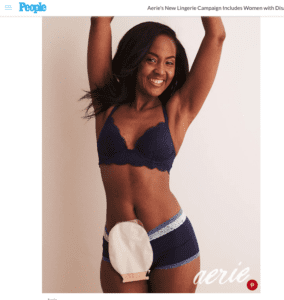
This feels like a moment. For many in the ostomy community seeing that someone with an ostomy has been included as a model, ostomy pouch showing, in a large national retail website was groundbreaking.

The viral #AerieREAL campaign showcased a smiling ostomate alongside other body positive models living with an insulin pump, wheelchair, crutches and conditions such as fibromyalgia and cancer. The brand has long highlighted “real, authentic and unretouched women.” You can find the photos scattered over their product pages.

The model, Gaylyn Henderson, has been sharing her infectious positivity with the ostomy community for years including in a past Ostomy Awareness Day Video produced by UOAA.

Her website Gutless and Glamorous chronicles her life speaking out in support of ostomy and IBD awareness. She was selected for the campaign after submitting a video for an open call for models. Gaylyn has since become a face of the campaign in mainstream media outlets such as People, CNN and Today.

She told Today Style “Having the support of an influential brand like American Eagle to promote positive ostomy awareness has already changed lives, and I know this because of the feedback I am seeing and receiving,” “To have this opportunity is surreal! For Aerie to give me this opportunity, I’m beyond grateful and thankful they would give someone like me a shot.”

The reaction has been uplifting and positive when shared on our Facebook Page and all around the web and social media.

Shaina W This is amazing! I had an ileostomy for 2 years because of ulcerative colitis and seeing this girl model hers with no fear is so incredible. I hope this sort of thing makes it less scary for people to go through this kind of surgery when they need it. I was so scared of how having an ileostomy would change my life that I wouldn’t even consider it for a couple years even though was so sick. This girl is showing how brave and awesome she is and I hope it inspires lots of people. ?

Avigail V Fabulous! As an ostomate, I’m thrilled to see us represented!

Megan H If you read through the comments everyone has been posting in response, it has been a dialogue game changer! People were asking all sorts of questions (which is exactly what those of us promoting ostomy awareness want and need) and expressing tons of positivity! As the mom of two young kids (a 10-year-old daughter and 7-year-old son) with ostomies, I am over the moon with this campaign, even if it’s only in viral form, which for some people, is the only way they get their information.

Many people with an ostomy reading this post have probably already had a friend or family outside the ostomy community email you a news link to these photos. And that proves that it is working, and reaching the audience it needs to.

Want to keep up that momentum? Spread ostomy awareness far and wide and invite everyone you know to celebrate World Ostomy Day this year.

Finding Confidence and Rocking Your Own Style with an Ostomy

By Tricia Hottenstein

I was packing to head out on a short vacation to Atlantic City and had all my outfits ready in my brand new suitcase. But when I went to pack my swimsuit, I started thinking about walking around at a hotel pool with my ostomy bag sticking out. Something about a hotel pool as opposed to just walking on the beach made me uneasy. I figure I don’t know the people on the beach and they’ll never see me again. But in a hotel for several days? Those people would recognize me. They’d see me dressed up for a nice dinner and know that underneath all that jewelry and makeup, there was a person with an ostomy bag glued to their stomach. A person who earlier in the day had a wet ostomy bag sticking out between their swimsuit pieces. And let’s be honest. A wet ostomy bag is a revealing ostomy bag. There’s no questioning what’s hiding inside of it. Something about that wasn’t okay with me.

Generally speaking, I feel pretty confident about my ostomy. It saved my life and I went from a love-hate relationship with it, to a genuine love of it, to more of a state of ignorance that it even exists. I’m not shy about telling people my situation and I will often show it to people who ask questions. But when it comes to swimsuits, the struggle has been a little more mental. I’ve previously tried one-piece suits and I hate them. I hate the way they pull on my bag when they get wet, the way they stick to every crevice of my body, the way I constantly check to make sure my bag isn’t leaking the second it starts to puff up. I tried bikini styles. My body is not made for a bikini, and the more often I wore it, the more sure of this I was. And then, hallelujah! The high-waisted trend hit stores, and I found a happy medium. A high-waisted bottom to cover most of my bag while still allowing it to breathe, and a cute colorful top that would hopefully draw attention away from the bag peeking out from my bottoms.

I love that I didn’t need to strip a whole wet swimsuit off in order to empty my bag, and I could easily flip it out after the pool to dry it off (which is a necessity in order to keep my sensitive skin from getting angry). The high waist also gave multiple coverage options and I could choose when and how my bag would be displayed. I could tuck it into the bottoms and feel secure, or leave it out over top of the suit if need be. I chose to secure my bag slightly flipped up inside the bottoms with just the top sticking out. Now this I could rock. And I did. But around complete strangers who would be seeing me over and over again, while never actually talking to me to understand who I was and what I’ve been through? It bothered me.

I bought a pretty cover-up. I tried on several new suits, but none worked the wonders I’d hoped they would. I even considered stopping on the way to the shore to keep trying. And then the lights of Atlantic City sparkled before me, and the tropical drinks and palm trees were calling me from the pool. So I went for it. I wore the cover-up and walked to the pool. Of course, I got stuck with several people in the elevator and noticed their eyes glancing down, and my fidgeting was more than noticeable.

I walked in the pool room and found a chair in the corner. I ordered a drink, hopped in the hot tub, and looked around. And I noticed every single other female in there looking as insecure as me. Ladies with towels draped around them the second they were out of the water. Women with tee shirts instead of swimsuits. Some just sitting on the outskirts, partially hidden by palm trees, in regular clothing. And suddenly I was okay. Forget this bag on my stomach. Every single person has something about them they don’t always love. I’ve got stretch marks I don’t worry about, and plenty of extra flab that doesn’t bother me. But for some reason I was getting caught up over this little protrusion on my stomach; a scar of a war I fought hard against and finally won. And I love this thing!

I was honestly upset with myself over the few days for the waver in my self-confidence. I got out of the hot tub, walked around to the pool, and held my head up a whole lot higher. And everyone who’s eyes glanced downward? They looked at me genuinely, some smiled. Because people who rock their scars in public have already changed perceptions. Chronic illness is becoming less and less of a taboo subject. We’re shaking the world by the shoulders. And THAT is beautiful.

Tricia Hottenstein blogs about life as a mother and living with an ostomy at stomama.com

Tag Archive for: body image

Nothing Found

Sorry, no posts matched your criteria