United Ostomy Associations of America
  • HOME
  • OSTOMY INFORMATION
    • Ostomy Information
      • What Is An Ostomy?
      • Living with an Ostomy: FAQs
      • Diet + Nutrition
      • Ostomy Skin Care
      • Sexuality
      • Bill Of Rights
      • New Ostomy Patient Guide
    • My Ostomy
      • Ileostomy
      • Colostomy
      • Urostomy
      • J-Pouch
      • Continent Diversions + Other Ostomy Types
      • Temporary Ostomy
      • Short Bowel Syndrome
      • Español
    • Children to Young Adults with Ostomies
      • Infant/Toddler (0-3 Years)
      • Preschool (3-5 Years)
      • Elementary School (6-9 Years)
      • Pre-Adolescent (10-13 Years)
      • Adolescent (14-18 Years)
      • Young Adult (18-25 Years)
      • Parents & Clinicians Resources
      • Know Your Rights
      • What To Expect After Surgery
      • Odor Control
      • Fast Facts
      • Ostomy Game
    • Crohn’s Disease & Ulcerative Colitis Information
      • Defining, Caring and Treating
      • Preparing for Ostomy Surgery
      • Common Issues, Managing Diet, Mental Health
      • Intimacy, Fertility and Pregnancy
      • Resources
    • General Information
      • UOAA Ostomy Marketplace
      • Product + Supply Information
      • UOAA Resources Library
      • Resources for Nurses/Home Health
      • Travel Tips + TSA
      • Donate Your Ostomy Supplies
      • Emergency Supplies
      • Related Links
      • UOAA Virtual Ostomy Clinic
      • Outpatient Ostomy Services Locator
  • SUPPORT
      • discussion
        Ostomy 101:
        Easily communicate “What is an ostomy?" with our infographic.

        Read More

    • Find Support
      • Support Group Finder
      • Support Group Websites
      • UOAA Virtual Ostomy Clinic
      • Online Peer and Ostomy Support Programs
      • Outpatient Ostomy Services Locator
      • Find a Mental Health Provider
      • Find an Ostomy Nurse
      • Online Discussion Board
      • Apps for Ostomates
      • Emotional Concerns
    • Connect With Us
      • Start/Affiliate Your Group With UOAA
      • Resources For ASGs
      • National Membership
      • Sign Up for Our E-Newsletter
    • Participate
      • Attend An Event
      • Become An Advocate
      • Join Us for a Conference
      • Make A Donation
      • Become a Member of The Phoenix Society
      • Donate Your Ostomy Supplies
      • Take A Survey
  • ADVOCACY
      • portal
        Roadmap to Establishing Outpatient Ostomy Services
        Documents that are available as PDFs to download and print.

        Read More

    • About
      • Advocacy Program
      • Advocacy Priorities
      • 10 Questions to Help You Speak Up and Self-Advocate
    • Get Involved
      • Understanding the Medicare Competitive Bidding Program 2025 Ruling
      • Take Action
      • Join Advocacy Network
      • How to Be An Ostomy Champion
      • Ostomy Awareness Day
      • Roadmap to Establishing Outpatient Ostomy Services
    • Tools and Resources Library
      • Non-Medical Switching Resources
      • Ostomy and Continent Diversion Patient Bill of Rights
      • Restroom Access Self-Advocacy Tools
      • Travel Tips + TSA Communication Card
      • Swimming with an Ostomy
      • Mythbusters Infographic
      • Workplace Resources
      • Aging with an Ostomy or CD
    • Take Control of your Healthcare
      • UOAA Virtual Ostomy Clinic
      • Know Your Ostomy Checklist
      • Know Your Ostomy Supplies Checklist
      • Physician Visit Checklist
      • Know Your Health Care Insurance
      • Know Your Pouching System
      • Know What’s in Your Medical Record
  • WHO WE ARE
      • Have a Question for Us?
        UOAA is a 501(c)(3) nonprofit organization that supports, empowers, and advocates for people who have had or who will have ostomy or continent diversion surgery.

        Contact Us

    • About Us
      • Our Mission + History
      • Our Leaders
      • National Sponsors + Partners
      • National Membership
      • Contact Us
    • How We Help
      • Advocacy
      • Awareness
      • Support
      • National Conference
      • Ostomy Nurse Scholarship
    • Get Involved
      • Volunteer
      • Become A Leader
      • Join A Committee
      • Career Opportunities
      • Sign Up for Our E-Newsletter
  • LATEST
  • EVENTS
    • Ostomy Awareness Day
    • Run For Resilience 5K
    • Ostomy Academy
    • Educational Webinars
    • 2025 National Conference
    • Calendar
  • GIVE NOW
  • SEARCH
  • Menu Menu

Tag Archive for: ostomy communication

10 Tips for Intimacy with an Ostomy

Body Image, Colostomy, Digital Sponsor, Emotional Health, Ileostomy, Sexuality, Social Life, Urostomy, Young Adult

Life with an ostomy can stir up deeply vulnerable questions: Will anyone love me like this? Does my ostomy bag make me unattractive? How can I be intimate while managing it? These anxieties often settle in the quieter corners of ostomy life, where many ostomates fear their bodies may never be chosen or desired.

Chloe Olsen has spent her whole life learning what it means to live with an ostomy. In this blog, she draws on more than 20 years of lived experience to share an honest perspective on connection, communication, and confidence. Her insights offer reassurance, perspective, and a reminder to fellow ostomates that they are worthy of love without conditions.

10 tips for intimacy with an ostomy (from a 20+ year ostomate)

Unlike most other ostomates, I never had a “before my ostomy.” I didn’t have to relearn intimacy because I’ve had an ostomy my whole life. This means I learned intimacy with an ostomy bag—first crushes, first touch, first relationships. For me, there was no “before my ostomy” to mourn—just figuring things out in real time like everyone else.

This is the only body I’ve ever been intimate in. Every version of intimacy I’ve ever known has included my ostomy bag. And that’s why I know you don’t owe anyone everything.

This topic in particular is especially important to me because I didn’t grow up seeing bodies like mine being desired or sexualized. I had no idea what intimacy would look like for me because there wasn’t anyone like me out there talking about it. After a lifetime of trial and error, of tender moments and of ones I’d rather forget, I’m sharing my tried and tested intimacy tips for any ostomate who needs straightforward honesty—not sugarcoating.

  1. You don’t owe anyone your medical history.

When meeting someone new, we can sometimes feel obligated to share our medical past. Don’t forget—you get to decide when and how much you share. There were times I would over-explain out of fear, thinking clarity would protect me. It didn’t—boundaries did.

You are not obligated to provide any details you don’t want to share, and this includes any questions you don’t feel comfortable with. A simple explanation is enough.

  1. You get to decide when to tell someone about your ostomy.

The pressure of this used to weigh on me a lot. If I didn’t tell someone soon enough, I would feel as if I were lying to them somehow, like keeping this secret from them was a form of deception. But if I told them right away, it would sometimes change their view of me—or even the way they treated me.

My advice: if you really like someone, tell them about your ostomy bag as soon as possible, as soon as you feel comfortable. Personally, I would always tell them right away, because I find it to be an excellent detector of who isn’t meant to be.

  1. Phrasing is important. Confidence is everything.

If you do decide to tell your intimate partner about your ostomy, your own attitude can make the biggest difference. If you frame it as something positive, like that it gave you your life back, they probably will too! But if you say, “Now I’m forced to live with this for the rest of my life!” it gives your ostomy a negative connotation, and they may be more likely to react negatively as well.

I know it’s easier said than done, but confidence really is everything! If you go in with no fear, as if your ostomy is no big deal, it likely won’t be a big deal to them either.

  1. If someone is uncomfortable, it’s not a reflection of your self-worth.

Not everyone handles it well, and learning not to internalize those reactions took time. But over time, you learn the difference between curiosity and discomfort—and you stop internalizing reactions that don’t belong to you.

Discomfort doesn’t mean you’re undesirable. It means they’re not equipped for your body or your honesty—and that’s not yours to fix.

  1. One-night stands are NOT off the table.

This is one of the biggest things I wish someone had told me! Having only known ostomy life, I let the stigma surrounding it convince me that one-night stands weren’t possible for me—but that’s actually the furthest thing from the truth. Hearing from my close ostomate friends a little bit older than myself, I learned that it’s actually not a big deal. Although it can be scary at first (how would this random stranger react?), one-night stands with an ostomy are not harder, just more intentional. Only share what’s necessary, and prep more so you can think less.

Most importantly, make sure you feel safe. Believe it or not, your ostomy will likely not be their primary focus—in fact, they may not even notice it at all.

  1. Communication is key.

Intimacy isn’t mind-reading, it’s communication—and that goes both ways. At first, I didn’t know how to communicate effectively during intimacy. Partners would assume they could accidentally “break” my bag or hurt me somehow. I learned to speak up for myself through trial, error, and a lot of unlearning silence. Don’t be afraid to just tell them, “I’m not fragile,” or educate them in the moment so they feel comfortable. Communication doesn’t ruin the moment—it makes it possible, and more enjoyable when they better understand your body.

And if they don’t want to take that extra moment of care, then maybe they aren’t worth your time and energy, and that’s your choice to make. Remember—you can always back out or say no.

  1. Prep is not unsexy.

Emptying your ostomy bag beforehand, wearing something that makes you feel secure, maybe even putting on a fresh bag—all these extra steps we take are just taking care of your body, an important part of intimacy. I know it can detract from the spontaneity, but take it from me, you don’t want to risk having a leak during an intimate moment—major mood killer.

Trust me, it’s worth taking the extra time—having peace of mind changes everything.

  1. The right intimacy doesn’t make you feel like your body is a problem.

I’ve felt the difference between being accommodated and being wanted. And once you feel the latter, you stop settling for the former. For too long, I stayed in unhealthy relationships because I didn’t think I deserved better. I believed I was “defective” or “damaged,” and therefore not in a position to be picky or stand up for myself. It took a while, but once I let myself believe that I was worthy to be loved the way I wanted, I never looked back.

You’re not something to tolerate, work around, or “get past.” You’re not less deserving because of your ostomy. You’re the body someone gets to be close to.

  1. Desire without shame.

I grew up feeling a lot of shame around my body, not because of my ostomy, but because of what I was taught to believe about it. In navigating intimacy, I’ve learned that it’s okay to crave it, and it’s okay to communicate your needs.

Desire doesn’t disappear because you have an ostomy or disability—it adapts, like everything else.

  1. There’s no “right” way to do this.

Reminder: You don’t owe intimacy to prove confidence, healing, or normalcy. There’s no timeline for feeling ready. Confidence with intimacy isn’t a finish line. It shifts with age, partners, energy, and life. And that’s normal—ostomy or not. It comes with time and learning to be comfortable in your own body before you can be comfortable with someone else.

If you’re just learning intimacy in your body—you’re not behind, you’re doing it.

Find more support for intimacy with an ostomy on Instagram and in Coloplast’s free e‑book, The Ostomate’s Guide to Intimacy.

Coloplast 
develops products and services that make life easier for people with intimate healthcare needs. Working closely with the people who use our products, we create solutions that are sensitive to their special needs. Our business includes ostomy care, continence care, advanced wound care, interventional urology, and voice & respiratory care.

Chloe is a Coloplast product user who received compensation from Coloplast to provide this information. Each person’s situation is unique, so your experience may not be the same. Talk to your healthcare professional about which product might be right for you.

Follow Coloplast on Instagram, Facebook, and YouTube, or visit us online at https://www.coloplast.us/


Editor’s note: This blog is from a UOAA digital sponsor, Coloplast. Sponsor support along with donations from readers like you help to maintain our website and the free trusted resources of UOAA, a 501(c)(3) nonprofit organization.
February 11, 2026
https://www.ostomy.org/wp-content/uploads/2026/02/Chloe-Olsen-Intimacy-with-an-ostomy.png 550 1000 Contributor https://www.ostomy.org/wp-content/uploads/2017/02/UOAAlogofinal2.png Contributor2026-02-11 10:18:502026-02-11 15:38:3310 Tips for Intimacy with an Ostomy

Do you speak stoma?

Colostomy, Emotional Health, Ileostomy, Ostomy Basics, Ostomy News, Ostomy Tips, Research, Urostomy

A New Guide aims to help you find the right words to talk about your ostomy

By Joga Ivatury, M.D., MHA

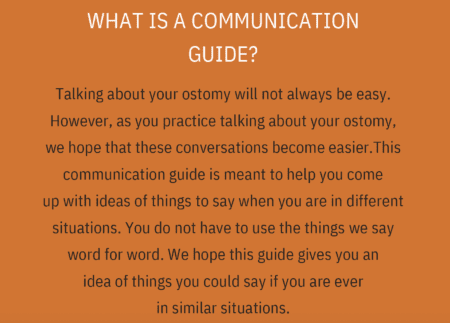
The Speaking Stoma Guide is the first health communication guide for people with ostomies. This work was coproduced through collaboration with ostomates worldwide, UOAA, clinical experts, and health communication experts. This guide is freely available here on UOAA’s website, encompassing 11 communication topics areas including managing pouch leaks, communicating with friends and family, and intimacy.

This work has been inspired by our experience working with ostomates. We recognize that talking about your ostomy will not always be easy. We created the Speaking Stoma Guide to help. We hope this guide gives you an idea of things you could say if you are ever in similar situations and ways to manage challenging social situations that may arise. Each section has a big topic and has different situations that you may experience. In the next section, we will provide a snapshot of situations inspired by real people with ostomies.

Leaks
In this section, we have suggestions for what you might say to help manage the situation based on how much you want to disclose about having an ostomy. These phrases were produced directly from things ostomates told us. For people who did not want to disclose anything about having an ostomy (low disclosure), a person may say, “Can you show me how to get to the bathroom?” For high disclosure, a person may say, “Can you show me how to get to the restroom? My ostomy pouch has leaked and I need to clean up. Would you be able to find me an extra set of clothes? I really appreciate it!” Each section has several suggestions like this.

Talking About Food
With an ostomy, some people have limitations on the food that they can eat. Some ostomates expressed embarrassment when they couldn’t eat the same food everyone else is eating. It’s hard to say “no” whenever someone offers you food. One participant noted that he once told a host on behalf of his wife: “Please don’t take offense. She doesn’t eat these things. It’s not your cooking.” For higher disclosure, a person may say “Thank you so much for inviting me. After my surgery I’m still figuring out the foods that make me feel best, so I ate before I came. Everything looks delicious!” In general, there are many people with and without ostomies that have dietary restrictions.

Public Restrooms
What do you do when you need to use a public restroom to care for your ostomy and there is a long line! For low disclosure, you may consider saying: “Excuse me, I have an emergency and need to get to a restroom right now.” This does not reveal anything to strangers except the urgent need. For higher disclosure, you may reveal the presence of your ostomy and the rapid need for its care. People in line can be helpful too. One of our participants recalls how a stranger helped her get to the front of the line during a pouch leak.

Talking to Friends and Family
Time with friends and family are vital to everyone. How do you address having an ostomy with them? Some of our participants suggested having a “code name” for the ostomy that they can use with their family and friends to talk it in public. Unfortunately, some people have disparaging comments or jokes about ostomies once they know about it. Some ostomates use humor back to deflect the situation. It is also ok to say: “I am not really comfortable joking about my ostomy like that, but I am glad you will be willing to help if I need it. I really appreciate it.”

Noises
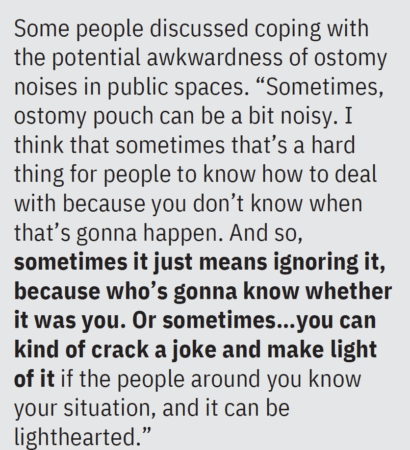
Noises happen! People with ostomies have no control of when they happen. In the beginning, our participants noted that they felt awkward about the noises their ostomies made. It helped people to remember that no one knows that the noises came from the ostomy. It is ok to say nothing (low disclosure). It is also ok to say: “Excuse me, I have an ostomy pouch and sometimes it makes noises” (medium disclosure).



Sex and Intimacy
Some people are not sure when or how to tell a romantic partner about their ostomy. There is no right or wrong time. Some people may choose to tell someone immediately, while other people might wait to tell the person until they know the person better. Your comfort is what is most important. We have suggestions and real-life testimonies in the guide related to speaking about sex and intimacy while having an ostomy.

Talking to Clinicians
We also go through ways to manage different levels of challenging social situations or what we term as “difficulty.” For example, you are in a clinical visit with a new physician who is not familiar with ostomies. Our participants universally encountered this situation. They noted that they often are the most knowledgeable person about ostomies in a clinical visit. In the guide we provide some easy to remember suggestions about how to manage this situation and others.

What’s Next?
We are scientists and this work does not end here. We are actively working to obtain funding to test this guide to see if it makes a difference for people with ostomies. We have also translated the guide into Spanish and are pilot testing it with people who prefer to speak in Spanish. Our experiences with major grant organizations, however, has been underwhelming to say the least. Some reviewers talk about “osteotomies” (surgically created bone holes) instead of ostomies demonstrating their complete lack of basic understanding. Other reviewers assumed that existing information already contained a wealth of communication-related information for ostomates. Despite these, we are undeterred and will keep pushing forward for funding. We would appreciate any support for this work from anyone including the ostomy community, ostomy pouch manufacturers, and local/state health agencies to keep the momentum going! We would also appreciate your feedback on the Speaking Stoma Guide. Please feel free to email me at jivatury@austin.utexas.edu.

Joga Ivatury, M.D., MHA, is an associate professor of surgery Dell Medical School and the inaugural chief of colon and rectal surgery at UT Health Austin. The Speaking Stoma Project was funded through the Communication for Health, Empathy, and Resilience Grant Program and created in partnership with Dell Medical School and the Center for Health Communication at The University of Texas at Austin.

April 4, 2024
https://www.ostomy.org/wp-content/uploads/2024/04/Screenshot-2024-04-04-at-1.13.55-PM.png 486 1248 Contributor https://www.ostomy.org/wp-content/uploads/2017/02/UOAAlogofinal2.png Contributor2024-04-04 14:32:192024-04-04 14:32:19Do you speak stoma?

Our Categories

Advocacy (78) Caregivers (19) Colorectal Cancer (19) Colostomy (138) Continent Diversions (8) Digital Sponsor (77) Disaster Preparation (4) Emotional Health (61) Events (32) Exercise/Sports (47) Fashion/Clothing (11) Healthcare (21) IBD (52) Ileostomy (181) J-Pouch (7) jejunostomy (7) Membership (3) Nutrition (19) Ostomy 5k (19) Ostomy 5k (15) Ostomy Awareness (55) Ostomy Basics (55) Ostomy News (94) Ostomy Nurse (13) ostomy reversals (12) Ostomy Supplies (2) Ostomy Tips (93) Ostomy Videos (4) Patient Stories (96) Pediatric Ostomy (4) Personal (63) Research (3) Sexuality (12) Short Bowel Syndrome (16) Skin Care (9) Social Life (5) Support Group News (12) Support Resources (15) Teens (3) Travel (11) UOAA Conference (17) UOAA History (3) UOAA Volunteers (3) Urostomy (111) Young Adult (7)

Support Us:

Your Donation Funds UOAA Educational Programs:

DONATE TODAY
SUSTAINING GIFT
BECOME A MEMBER
UOAA E-NEWS SIGN UP
Get updates on events, national advocacy and important topics in the ostomy and continent diversion community.

Contact Us


United Ostomy Associations of America
P.O. Box 2293
Biddeford, ME 04005-2293

Virtual Ostomy Clinic

Contact UOAA

Donate Your Supplies

Call us toll-free at: 1-800-826-0826.
Our Information Line hours are Monday-Friday, 9am to 3pm EST. If you have an emergency, please dial 911 or contact your local medical professional.

Please understand that UOAA is a private, nonprofit, advocacy and informational organization. We are not a medical facility and we do not have medical or legal professionals on staff. Therefore, UOAA does not provide Medical, Mental Health, Insurance or Legal Advice. Visit UOAA Virtual Ostomy Clinic provided by The Wound Company for non-emergency, virtual ostomy support.

Privacy Policy

Get Involved

UOAA is the leading organization proactively advocating on behalf of the ostomy community. Recognizing that we are always stronger together, we encourage everyone to get involved by joining our Advocacy Network. We’ve also created several Advocacy Tools and Resources to help you successfully advocate on behalf of the ostomy community to ensure every ostomate receives quality care.

UOAA Run for Resilience Logo

UOAA does not and shall not discriminate on the basis of race, color, religion (creed), gender, gender expression, age, national origin (ancestry), disability, marital status, sexual orientation, or military status, in any of its activities or operations.

Digital Health Award
© 2005-2026, UOAA. All Rights Reserved l Design by Tap House Media
  • Link to Facebook
  • Link to X
  • Link to Pinterest
  • Link to LinkedIn
  • Link to Youtube
  • Link to Mail
  • Link to Instagram
Scroll to top Scroll to top Scroll to top