United Ostomy Associations of America
  • HOME
  • OSTOMY INFORMATION
    • Ostomy Information
      • What Is An Ostomy?
      • Living with an Ostomy: FAQs
      • Diet + Nutrition
      • Ostomy Skin Care
      • Sexuality
      • Bill Of Rights
      • New Ostomy Patient Guide
    • My Ostomy
      • Ileostomy
      • Colostomy
      • Urostomy
      • J-Pouch
      • Continent Diversions + Other Ostomy Types
      • Temporary Ostomy
      • Short Bowel Syndrome
      • Español
    • Children to Young Adults with Ostomies
      • Infant/Toddler (0-3 Years)
      • Preschool (3-5 Years)
      • Elementary School (6-9 Years)
      • Pre-Adolescent (10-13 Years)
      • Adolescent (14-18 Years)
      • Young Adult (18-25 Years)
      • Parents & Clinicians Resources
      • Know Your Rights
      • What To Expect After Surgery
      • Odor Control
      • Fast Facts
      • Ostomy Game
    • Crohn’s Disease & Ulcerative Colitis Information
      • Defining, Caring and Treating
      • Preparing for Ostomy Surgery
      • Common Issues, Managing Diet, Mental Health
      • Intimacy, Fertility and Pregnancy
      • Resources
    • General Information
      • UOAA Ostomy Marketplace
      • Product + Supply Information
      • UOAA Resources Library
      • Resources for Nurses/Home Health
      • Travel Tips + TSA
      • Donate Your Ostomy Supplies
      • Emergency Supplies
      • Related Links
      • UOAA Virtual Ostomy Clinic
      • Outpatient Ostomy Services Locator
  • SUPPORT
      • discussion
        Ostomy 101:
        Easily communicate “What is an ostomy?" with our infographic.

        Read More

    • Find Support
      • Support Group Finder
      • Support Group Websites
      • UOAA Virtual Ostomy Clinic
      • Online Peer and Ostomy Support Programs
      • Outpatient Ostomy Services Locator
      • Find a Mental Health Provider
      • Find an Ostomy Nurse
      • Online Discussion Board
      • Apps for Ostomates
      • Emotional Concerns
    • Connect With Us
      • Start/Affiliate Your Group With UOAA
      • Resources For ASGs
      • National Membership
      • Sign Up for Our E-Newsletter
    • Participate
      • Attend An Event
      • Become An Advocate
      • Join Us for a Conference
      • Make A Donation
      • Become a Member of The Phoenix Society
      • Donate Your Ostomy Supplies
      • Take A Survey
  • ADVOCACY
      • portal
        Roadmap to Establishing Outpatient Ostomy Services
        Documents that are available as PDFs to download and print.

        Read More

    • About
      • Advocacy Program
      • Advocacy Priorities
      • 10 Questions to Help You Speak Up and Self-Advocate
    • Get Involved
      • Understanding the Medicare Competitive Bidding Program 2025 Ruling
      • Take Action
      • Join Advocacy Network
      • How to Be An Ostomy Champion
      • Ostomy Awareness Day
      • Roadmap to Establishing Outpatient Ostomy Services
    • Tools and Resources Library
      • Non-Medical Switching Resources
      • Ostomy and Continent Diversion Patient Bill of Rights
      • Restroom Access Self-Advocacy Tools
      • Travel Tips + TSA Communication Card
      • Swimming with an Ostomy
      • Mythbusters Infographic
      • Workplace Resources
      • Aging with an Ostomy or CD
    • Take Control of your Healthcare
      • UOAA Virtual Ostomy Clinic
      • Know Your Ostomy Checklist
      • Know Your Ostomy Supplies Checklist
      • Physician Visit Checklist
      • Know Your Health Care Insurance
      • Know Your Pouching System
      • Know What’s in Your Medical Record
  • WHO WE ARE
      • Have a Question for Us?
        UOAA is a 501(c)(3) nonprofit organization that supports, empowers, and advocates for people who have had or who will have ostomy or continent diversion surgery.

        Contact Us

    • About Us
      • Our Mission + History
      • Our Leaders
      • National Sponsors + Partners
      • National Membership
      • Contact Us
    • How We Help
      • Advocacy
      • Awareness
      • Support
      • National Conference
      • Ostomy Nurse Scholarship
    • Get Involved
      • Volunteer
      • Become A Leader
      • Join A Committee
      • Career Opportunities
      • Sign Up for Our E-Newsletter
  • LATEST
  • EVENTS
    • Ostomy Awareness Day
    • Run For Resilience 5K
    • Ostomy Academy
    • Educational Webinars
    • 2025 National Conference
    • Calendar
  • GIVE NOW
  • SEARCH
  • Menu Menu

Tag Archive for: colostomy bag

UOAA Supports Colorectal Cancer Survivors

Advocacy, Colorectal Cancer, Colostomy, Ileostomy, Ostomy Basics, Ostomy News, ostomy reversals, Support Resources

By Cheryl Ory, UOAA President

While advances in cancer treatments rise the news on colorectal cancer has been alarming. Colorectal Cancer is the 2nd leading cause of cancer death in the U.S. and the number one cancer killer of people under the age of 50 according to the American Cancer Society.

The deaths this year of the beloved actors James Van Der Beek and Catherine O’Hara have brought more awareness to colorectal cancer. Hopefully the spotlight during this National Colorectal Cancer Awareness Month continues to encourage more people to be screened. UOAA stands alongside partner organizations like Fight Colorectal Cancer to push lawmakers into giving more funding and attention to what is a colorectal cancer crisis.

United Ostomy Associations of America (UOAA) has been supporting cancer survivors and others living with an ostomy for over twenty years so that they can have the best quality of life possible. If your cancer requires life savings ostomy surgery, remember – you are not alone. UOAA estimates that between 725,000 to 1 million people in the U.S. of all ages and backgrounds are living with an ostomy, and over 100,000 ostomy surgeries are performed each year.

UOAA President Cheryl Ory at the Fight Colorectal Cancer United in Blue Rally in Washington, D.C. in 2024.

In 2008 I was diagnosed with Stage 3b colorectal cancer. I was told the cancer had been developing for at least 10 years or more, most likely when I was in my early 30’s. There was a polyp, if it had been removed at an earlier date the cancer would not have developed. After radiation, chemo, surgery, and more chemo I am now a colorectal cancer survivor with a permanent colostomy, an ostomy that has saved mine and others lives from not only cancer, but other debilitating diseases.

If you are a person still at risk, like those with IBD, let me urge you to get screened. Screening can result in any colorectal cancers being found earlier when they are easier to treat.

Every individual person’s disease treatment is unique but ostomy surgery for colorectal cancer may mean a temporary ostomy, ileostomy (from the small intestine) or colostomy (large intestine). This may be required to give a portion of the bowel a chance to rest and heal. When healing has occurred, the colostomy can often be reversed and normal bowel function restored.  It’s important to know that not everyone with an ostomy will be a candidate for a reversal operation. A permanent colostomy may be required when a disease affects the end part of the colon or rectum.

We have two guides written from a patient’s perspective, Living with a Colostomy and Living with an Ileostomy, to help you learn as much as possible before and after you have this life changing surgery.

It’s especially important to connect with one of hundreds of  UOAA Affiliated Ostomy Support Groups in the U.S. before, or shortly after, your surgery. Even online peer support and preparation can put you on the path to success in what may be a challenging time both emotionally and physically.  Ask if the hospital has a certified ostomy nurse and insist on having your stoma placement marked before surgery. These and other self-advocacy tools are paramount and outlined in our Ostomy Patient Bill of Rights.

You may feel too overwhelmed as you are discharged at the hospital to fully understand ostomy pouching systems and accessories and lifestyle considerations.

As you recover, if you have a descending or sigmoid colostomy you may want to ask your doctor or ostomy nurse if you are a candidate for colostomy irrigation. I utilize colostomy irrigation, which is similar to an enema, as a way to have control over my output schedule that fits my lifestyle. UOAA seeks to raise more awareness for the practice and encourages medical professionals to discuss this treatment option with patients who may benefit.

If you have a  medical question contact your doctor or ostomy nurse. If you need help finding an ostomy nurse use or our outpatient ostomy clinic finder or make plans online with a virtual ostomy clinic. If you have a quality of life question-UOAA resources here at ostomy.org and peers at UOAA Affiliated Support Groups likely have the answers.

It’s important to learn the facts about living with an ostomy. After the healing period outlined by your surgeon you can swim, bathe, be intimate, travel, and embrace a new normal life. After some trial and error, you may also eat most of the foods you have been able to eat in the past. Education is key to battling misinformation.

Unfortunately misinformation and stigmas surrounding both ostomy surgery and colorectal cancer affect the number of people getting screened or getting the medical treatment they need.  Let’s work together to educate, advocate and support survivors.


Cheryl Ory is a colorectal cancer survivor who received a permanent colostomy in 2008. Cheryl is a Registered Nurse who has had a passion for volunteering with the ostomy community ever since and first joined UOAA’s Board of Directors in 2015. She now holds the position of President.


March 2, 2026
https://www.ostomy.org/wp-content/uploads/2026/03/colorectal-cancer-survivors.png 788 940 Contributor https://www.ostomy.org/wp-content/uploads/2017/02/UOAAlogofinal2.png Contributor2026-03-02 13:11:302026-03-10 23:26:39UOAA Supports Colorectal Cancer Survivors

Tips for Choosing the Right Ostomy Supplies

Colostomy, Ileostomy, Ostomy Basics, Ostomy Supplies, Ostomy Tips, Skin Care, Urostomy

Navigating the world of ostomy products and supplies can feel overwhelming, but finding the right system and products are crucial for comfort and security.

The appropriate pouch is determined by a number of factors says certified ostomy nurse Linda Coulter. “First the pouch must be appropriate for the type of stoma and

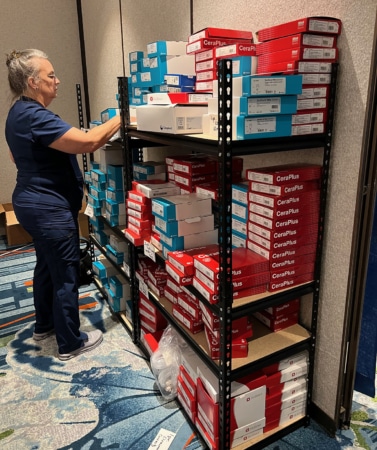
A nurse selects ostomy product samples donated by a wide variety of manufacturers for the stoma clinic at UOAA’s 9th National Conference.

output (e.g. don’t use a urostomy pouch for a colostomy/ileostomy and vice-versa). Stoma characteristics such as size, protrusion, and surrounding contour (e.g. scars, creases, bulges, etc.) also affect pouch choice.”

Other factors, such as an individual’s lifestyle and dexterity play a role.

Here’s some helpful tips whether you are just out of the hospital or you’re having new issues and wondering if you should try something new.

Get Professional Help and Sample Supplies

  • Always consult with an ostomy nurse first for information and recommendations tailored to your body and stoma type. If you’re having trouble with your current system, such as skin irritation or recurrent leaks, ask them to help you find a solution and assist in getting it prescribed. Find an ostomy nurse available in-person or virtually or an Outpatient Ostomy Clinic near you.
  • Remember that every person is different, and you need to find what works best for you. People in online discussions don’t always say their ostomy type ileostomy, colostomy, urostomy and that is key to know what type of supplies to use.
  • Expect some trial and error. It’s common to try several types of products until you find what works best. You can request product samples from manufacturers or a supplier that works with your insurance company. Talk with members of a UOAA Affiliated Support Group, many have a supply closet where members share excess supplies.

Picking an Ostomy Pouching System

You’ll hear the terms appliance, ostomy pouch system, ostomy pouch, or ostomy bag. They are all just referring to a device consisting of pouch and a skin barrier (wafer, baseplate or faceplate) that sticks to and protects the skin around the stoma.

Understanding the terminology will help you communicate your needs effectively. “When possible, patient preference is taken into account for things like 1-piece vs 2-piece systems, clear vs opaque pouches, and pouch brand,” says Linda Coulter, BSN, RN, CWOCN.

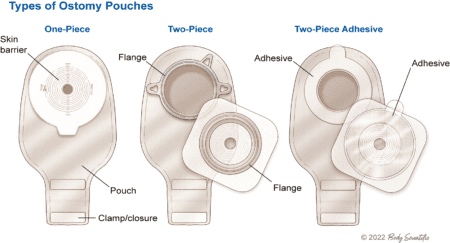
Types of ostomy bags or pouches ileostomy

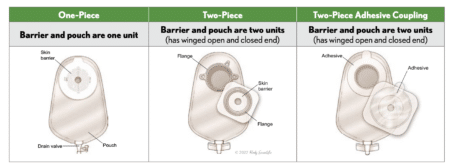
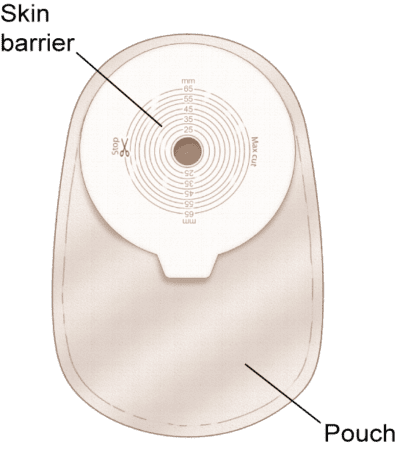
  •  One-piece system: The skin barrier/wafer and pouch are pre-attached. When you change the pouch, you change the whole thing (including the barrier).
    Why people choose it: Simple application and use, low profile under clothing, hernia or bulge near stoma, affordability.
  • Two-piece pouching system: A two-piece system lets you change the pouch while keeping the skin barrier/wafer in place. The pouch attaches to the barrier through a flange/coupling (often a snap-style ring or possibly an adhesive connection).Why people choose it: Versatility. Can easily switch between higher capacity or shorter pouch. Allows pouch to be changed more frequently than the skin barrier. Skin barrier stays in place while pouch is changed, best for higher stoma output, skin sensitivities, fast pouch changing.

Types of Urostomy Pouches

Pouch Closures

  • Drainable (open-ended): You can empty these while they are still attached. Colostomy or ileostomy pouches: use tail closures or separate plastic
    Colostomy Bag One-Piece

    Colostomy Pouch One-Piece Closed End

    clamps/clips. Urostomy pouches (urine): use a valve or “tap closure”. As the name implies, high-output pouches are designed to hold larger volume ileostomy output (rarely colostomy) and have tap closures.
    Why people may choose it: Have output throughout the day requiring pouch to be emptied 3 or more times per day, quick and easy to empty.

  • Closed-end: These are sealed at the bottom and typically discarded after one use. They are most commonly used by colostomates who have regular elimination patterns or can irrigate. Insurance usually covers up to 2-closed pouches per day.
    Why people may choose it: Can remove and throw it away, no draining or clamps.

Other Pouch Choices

Pouch options can include filtered (for automatic gas release and odor) or unfiltered (best with thick stool). Clear pouches are available to monitor output or color and opaque pouches for those who prefer not to see it. A variety of sizes are available depending on output and lifestyle. Urostomates often attach their pouch to an additional drainage bag or container at nighttime.

Skin Barriers

Picking the best skin barrier is critical since it protects the skin around the stoma and enables a secure seal and fit. Your choice depends on your stoma, output, and other factors, such as sensitivity. Frequent changers may ask about gentle adhesion options while those with liquid output may require a stronger adhesion. If your stoma size is changing or oval you may want to get cut-to-fit or moldable skin barriers while, if it is stable and round, pre-sized are a convenient option.

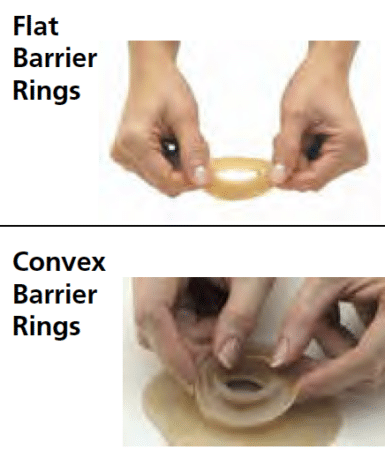
  • Flat: Flat barriers sit level on the skin. Why people may choose it: When the stoma sticks out, pouching with hernia or creases.
  • Convex: Refers to a curved skin barrier (or a system/insert that creates this curve) which helps press inward on the skin next to the stoma. This can help the stoma protrude outward, which helps output go into the pouch instead of leaking under the barrier. There are a variety of depths and flexibilities available.
    Why people may choose it: When the stoma does not stick out enough, or soft tissue, skin folds/creases.

Ostomy Accessories

Depending on the person and stoma type, accessories include products such as cleaning wipes, adhesive removers, stoma powder (pectin-based, non-medicated), stoma paste or barrier ring (provides a seal around the stoma), stoma belt, scissors, wafer extenders, skin protectant wipes, and lubricating deodorant. These products can improve wear time, skin condition, and overall pouching experience.

Ask an ostomy nurse what may be helpful for you.

As you explore different ostomy products and supplies, UOAA’s Ostomy Marketplace Directory can be a helpful place to discover ostomy-related vendors, pouching systems, accessories, clothing, support resources, and more. Browse the directory to learn about available products and connect with companies serving the ostomy community.

UOAA’s Ostomy Marketplace Directory

Keeping Track of it All

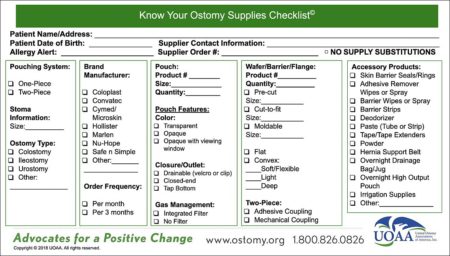
Know Your Ostomy Supplies Checklist

Know your ostomy pouching system and supplies. Once you’ve found the supplies working best for you be sure to keep track of the names, sizes and order numbers. Download the UOAA Know Your Ostomy Supplies Checklist tool to have handy as you work with your ostomy nurse, doctor, supplier or insurance to get the ostomy pouching system and accessories you need.


 Blog by Ed Pfueller, UOAA Director of Strategic Communications with medical review by Linda Coulter, BSN, RN, CWOCN

February 6, 2026
https://www.ostomy.org/wp-content/uploads/2026/02/Choosing-Ostomy-supplies-blog.png 720 1280 Contributor https://www.ostomy.org/wp-content/uploads/2017/02/UOAAlogofinal2.png Contributor2026-02-06 16:37:192026-05-27 13:44:14Tips for Choosing the Right Ostomy Supplies

Embracing Life After Surgery 

Caregivers, Colostomy, Emotional Health, Ostomy Tips, Patient Stories, Personal

Before cancer came into my life, I was a very social person. My various professional ventures along with the diverse group of friends kept me on the go. Even though I dealt with anxiety it was mild enough that I was still a social butterfly.  

I was diagnosed with anal cancer on May 5, 2015, that’s Cinco de Mayo. We had the day planned, going to the groceries for Taco & Nacho Day. Watch mindless shows and spend the day together.  

Much like others like me, your caregiver becomes your world.

We were three years into our relationship, and this was not on our Bingo card of relationships… Or was it? That whole summer was spent in bed or on the couch sleeping. I couldn’t stand a lot of smells or people- so not much socializing.  

Much like others like me, your caregiver becomes your world. You are dependent on them for food, medical needs, and conversation. Chrisitan, my boyfriend, was all that and more. He was also my punching bag and took all my frustration and honestly, I don’t know where he put that energy.

It made our relationship stronger; it tested the relationship and us. He also helped me get back into the real world easier although it takes the caregiver longer to step out of his role. I don’t know if they ever leave completely.  

It took almost six months to decide or be convinced for the ostomy surgery. I had done hyperbaric chamber treatment, and we were hoping things would heal. We expected a miracle. My sphincter would not grow back.  

Diapers were not very convenient for work. I traveled quite a bit and changing on the go was a pain in the butt. Those changing tables in the bathroom don’t hold an adult! I finally picked a date for the surgery.  

My surgery was scheduled for April 1, 2016. If that date sounds familiar it’s because it’s April Fool’s Day. Yes, my surgery was a joke, and I wasn’t laughing. I didn’t have a mentor, buddy or a nurse to tell me what to do. My brain was in constant conflict between I don’t want anyone to see me, and I need to get back out in front of people. I wanted to act, public speak, or at best go shopping and try on clothes.

Go through the feelings and emotions. I denied that anything happened, got very angry, negotiated with my higher power, still dealt with a bit of depression, and I’ve accepted that this is my reality. It has allowed me to move forward faster.  

When I first started to go out in public, I would use surgical tape and bind my bag down. I was sure that if I taped it hard enough it would go away. I felt so self-conscious that I would wear shirts one size larger.

Then one day, in a support group, I heard about wraps. I had to look up this miracle device that would give me back my manly figure. As if they were security secrets that you had to find through a scavenger hunt.

I felt confident, strong, and back to me… Kinda. I felt like a piggy bank and that everyone was looking at my belly. Finally, Tommy the Ostomy and I had worked out the kinks, made peace, and became frenemies… Kinda.

Eight years later I am out more, I travel more, and still panic a bit. Tommy still manages to surprise me from time to time. Almost every day I put on my belly-bra to keep things tight and snug, and I watch my weight so things don’t pop out.

I still get panic attacks, I still think everyone is looking at me, and I still think I’ll wake up and It’ll be gone. Except I have more self-esteem, I share my story, and I look great in a tight shirt and jeans!

If I could share any words of wisdom if a new ostomate it would be go hunting online for patient stories and trusted information like this website. Find a support group and ask as many questions as pop in your head. Some things you’ll learn on your own but we’re here to help.

Another thing, go through the feelings and emotions. I denied that anything happened, got very angry, negotiated with my higher power, still dealt with a bit of depression, and I’ve accepted that this is my reality. It has allowed me to move forward faster.  

June 13, 2024
https://www.ostomy.org/wp-content/uploads/2024/06/daniel-2.jpeg 1720 1721 Contributor https://www.ostomy.org/wp-content/uploads/2017/02/UOAAlogofinal2.png Contributor2024-06-13 11:16:342024-06-13 11:16:34Embracing Life After Surgery 

Do you speak stoma?

Colostomy, Emotional Health, Ileostomy, Ostomy Basics, Ostomy News, Ostomy Tips, Research, Urostomy

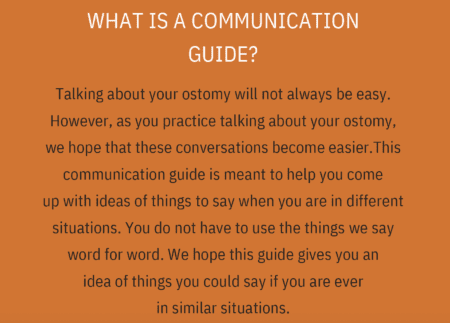
A New Guide aims to help you find the right words to talk about your ostomy

By Joga Ivatury, M.D., MHA

The Speaking Stoma Guide is the first health communication guide for people with ostomies. This work was coproduced through collaboration with ostomates worldwide, UOAA, clinical experts, and health communication experts. This guide is freely available here on UOAA’s website, encompassing 11 communication topics areas including managing pouch leaks, communicating with friends and family, and intimacy.

This work has been inspired by our experience working with ostomates. We recognize that talking about your ostomy will not always be easy. We created the Speaking Stoma Guide to help. We hope this guide gives you an idea of things you could say if you are ever in similar situations and ways to manage challenging social situations that may arise. Each section has a big topic and has different situations that you may experience. In the next section, we will provide a snapshot of situations inspired by real people with ostomies.

Leaks
In this section, we have suggestions for what you might say to help manage the situation based on how much you want to disclose about having an ostomy. These phrases were produced directly from things ostomates told us. For people who did not want to disclose anything about having an ostomy (low disclosure), a person may say, “Can you show me how to get to the bathroom?” For high disclosure, a person may say, “Can you show me how to get to the restroom? My ostomy pouch has leaked and I need to clean up. Would you be able to find me an extra set of clothes? I really appreciate it!” Each section has several suggestions like this.

Talking About Food
With an ostomy, some people have limitations on the food that they can eat. Some ostomates expressed embarrassment when they couldn’t eat the same food everyone else is eating. It’s hard to say “no” whenever someone offers you food. One participant noted that he once told a host on behalf of his wife: “Please don’t take offense. She doesn’t eat these things. It’s not your cooking.” For higher disclosure, a person may say “Thank you so much for inviting me. After my surgery I’m still figuring out the foods that make me feel best, so I ate before I came. Everything looks delicious!” In general, there are many people with and without ostomies that have dietary restrictions.

Public Restrooms
What do you do when you need to use a public restroom to care for your ostomy and there is a long line! For low disclosure, you may consider saying: “Excuse me, I have an emergency and need to get to a restroom right now.” This does not reveal anything to strangers except the urgent need. For higher disclosure, you may reveal the presence of your ostomy and the rapid need for its care. People in line can be helpful too. One of our participants recalls how a stranger helped her get to the front of the line during a pouch leak.

Talking to Friends and Family
Time with friends and family are vital to everyone. How do you address having an ostomy with them? Some of our participants suggested having a “code name” for the ostomy that they can use with their family and friends to talk it in public. Unfortunately, some people have disparaging comments or jokes about ostomies once they know about it. Some ostomates use humor back to deflect the situation. It is also ok to say: “I am not really comfortable joking about my ostomy like that, but I am glad you will be willing to help if I need it. I really appreciate it.”

Noises
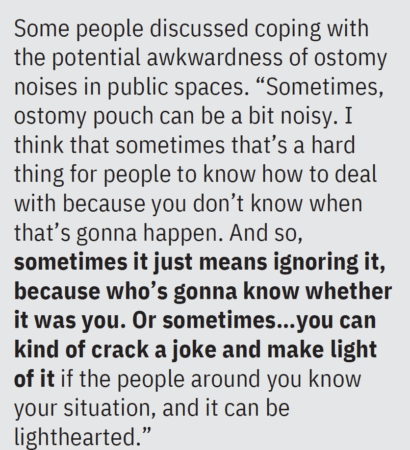
Noises happen! People with ostomies have no control of when they happen. In the beginning, our participants noted that they felt awkward about the noises their ostomies made. It helped people to remember that no one knows that the noises came from the ostomy. It is ok to say nothing (low disclosure). It is also ok to say: “Excuse me, I have an ostomy pouch and sometimes it makes noises” (medium disclosure).

Sex and Intimacy
Some people are not sure when or how to tell a romantic partner about their ostomy. There is no right or wrong time. Some people may choose to tell someone immediately, while other people might wait to tell the person until they know the person better. Your comfort is what is most important. We have suggestions and real-life testimonies in the guide related to speaking about sex and intimacy while having an ostomy.

Talking to Clinicians
We also go through ways to manage different levels of challenging social situations or what we term as “difficulty.” For example, you are in a clinical visit with a new physician who is not familiar with ostomies. Our participants universally encountered this situation. They noted that they often are the most knowledgeable person about ostomies in a clinical visit. In the guide we provide some easy to remember suggestions about how to manage this situation and others.

What’s Next?
We are scientists and this work does not end here. We are actively working to obtain funding to test this guide to see if it makes a difference for people with ostomies. We have also translated the guide into Spanish and are pilot testing it with people who prefer to speak in Spanish. Our experiences with major grant organizations, however, has been underwhelming to say the least. Some reviewers talk about “osteotomies” (surgically created bone holes) instead of ostomies demonstrating their complete lack of basic understanding. Other reviewers assumed that existing information already contained a wealth of communication-related information for ostomates. Despite these, we are undeterred and will keep pushing forward for funding. We would appreciate any support for this work from anyone including the ostomy community, ostomy pouch manufacturers, and local/state health agencies to keep the momentum going! We would also appreciate your feedback on the Speaking Stoma Guide. Please feel free to email me at jivatury@austin.utexas.edu.

Joga Ivatury, M.D., MHA, is an associate professor of surgery Dell Medical School and the inaugural chief of colon and rectal surgery at UT Health Austin. The Speaking Stoma Project was funded through the Communication for Health, Empathy, and Resilience Grant Program and created in partnership with Dell Medical School and the Center for Health Communication at The University of Texas at Austin.

April 4, 2024
https://www.ostomy.org/wp-content/uploads/2024/04/Screenshot-2024-04-04-at-1.13.55-PM.png 486 1248 Contributor https://www.ostomy.org/wp-content/uploads/2017/02/UOAAlogofinal2.png Contributor2024-04-04 14:32:192024-04-04 14:32:19Do you speak stoma?

Why Larry David’s “Colostomy Bag” Curb episode is making me speak out about my ostomy after 48 years

Colostomy, IBD, Ileostomy, Ostomy Awareness, Ostomy News, Personal

By Robin Bergstein Berman

The latest episode of Larry David’s, Curb Your Enthusiasm was called “The Colostomy Bag” and during an attempt to be humorous, his usually (awkward and despicable character) made disparaging comments relating to ostomates. At least it opened up room for discussion… It’s the first time that I posted on my Facebook page about my one-and-done Ileostomy surgery 48 years ago and I received nothing but words of support. I shared below why I found the episode harmful:

“Being an ostomate does not define me.” Says Robin, 63, and has had her ileostomy for 48 years, finding health and a full life after ulcerative colitis.

This is too important not to address so I’m about to “out” myself for those who do not know. Larry David’s, Curb Your Enthusiasm episode that aired tonight was called “The Colostomy Bag” and it was harmful for a few reasons. I’m able to laugh at myself but this was not funny mostly because it passed along inaccurate information and promoted public stigmas that could cost lives. Those who desperately need a life-saving surgery (for bowel diseases, cancers and more), often put it off far too long due to inaccurate public opinion including that of too many doctors.

There were three primary comments that were said, I want to address about the episode while giving only a glimpse of my journey. First of all, not all who have an ostomy have a colostomy and therefore do not wear ”Colostomy Bags”. Larry kept saying colostomy as if it encompassed all ostomies… it doesn’t.

Secondly, having an ostomy is not the worst thing that anyone could possibly have. He made it sound as if it is. It’s life-saving and has given me personally 48 more years of life to date that I wouldn’t have had without the complete colectomy/Ileostomy I was given in a nine hour surgery in 1975. I would not be here without it since I was bleeding to death and not able to recover after given the maximum doses of steroids for an extended period of time. Polyps, the breeding grounds for cancer cells were present and multiple were seen when my entire colon and rectum were removed at 15 years old. The pain I endured prior to surgery was unfathomable and I won’t here expand on all of what I experienced. I had the most severe chronic ulcerative colitis, spending weeks and months at a time in the hospital from 11 to 15 years old.

Robin with her two, now adult sons, whom she carried to term and had by emergency c-section after her ileostomy surgery.

Back to the episode; there is no such thing as a “shit in the bag look” for anyone thinking there is, like Larry. It was only slightly humorous in the context, but for someone facing this surgery and not knowing, there is no facial indications that we wear an appliance/pouch/bag. Now when he felt guilty about his comment to the car salesmen and wondered if he could gift a Louie Vitton Illeostomy Bag, that I’d like !!!…lol THIS was funny when Larry brought it up.

While they did say the car smelled like smoking, they alluded to it smelling like the man’s ostomy bag which is also not a “thing”. Popular public thinking is that ostomates smell, are unattractive, unappealing, not sexy or sexual and should be pitied. This too is not true. Within months after my surgery, I was at the beach away with my friend and her family, continued my relationship with my first boyfriend and went onto have others, didn’t miss a beat with school and countless other activities which were extensive and then went onto college away two years after my surgery. I’ve lived a full, active, useful life, carried both of our sons to term, working primarily but not exclusively in fragrance and cosmetics and certainly do not smell bad being told my entire life that I smell good (lol). In fact the first thing that attracted my husband to me was how I smelled at a bar after fragrance modeling all day.

I wear almost everything I want with some exceptions and am fashionable according to most. I’ve heard from too many that someone would rather be dead than to wear an ostomy bag. It’s the most absurd thing I’ve ever heard all caused by antiquated public opinion that is not valid and what this last episode of Larry David continues to promote.

I was going to wait until my 50-year anniversary with my ileostomy to reach out and make myself available but this prompted me to do it sooner.

Without fail when TV, even medical dramas, present ostomy surgery and the wearing of an appliance, they present it unfairly, wrong and impose additional stigmas. Don’t misinterpret me since adjusting to it sucks and there are challenges but it’s totally doable and makes a person no less the person they were in any way other than making them hopefully healthier.

If any one of you are facing this now or in the future, I am more than willing to help you or anyone you care about, to get through and adjust by listening, empathizing and giving you the tips and tricks I learned from a lifetime, 48 years, through all stages and phases of life.

Robin and her husband of 34 years.

It’s so much easier to find info today with social media than when I learned to adjust on my own without an ostomy, now a community is a click of a phone away and with laser surgery lessening the more invasive total cutting my body went through.

I was triggered tonight by the episode knowing how people are discouraged by doctors and the public’s misconceptions, I just had to address it not for me but for others. Ostomates are all ages and sexes and all walks of life including some professional athletes. Please let me know if you have any questions but mostly if you or a loved one are facing this life saving surgery, I’d be glad to help.If anyone would like to share my post, I’ll be glad to make it shareable by allowing public access. Let me know.

I was going to wait until my 50-year anniversary with my ileostomy to reach out and make myself available but this prompted me to do it sooner. I help where I can in the support groups and over 48 years ago tried forming a youth group here in Pittsburgh for ostomates, spoke to auditoriums full of high schoolers at various schools trying to discuss differences and acceptance for all and was always received well.  I went on a local talk show regarding my surgery back in 1975. Being an ostomate does not define me so I spend little time discussing it unless I can be of help or it’s in a relevant conversation, which it is this week!

Editors note: The humor of the Larry character in Curb Your Enthusiasm is often built around his selfish and ignorant views. In past episodes with characters who are disabled or have a disease, those characters are usually used to help magnify his faults. This episode did not include an ostomate character just the perception of what one would be like and what life would be like with one. The opportunity for awareness, such as what Michael J Fox brought to Parkinson’s in his past episodes, was missed. 

Want to get a more positive ostomy awareness message on TV and social media? Share UOAA’s Ostomy Public Service Announcement.


March 28, 2024
https://www.ostomy.org/wp-content/uploads/2024/03/robin-01-web.jpg 1350 1800 Contributor https://www.ostomy.org/wp-content/uploads/2017/02/UOAAlogofinal2.png Contributor2024-03-28 10:43:022024-03-28 15:11:26Why Larry David’s “Colostomy Bag” Curb episode is making me speak out about my ostomy after 48 years

Resilience Story: Chris Seyler

Colostomy, Exercise/Sports, IBD, Ileostomy, Ostomy 5k, Ostomy 5k, Ostomy Awareness, Ostomy News, Patient Stories, Urostomy

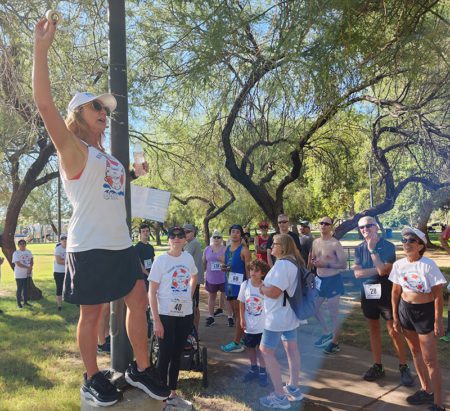
Chris Seyler joined the Phoenix (Arizona) Ostomy Support Groups during COVID times and met up with the group at a park ostomy meeting. Recovering from long term illness and recent surgery, he was ready to find his way back to normal life.

Chris was born in the Phoenix area. While growing up his parents taught him to be active in a team sport, exercise and stay away from bad habits in life.  Chris played basketball and ran track, being nominated for all state in both sports. Receiving a basketball scholarship, and motivated by teachers and coaches, Chris majored in Kinesiology and Science from The Master’s University and became a teacher.

While in college Chris met his wife Colleen, also a teacher. Their son, Nathan, shares his parents’ passion for teaching and athletics and was selected to be in a Disney running movie, MacFarland, USA. Father-Son teamed up to coach school teams in Track and Basketball, winning state Championships.

Following his passion, and inspired by his son, Chris started competing in more events. From 2003 to 2017 he competed in 5ks, 10ks, half and full marathons, triathlons, Ironman, and obstacle racing. It was after AZ IRONMAN 2013 that Chris was diagnosed with ulcerative colitis and started losing weight in 2017.  The next couple of years were tough; in and out of the hospitals for nutrition and dehydration and battling a bacterium in his colon.  Various medications and infusions did not help with easing the illness and emergency surgery was performed in 2019.

Weak from illness and surgery Chris retired from his full-time teaching job and put his running shoes aside.

As time went on and recovery was underway, Chris set a goal to run a 5k. Not able to keep up with his wife, she encouraged him to walk, jog, and run. Hydration was always important as part of Chris’ races, but not having a colon taught him he had to be even more diligent about it.  During Run for Resilience Ostomy 5k 2021, Colleen ran the race. Chris walked and rested with his dog…but he finished…and his passion was returning! While training he worked on improving balance and strength and was able to jog/run at the Arizona Run for Resilience Ostomy 5k in 2022. Chris will be participating this year on the Arizona Virtual Race Team as part of the 2023 Run for Resilience Virtual Ostomy 5k on October 7th.

Passionate about life after ostomy surgery; Chris is teaching part-time, is the Phoenix Ostomy Group Secretary and the Meeting Leader at HH Cowden Center ostomy meetings.

To learn more or sign-up for the Run for Resilience Ostomy 5k visit ostomy.org/5k. You can donate to UOAA fundraisers by Chris and other resilient participants here. 

September 21, 2023
https://www.ostomy.org/wp-content/uploads/2023/09/Chris-Seyler-Ironman-UOAA-1.jpg 1075 963 Contributor https://www.ostomy.org/wp-content/uploads/2017/02/UOAAlogofinal2.png Contributor2023-09-21 10:47:512023-09-21 14:09:46Resilience Story: Chris Seyler

Resilience Story: Maria Sandoval

Colostomy, Exercise/Sports, IBD, Ileostomy, Ostomy 5k, Ostomy 5k, Ostomy Awareness, Ostomy News, Patient Stories, Urostomy

Hi, my name is Maria Sandoval. I wanted to come on here and share my story with you. You may ask, why am I putting the Run for Resilience Ostomy 5k run/walk/roll together in my community? Because it has given me my life back.

In November of 2022 I had surgery to get an ostomy because my ulcerative colitis was getting worse. I was diagnosed with ulcerative colitis in 2012. Ulcerative colitis is an inflammatory bowel disease (IBD) that causes inflammation and ulcers (sores) in your digestive tract. Ulcerative Colitis affects the innermost lining of your large intestine, also called the colon, and rectum. In most people, symptoms usually develop over time, rather than suddenly.

In my case my symptoms did develop over time and things got worse in 2020. The medication I was put on was no longer working. My body was shutting down and therefore my doctor recommended colorectal surgery.

It’s important to me to shine light on ostomies and to give hope to my ostomy community in Arkansas and show them that they are not alone.

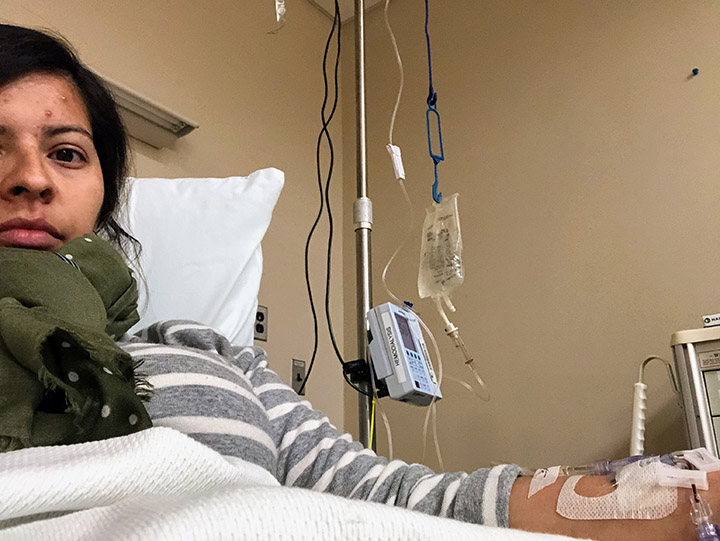
Me during a Remicade infusion for ulcerative colitis before making the choice to have ostomy surgery.

I had no idea what this surgery was nor did I know anyone that had undergone this type of surgery. The fear of the unknown put me off from having this done. I was fortunate to have a great surgeon with a great team who gave me all the information I could ask for. They were patient with me, and so understanding of all my feelings. They answered my questions and addressed my concerns. Having that information and having faith, helped me make the decision to have this surgery. I had hope for the first time since being diagnosed with ulcerative colitis.

Currently, it’s 2023 and I am 33 and I have my life back. For the first time in a decade I can honestly say I feel safe in my body. I have energy, I feel empowered and I’m here to share my story. Making the decision to have my colon removed and have an ostomy was the best thing I could have done for myself.

I am here to stop the stigma around having an Ostomy. I am here to highlight the positives of having one and how it has impacted my life.

I learned about UOAA through social media. I went to ostomy.org to look up what UOAA is all about and saw that they had a 5k run for Ostomy Awareness Day every October. I have always loved to run in races and thought how cool it would be if I could bring this run to my area. I contacted UOAA to see if they would like to have Northwest Arkansas be part of their Run for Resilience Ostomy 5k and they were more than happy to do so.

I was so proud to have finished the race. I wasn’t racing for time, rather, I was racing for me. My ostomy gave me back my confidence in running.

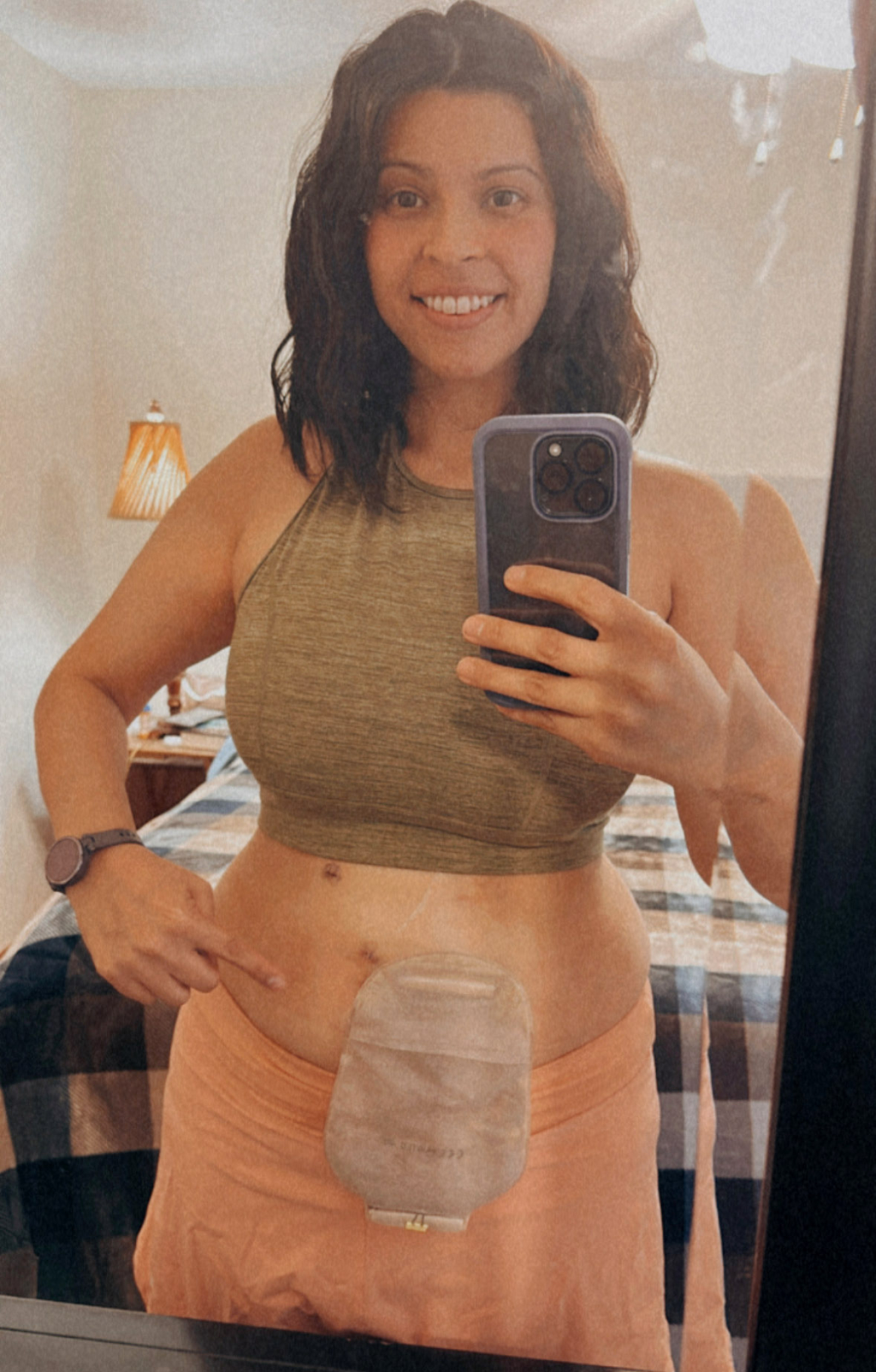
Me 19 days after my Ostomy Surgery.

The Run for Resilience Ostomy 5k is the major fundraiser for all the great things UOAA does. UOAA has great resources to help with recovery and one of those resources I happened to stumble upon is their support group finder. UOAA does a great job of locating support groups and WOC nurses in your area. Forever grateful for that! I also use their site for educational information, self-advocacy checklists, and finding events they have going on, like the Run for the Resilience Ostomy 5k and their National Conference.

By hosting and taking part in the Run for Resilience I hope to spread awareness on ostomies and continent diversion surgery. It’s important to me to shine light on ostomies and to give hope to my ostomy community in Arkansas and show them that they are not alone. That they have a community to go to.

My mother is helping me host our first event. I am so grateful to have my family help me through this journey. My husband and mother were my caregivers before and after surgery. Making the decision to have surgery was a difficult one, but they both helped me through it.

I hope everyone no matter of where they are out takes part in a Run for Resilience event near them or the Worldwide Virtual Ostomy 5k. I love sharing photos like the one here of a half-marathon I ran five months post-op! Everyone should go at their own pace and talk to their doctor, but for me I think it was one month after my ostomy surgery when I started to train for the half marathon. I took it pretty slow. I began by walking a mile and slowly worked my way up to a jog. By month four I was feeling great and feeling like my old self. I was so proud to have finished the race. I wasn’t racing for time, rather, I was racing for me. My ostomy gave me back my confidence in running.

I would run races here and there before my ostomy surgery. My ulcerative colitis would make it difficult at times to run, but when it was in remission I was happy to get back to running. I have always enjoyed running because it was the one thing I could control in my life. My ostomy gave that back to me. Ostomies are truly life savers!

To sign-up or donate to a Run for Resilience Ostomy 5k event near you visit ostomy.org/5k. Support or learn more about Maria’s event, the Rogers, Arkansas Ostomy 5k and follow her 5k on Instagram.

August 16, 2023
https://www.ostomy.org/wp-content/uploads/2023/08/web-E54EDDAB-0C78-4E3E-963C-F27E0985D76E.jpg 1080 1080 Contributor https://www.ostomy.org/wp-content/uploads/2017/02/UOAAlogofinal2.png Contributor2023-08-16 16:29:292023-08-16 16:29:29Resilience Story: Maria Sandoval

Ostomy What? Post Surgery Ostomy Advice

Colostomy, Ileostomy, Ostomy Basics, Ostomy Tips

By Lisa Febre

You’re not alone, as a new ostomy patient I was overwhelmed. Here is how I learned how to take it slow, keep it simple, and learn about this new normal.

I awoke from surgery like many new ostomates: confused, frightened, angry, overwhelmed, sad, and anxious. A cancer diagnosis and a colostomy were more than I could handle for one morning. It’s a lot to take in, and I just wasn’t ready to face any of it.

Until I had my ostomy, I did not know what this was. Sometimes I would hear vague references on a tv show to “a bag,” but no proper descriptions or explanations. I had a bag and no idea what it was or what to do with it. Afraid to look at it, I thought I might see something so gross it would prevent me from taking care of myself. Would I need to rely on someone else to take care of me from now on? Did all my independence just go out the window with one surgery?

Though knowledgeable and well meaning, the ostomy nurse at the hospital left me feeling overwhelmed. The information she was sharing came at breakneck speed. Words like “flange,” “wafer,” “stoma,” “output,” and “pouching system” were being thrown around as if I already knew what they were. Demonstrations of things like ostomy powders and barrier tape only confused me more. All I remembered from the half-hour spent with the ostomy nurse was how to measure my stoma and how to cut the barrier to size.

Types of ostomy bags or pouches ileostomyThe ostomy nurse had a lot of information to cover in a short period, and she thought all of it was important. Afraid of failing, I was certain that I was going to make terrible mistakes. I doubted my ability to do any of this.

Amidst my stress over the new colostomy, I was also recovering from major abdominal surgery. A colectomy is a dramatic change to the body. In my case, I had a large vertical incision that needed care, along with the sutures around my new stoma. Five days after surgery, I was still easing into my post-op life with a soft-solids diet, gradually introducing new foods according to the nutrition guidelines my surgeon and nutritionist had set for me. Exhausted, sore, depressed, and worried about the future, I had a lot on my plate.

Learn About Your Ostomy Supplies

Videos to the rescue. The ostomy supply manufacturers offer “how-to” videos on YouTube and elsewhere for their products, which are straightforward and helpful. I spoke with a customer support representative from the medical supply service a few days after I got home, and he gave me the best advice: “keep it simple until you get the hang of it. Then you can try the fancy stuff.” His explanations were simpler and this time, he instilled me with confidence. He took the time to answer my questions and used language that made it clear to me that this wasn’t rocket science.

Don’t be afraid to make phone calls to the ostomy supply companies. Their customer service people can be the most helpful people you’ll encounter with your ostomy. Also get the New Ostomy Patient Guide from UOAA that has images and articles to help you adjust to all the new terminology and information.

Get to know the parts of your pouching system. Hospitals will send you home with a particular brand, so begin there but know you can sample a variety of products. I had a 2-piece, filtered, drainable system with a flat barrier (wafer). I decided to stick with what the surgeon had stuck on me, copying that for a few weeks. Thankfully, it can take up to a week after surgery for the gut to work again, so I had time to get to know the appliance before having to deal with output.

Take it Slow

Caring for the colectomy and ostomy incisions was no different from other surgeries. Follow the hospital’s discharge instructions, which are to keep the sutures dry when bathing (there are excellent waterproof dressings readily available online and at your pharmacy). It’s a good idea to trim your barrier adhesive patch to avoid your midline incision until it is fully healed. Even though the sutures around your stoma are being exposed to output, don’t panic. Gently wash the area with each appliance change.

Your surgeon will give you important instructions regarding lifting limits. This usually entails not lifting over 5 pounds for several weeks. They will also advise you to walk as much as possible. Movement aids in jumpstarting your digestion, so walk every day! Always follow your doctor’s instructions: many people are at high risk for parastomal hernia. Your surgeon will tailor your lifting and activity limits to your personal needs, and it is in your best interest to follow those instructions diligently.

Keep it Simple

Keep things as simple as possible as you adjust to your new ostomy. Don’t burden yourself by wondering about all the extra items floating around in the “Starter Kit.” When people in your support group talk about tricks and tips, don’t worry, you’ll soon reach a point when you’re the one giving the advice. It’s overwhelming in the beginning, but before you know it, you’ll become familiar with all the accessories, too. As your body recovers, and you settle into your new normal, you’ll gain confidence in caring for your ostomy. For a month after surgery, I only dealt with the wafer/barrier and pouch. Simplicity helped me feel confident.

After surgery, your stoma will be inflamed. For 8-12 weeks after surgery, as it heals, it will change size before settling into its permanent size. Each time you change your barrier, use the stoma template that comes with your supplies. And don’t worry if your stoma bleeds a little – this is completely normal and should stop quickly. If the bleeding is heavy, it won’t stop, or you know for a fact you cut your stoma on a sharp edge, call your doctor or ostomy nurse.

Don’t be afraid: stomas move before and during output. Your stoma is a living piece of your intestine and intestines move! It is normal for it to retract and pucker. It will let you know when something is about to happen. This is very useful when you’re not home; you’ll feel more confident about knowing when to find a bathroom.

Find the Supplies that Work Best for You

By the end of the first 6 weeks, I was feeling much surer of myself with taking care of my colostomy. Then, I tried all kinds of pouching systems along with many accessories. When I changed brands, I went through the process all over again, speaking to sales representatives and using all the free samples they sent me. Just remember you’ll need a prescription for your supplies from your surgeon, so once the hospital sets you up with a supply company, give that to them. And if/when you change brands, you’ll need a new prescription for that. Don’t worry, it sounds confusing now, but your supply company should handle these details for you.

Be Kind to Yourself and Embrace Peer Support

It’s normal to be overwhelmed in the beginning, so aim to keep things simple. If your ostomy nurse was like mine and raced through the material, it’s difficult to feel confident on your own. Hit reset and try to copy what the surgeon put on you after surgery. Your home health aide may or may not have experience with ostomies, so do your own research and practice with sample supplies. Join a support group as soon after surgery as you can. Armed with information, experience, and support, you, too, will find the confidence you need to care for your new ostomy.


Lisa Febre is the author of “Round the Twist: Facing the Abdominable,” a memoir about her diagnosis and treatment of Stage-4c Colon Cancer, which hits bookshelves in September 2023. She had a descending colostomy for 10-months. To learn more visit her at UOAA’s National Conference in August or visit  lisafebre.com.


June 29, 2023
https://www.ostomy.org/wp-content/uploads/2023/06/ostomy-qustions-blog.png 924 1640 Contributor https://www.ostomy.org/wp-content/uploads/2017/02/UOAAlogofinal2.png Contributor2023-06-29 14:15:312023-07-21 13:10:34Ostomy What? Post Surgery Ostomy Advice

‘UOAA Has Been A Lifesaver for Me’ Says New Ostomate

Colostomy, Donate Page, Emotional Health, Ileostomy, Membership, Ostomy Basics, Ostomy News, Ostomy Tips, Patient Stories, Support Group News, Support Resources, UOAA Conference, Urostomy

When first presented with having a “bag” I was terrified. I had a lot of questions…. How will I wear my clothes? Will I still be able to run or lift weights? Will I ever date again? How can I go to the beach? And so many more. I really was not familiar with this at all.

How UOAA Helps: Connie contacted UOAA before surgery earlier this year and is now on the path to health and happiness in life with an ostomy. Donate to help the next ostomate in need.

I did my fair share of googling, but there are so many conflicting pieces of information out there. I also joined some Facebook groups to find some support.  That proved to be very confusing and often quite discouraging. In February of 2023, a week before my surgery, I met with an ostomy nurse for the first time.  That is when it hit me.  She showed me a practice stoma, put my markings on, and had me look in a mirror with a bag.  I realized I needed more information in order to navigate this the best I can.

Finding UOAA

I came home and searched for ostomy support groups in my area and found one. I immediately connected with them, and they shared UOAA’s information with me. I then went on to their website ostomy.org to gain as much knowledge as possible. I went into surgery with a positive attitude because I knew my life would be so much better afterward.

The people I talked to at UOAA’s office were so helpful! They answered all my questions, and I had a lot!  They directed me to many resources like a New Patient Guide and sent me links to videos and other information which I still use. It is reassuring to know that I can reach out with questions and that they will be there for support.

UOAA has been a lifesaver for me. I was overwhelmed following my ostomy surgery. I am so excited that I am feeling better. I am so appreciative of the connections I have been able to make and the educational materials I have received by contacting UOAA.

On February 23, 2023, I had surgery for an end ileostomy, total colectomy, rectopexy, and hernia and bladder repair. After a lifetime of being a prisoner to my colon and GI tract, a ton of medications, and a ridiculous daily twelve-hour ritual that dictated my days, I finally was given hope to improve my quality of life. The day after surgery I already knew this was the right thing for me, and I somehow felt “free” of all the meds and issues I had before.

Helpful Free Resources

UOAA sent me a welcome packet in the mail with a ton of info about nutrition, living with an ostomy, exercise materials, you name it. The coolest thing was the card to use with TSA when I fly… that is going to be a lifesaver, I think! I had many questions about getting back to my normal activities, and I was sent links to Youtube and even Instagram of people that have ostomies and have resumed, or even surpassed, their pre-ostomy fitness routines.

My experience has definitely been better with my local ostomy group and with UOAA by my side.

A link to an occupational therapist was also helpful. I started following and connecting with many of these people, as I have found inspiration in them. I have since called UOAA several more times seeking answers to my questions, concerns, or even worries. Each time they have promptly responded and provided me with continued optimism as I begin this ostomy journey.

UOAA Helped Me Feel ‘Normal’ Again

I think that the biggest thing is that UOAA helped me to feel “normal” and that I am not alone in this.  Starting out with an ostomy is pretty scary, and there are a lot of unknowns. So much of what you read is negative from people that have had problems or are just very discouraged with their situations. UOAA shares the successes, the positives, and the education so that you can learn and grow each day knowing that you don’t have to give up anything at all.

For me, I plan to get back to my full fitness routine once I am fully recovered. I already feel healthier than I have for so many years.  But I know I still have a lot of learning to do… from appliances (I still can’t figure out the best ones for me), to the different types of foods to eat, to stoma care (I still always want to make sure everything is okay), to traveling, exercise, clothing, wraps, connecting with other people with ostomies, and maybe even dating again in my future. My experience has definitely been better with my local ostomy group and with UOAA by my side.

Grateful to Learn More at the National Conference this Summer

I’m also very thankful to have been awarded a CARES scholarship (FYI, current scholarships have been filled) to attend UOAA’s National Conference in Houston. This assistance will allow me to continue on my journey in a healthy and positive way.

As a single 57-year-old mom, I have three grown children (one still in graduate school), a new granddaughter, and two younger children I adopted, one with unique medical needs – it has not been easy. Last year’s hurricane, coupled with the astronomical surgery costs, have me struggling greatly on a teacher’s salary. I have worked really hard to provide for other people, and I’ve never really done for me.

This conference is something I feel is important for me as I want to be able to live my life to the fullest. I strive to be the best Nana, mom, and person I can be. I want to embrace my body, my life with an ostomy, and continually improve my quality of life.. It will allow me to move forward, make connections, gain much-needed knowledge, be an advocate for myself and others, and to stay “OSTOMISTIC!” 

One day I can even envision myself advocating for others in the ostomy world, being active in the ostomy community, and I would love to get to the point where I can even be an inspiration to others.

Connie, you are already inspiring to those of us at UOAA.

Please Donate to UOAA to put other people like Connie on a successful path.  Support quality of life resources, education and advocacy for people living with an ostomy or continent diversion. United Ostomy Associations of America inc. (UOAA) is a 501(c)(3) nonprofit organization and all donations are tax deductible. Thank you!

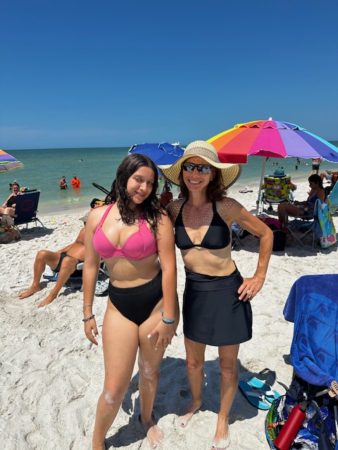
Shared by Connie Pollina of Naples, Florida

May 23, 2023
https://www.ostomy.org/wp-content/uploads/2023/05/connie-ostomy-blog.jpg 640 549 Contributor https://www.ostomy.org/wp-content/uploads/2017/02/UOAAlogofinal2.png Contributor2023-05-23 16:59:172023-06-10 09:52:48‘UOAA Has Been A Lifesaver for Me’ Says New Ostomate

Telling People About Your Ostomy

Colostomy, Digital Sponsor, Emotional Health, Ileostomy, Ostomy Basics, Ostomy Tips, Sexuality, Urostomy

It’s been said before, but it is worth repeating: who you tell about your ostomy and when you tell them is completely up to you. This is the first and foremost rule you should keep in mind when it comes to sharing about your ostomy. Most likely others won’t know you have an ostomy unless you bring it up.  If you are reading this before your surgery, you will need to think about what kind of support you are looking for. As you decide to let people in on your new situation, consider who can offer you the support and friendship you need during this time.

Place of Work

There is no right or wrong way when it comes to sharing about your ostomy at work. It might be that no one needs to know about it, it doesn’t affect your work and you are receiving enough support from friends and family and other people outside of work. Or, your situation might be that you need to take frequent breaks to empty your pouch and so explaining a little bit about your surgery will help your employer to understand what’s going on. Again, feel free to be as specific or general as you want. It might even be helpful to write out a small script so you can go into this conversation with added confidence. Decide how much you want to share, and how willing you are to answer questions.

Family and Close Friends

Hopefully, you aren’t trying to go through this life-changing experience alone. Family and/or friends should be the foundation of your support network. Having someone you trust at medical appointments with you can be helpful for your morale, but also to have another set of ears to remember details and information that you may have missed. When you decide to let other people close to you in on the reality of your situation, ask the person who was with you at those appointments to be there to support you. It’s amazing how much more confident we can feel having the energy of a loving and loyal person at our side.

Romantic Partners

If you are in a committed relationship prior to your surgery, then it’s likely they will be informed of your ostomy and the changes to your body. While it can be scary to let people in and tell them about your ostomy, it can be even scarier to be alone in the process. Going through this with a partner by your side can be so beneficial to your recovery process, and can also help to strengthen your relationship.

Dating after your ostomy can seem daunting at first, but as you heal and become more and more comfortable with your new routine, your confidence will grow.  Keep in mind that it’s completely up to you when to tell a new romantic partner about your ostomy. As with your workmates, you may want to take the time to figure out what you want to say before you say it. It’s okay to keep it short and basic and then decide if you want to take some time to answer questions.

Confidence

The more confident and comfortable you are with your ostomy, the more this will show when you speak about it. Be patient with yourself and allow yourself time to heal and get used to the changes and new routine that an ostomy brings. Try to focus on the positive things that having an ostomy surgery has done for you and your body. It may be helpful to speak with others who are in a similar situation.  Talk to someone who has gone before you and find out how they told people about their ostomy.

It’s up to you who you tell, when you tell them and how you do it.

Visit the Coloplast Care site for more information on sharing about your ostomy at work.


Information from Coloplast® Care is for educational purposes only. It is not intended to substitute for professional medical advice and should not be interpreted to contain treatment recommendations. You should rely on the healthcare professional who knows your individual history for personal medical advice and diagnosis.

Editor’s note: This blog is from one of our digital sponsors, Coloplast. Sponsor support along with donations from readers like you help to maintain our website and the free trusted resources of UOAA, a 501(c)(3) nonprofit organization.

April 25, 2023
https://www.ostomy.org/wp-content/uploads/2023/04/coloplast.png 552 830 Contributor https://www.ostomy.org/wp-content/uploads/2017/02/UOAAlogofinal2.png Contributor2023-04-25 09:57:482023-05-11 10:44:05Telling People About Your Ostomy

Daily Living with an Ostomy

Colorectal Cancer, Colostomy, Exercise/Sports, Fashion/Clothing, Ileostomy, Ostomy Basics, ostomy reversals, Ostomy Tips, Personal

Every Individual is Unique so Don’t Put Restrictions on Yourself Based on Others

By Lisa Febre

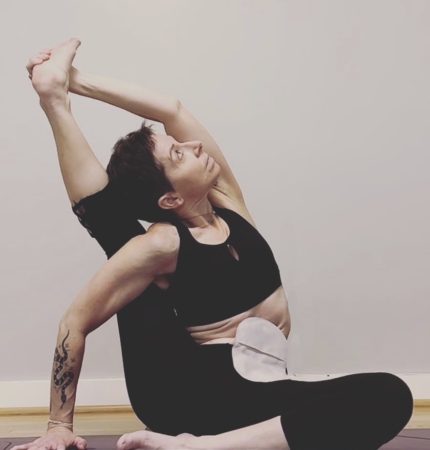
The morning after my colectomy, the first question I had for my surgeon was “can I still do yoga?” My surgeon had a good-natured and amused response: “Please give yourself two weeks to recover from this surgery, and then you can do all the yoga you want.” He also told me that with my specific colostomy, in two weeks I could get back to my regular diet with no restrictions. (I’ve since learned those with an ileostomy have different considerations.)

Sure enough, two weeks later, once I was sufficiently recovered, I was living out his predictions. I was back on the yoga mat, twisting myself into pretzels, lifting into tricky arm balances, and standing on my head. I was outdoors hiking and running. For the first week after surgery, I was following a soft-solids diet, and by the second week I was eating whatever I wanted. By the end of the month, I was even eating Reuben sandwiches with sauerkraut!

I knew no boundaries because I had none.

It wasn’t until I joined a support group on social media that I noticed people were questioning things I was taking for granted like taking a shower, exercising, wearing pants, and eating vegetables. Are there eating restrictions for ostomates? Was it possible some people were told they could not exercise with their ostomy? The answer is …yes… ish.

Showering with an Ostomy

I was given a temporary colostomy in December 2021 when I was diagnosed with Stage-4c Colon Cancer (at the age of 47). There is no way around it: this is a big shock to the body and the mind. But the only thing I could think about was getting into the shower and washing off the five days’ worth of sweat and grime that had accumulated on my body during my hospital stay. I stripped down, my new Hollister 2-piece system hanging off of me and stepped into the shower. I didn’t think about the bag at all, I just showered like I normally did. When I was done, I dried myself and the bag off with a towel, and… that was it. I did this every single day without a second thought.

I would laugh at myself and say: it’s just poop, it’s not nuclear waste!

Weeks later, I was surprised to learn people commenting online were wrapping up their colostomy bags with layers of plastic wrap and were trying desperately to keep their abdomens out of the water. Wait… are we not supposed to get the bags wet? That didn’t sound right to me. The barrier has to be taken off with adhesive removal wipes or sprays, and even then, it can be difficult to separate it from your skin. The durable plastic receptacle bag is meant to hold all kinds of bodily fluids, it seems obvious that it should be able to handle a little soap and water. The customer service reps at both Hollister and Coloplast concurred: they specifically told me that their products are meant to be used while showering, bathing, and even swimming, with no extra accessories. Again, because no one told me I couldn’t, I was already doing these things. It was heartbreaking to see so many of my fellow ostomates avoiding basic hygiene for fear of doing it with the bag on.

It seems like the solution might be to shower without the appliance. There tends to be even more fear surrounding this practice of naked showers. Again, this was something that I had already done without asking for permission. One day I was changing my appliance, decided it would be a great time to shower, and just jumped in. The soap on my newly exposed skin felt fantastic, my stoma looked to be enjoying the water running down my belly. Naked showers were soothing and necessary for my peace of mind. I always felt the cleanest when I showered without my appliance. The skin under the barrier stayed healthy and the adhesives worked much better. Always close at hand was a disposable plastic cup filled 1/4 up with water which I used to catch any “visitors” that might erupt from my exposed stoma during my shower. I would laugh at myself and say: it’s just poop, it’s not nuclear waste!
Exercising with an Ostomy

This is something you absolutely must talk to your doctor about. I can’t give you proper advice since everyone has a different risk value for a parastomal hernia (that’s when your intestines try to push their way through the incision around the stoma). Although 50% of people with a stoma will get a parastomal hernia, that doesn’t mean you are going to get one. Your surgeon will assess your risk. I had almost no risk of one of these hernias because I was fit and active before the surgery; there was a low likelihood that my incision site would fail while I had the stoma. I was told I could begin exercising again 2 weeks post-op. Alternately, when I had my reversal surgery 10 months later, my surgeon said there is a slightly higher risk of a hernia at the closure site and wanted me to wait 8 weeks before lifting anything over 10 pounds, and that included doing yoga.

Even within one person, my risks were different for each surgery. This is why you have to have a clear assessment from your doctor and follow their directions. Some people may still develop a hernia despite following their surgeon’s directions. It’s important to question and clarify, but ultimately listen to your doctor– and not just people online, this gives you the best chance for success.

Dressing with an Ostomy

This is a tricky one for ostomates because everyone’s stoma is in a slightly different spot. I was able to wear jeans and form-fitting clothing because the location of my stoma made that possible. Someone else may have their stoma exactly where the rigid waistband of their favorite jeans falls, which can be an issue. Your clothing isn’t necessarily going to hurt the stoma, but you do need to save room for when your stoma has output. For some, tight-fitting clothing can restrict the bag, forcing the output backward toward your skin and under the barrier.

Dressing is definitely not a one-size-fits-all situation, so unfortunately no one can really give someone else game-changing advice. Be ready to experiment, but always wear clothing that makes you feel good. It was important to me to wear jeans, so I bought new jeans with a lower waistband that fell just under my stoma. Many other women invest in maternity pants. But I never left the house feeling frumpy. My colostomy was not in charge of my fashion sense, I was!

Eating with an Ostomy

Everyone has a unique reason for having an ostomy. In my case, I had my colostomy because of cancer; I had no pre-existing intestinal issues or dietary restrictions. If you are like me and could eat whatever you wanted before, chances are high that your doctor will tell you you can go back to that way of eating after your surgery. But some people, who come to a colostomy or ileostomy through ulcerative colitis or Crohn’s disease (or other gastrointestinal disease), may already have restrictions that they still need to take into consideration. An ostomy does not always magically erase your special diet for your IBD.

The general rule is however you ate before your colostomy is how you can eat now.

It does not rule you; it is not the most important thing about you, and it does not define your life.

I am vegan and I had no trouble eating any vegetables with my colostomy. UOAA’s trusted Eating with an Ostomy Guide provides info including a standard chart of foods to avoid at first with an ileostomy or colostomy – whether that is because they create stinky output, excess gas, diarrhea, constipation, or could cause blockages. Speak with your doctor and surgeon if you are unsure how to handle building your new diet. If you’re introducing new vegetables (or any kind of food) into your post-colostomy diet, just try a little bit and see what happens! If your doctor says it’s ok, don’t be afraid to try eating the old things you love, and maybe be inspired to try some new things as well. A good practice for all is to chew thoroughly and stay hydrated.

Stay Positive with an Ostomy

Some people wonder how they can ever find something positive in something so scary as an ostomy, but it can be done. You don’t need to do it in big grand gestures or sweeping alterations in your character. Just try one little switch when the opportunity comes up. It isn’t about skipping down the street singing the praises of your ostomy, it’s about finding moments when you can see the silver lining. I thought it was sort of fun to have something so unique on my body. Very few people ever get to have this close a relationship with their intestines, so instead of feeling sorry for myself, I decided to call myself “lucky” for learning so much about how my digestive tract works.

Maybe most important of all, my ostomy led me to a UOAA support group where I met some wonderful people. I have made new friends who I would never have met without my ostomy. That is something to be very thankful for.

Spend some time every day when you force yourself to not think about your ostomy. Even if it’s just 20 seconds, it is important to learn to push this thing into the background of your life. It does not rule you; it is not the most important thing about you, and it does not define your life. Stay Positive! One day, one hour, sometimes one minute at a time, but you can do this.

Learn to Take Care of Your Ostomy

Our emotional recovery depends on regaining independence. I was only 47 when I received my ostomy. I am too young to rely on others to take care of me. I laughed when the home health aide arrived and started treating me like I was 80. I was not going to lie down and become helpless. I was going to be an active participant in my own health and recovery.

Learning how to care for yourself makes you feel like a Superhero!

If you suddenly find yourself having to depend on someone else to maintain your appliance, you will feel even more out of control and worried that something might go wrong. Believe me: something will go wrong — leaks happen to the best of us, and at the most unexpected times. If you have to wait until your nurse can come to your house, or until your partner gets home from work, you will feel more helpless with each passing day. Paranoid that something terrible will happen if you get a leak while you’re alone, you may not leave the house to run errands, you may say no to social gatherings, and you may not want to go back to work.

Learning how to care for yourself makes you feel like a Superhero! I had a cool little zipper bag that fit in my purse containing a precut barrier, 2 extra bags, 2-3 adhesive remover wipes, 2-3 skin prep wipes, a disposal bag, and a travel-size PooPourri Spray. Knowing I had all the supplies I needed to do a quick bag change in a strange bathroom gave me immense peace of mind. I could change the whole system in less than 5 minutes, all by myself!

And if you need a little smile while you fumble around with your first bag change alone, just repeat my favorite mantra out loud: I got this whole thing in the bag!


Lisa Febre is the author of “Round the Twist: Facing the Abdominable,” a memoir about her diagnosis and treatment of Stage-4c Colon Cancer, which hits bookshelves in September 2023. She had a descending colostomy for 10-months.


March 31, 2023
https://www.ostomy.org/wp-content/uploads/2023/03/Daily-Living-Ostomy-FB.png 788 940 Contributor https://www.ostomy.org/wp-content/uploads/2017/02/UOAAlogofinal2.png Contributor2023-03-31 11:22:542023-03-31 13:39:45Daily Living with an Ostomy

We’re here for Colorectal Cancer Survivors

Advocacy, Colorectal Cancer, Colostomy, Ileostomy, Ostomy Basics, Ostomy News, ostomy reversals, Support Resources


By Cheryl Ory, UOAA President

President Biden has proclaimed March 2023 National Colorectal Cancer Awareness Month. The American Cancer Society says that colorectal cancer is the third leading cause of cancer related deaths in both men and women. On another note, the death rate has been dropping for several decades. One reason is that treatments have improved. Another reason is that colorectal polyps are now being found more after screening and removed before they can turn into a cancer.

UOAA Advocate, ostomate and colorectal cancer survivor Allison Rosen speaks on the National Mall as part of the United in Blue Rally sponsored by Fight Colorectal Cancer. Video: United in Blue Rally on the Mall (1)

In 2008 I was diagnosed with Stage 3b colorectal cancer. I was told the cancer had been developing for at least 10 years or more, most likely when I was in my early 30’s. There was a polyp, if it had been removed at an earlier date the cancer would not have developed. After radiation, chemo, surgery, and more chemo I am now a colorectal cancer survivor with a permanent colostomy, an ostomy that has saved mine and others lives from not only cancer, but other debilitating diseases.

I’m happy that UOAA is standing alongside partner organizations like Fight Colorectal Cancer to push lawmakers into giving attention to the alarming rise in young people with colorectal cancer.

With younger people being as risk and diagnosed , The U.S Preventative Services Task Force lowered the recommended screening age to 45 in 2021.  One in five colorectal cancer patients is between the ages of 20-54. Talk to your doctor about options for colorectal cancer screening. As the Colon Cancer Coalition states with earlier screening and detection, “Colorectal Cancer can be  Preventable, Treatable, Beatable.”

If you are a person still at risk, like those with IBD, let me urge you to get screened. Screening can result in any colorectal cancers being found earlier when they are easier to treat.

Here at United Ostomy Associations of America (UOAA) we have a long legacy of supporting the survivors of cancer and many other conditions so that they can have best quality of life possible. If your cancer requires a life-saving ostomy surgery remember-you are not alone. 725,000- 1 million people in the U.S. of all ages and backgrounds live with an ostomy.

Every individual person’s disease treatment is unique but ostomy surgery for colorectal cancer may mean a temporary ileostomy (from the small intestine) or colostomy (large intestine). This may be required to give a portion of the bowel a chance to rest and heal. When healing has occurred, the colostomy can often be reversed and normal bowel function restored.  It’s important to know that not everyone with an ostomy will be a candidate for a reversal operation. A permanent colostomy may be required when a disease affects the end part of the colon or rectum.

We have new Living with a Colostomy guide and ileostomy guide to help you learn as much as possible before or after you have this life changing surgery.

It’s especially important to connect with one of hundreds of  UOAA Affiliated Ostomy Support Groups in the U.S. before, or shortly after, your surgery. Peer support and preparation can put you on the path to success in what may be a challenging time both emotionally and physically.  Ask if the hospital has a certified ostomy nurse and insist on having your stoma placement marked before surgery. These and other self-advocacy tools are paramount and outlined in our Ostomy Patient Bill of Rights.

You may feel too overwhelmed as you are discharged at the hospital to fully understand ostomy pouching systems and accessories and lifestyle considerations. If you have a  medical question contact your doctor or nurse, but if you have a quality of life question-UOAA resources here at ostomy.org and peers at UOAA Affiliated Support Groups likely have the answers.

It’s important to learn the facts about living with an ostomy. After the healing period outlined by your surgeon you can swim, bathe, be intimate, travel, and embrace a new normal life. After some trial and error, you may also eat most of the foods you have been able to eat in the past. Education is key to battling misinformation.

Unfortunately misinformation and stigmas surrounding both ostomy surgery and colorectal cancer affect the number of people getting screened or getting the medical treatment they need.  Let’s work together to educate, advocate and support survivors.


Cheryl Ory is a colorectal cancer survivor who received a permanent colostomy in 2008. Cheryl is a Registered Nurse who has had a passion for volunteering with the ostomy community ever since and first joined UOAA’s Board of Directors in 2015. She now holds the position of President.


March 14, 2023
https://www.ostomy.org/wp-content/uploads/2023/03/colorectal-cancer-awareness-month.png 389 648 Contributor https://www.ostomy.org/wp-content/uploads/2017/02/UOAAlogofinal2.png Contributor2023-03-14 14:11:472023-03-14 17:21:49We’re here for Colorectal Cancer Survivors

Ostomy Surgery Saved Matthew Perry’s Life. It’s Time to Stop the Stigmas.

Advocacy, Colostomy, Ileostomy, Ostomy Awareness, Ostomy News

Excerpts from Matthew Perry’s new memoir show that even TV stars are vulnerable to poor ostomy care and stigmas UOAA is working to erase.

By James Murray, UOAA President

(Update: People around the world have been reacting to the sad news that Perry was found dead in his home on October 28, 2023.)

In a preview of his new memoir Friends star Matthew Perry reveals to People that in 2019 his colon burst from opioid abuse and that he spent two weeks in a coma before waking up unaware that he had emergency ostomy surgery to save his life.

He reveals that ‘It was pretty hellish having one because they break all the time’ which as President of United Ostomy Associations of America (UOAA) shows me that even a Hollywood star is susceptible to poor quality of care and the ostomy stigmas our organization is fighting to end.

I had lifesaving ostomy surgery as a result of colon cancer and I am among the 725,000 to 1 million people in the United States we estimate are living with an ostomy or continent diversion. Many of us live healthy and active lives thanks to follow-up care by certified ostomy nurses, education, emotional support, and the fact that a properly fitted ostomy pouch should not break, smell or restrict your desired lifestyle.

The book also reveals that Perry’s ostomy was temporary and that his therapist said ‘The next time you think about taking OxyContin, just think about having a colostomy bag for the rest of your life.’ Perry says this was the catalyst for wanting to break his long pattern of addiction.

While it’s wonderful that Perry has fought to end his addiction, these words sting for those of us who deal with the consequences of ostomy stigmas in our society. We wonder if Perry would have come to see the ostomy differently if given the chance to attend an ostomy support group or talk with another person living with an ostomy during his 9-month recovery. Did he receive information about organizations that support ostomy patients prior to discharge? Research shows that these and other UOAA standards of care can make all the difference in a patient’s outcome.

Despite the fact that ostomy surgery saves or improves lives, there are still people who believe that death is a better choice than having this surgical procedure. People of all ages struggle with body image issues and acceptance in life with an ostomy and perpetrating these stigmas can leave deep scars.

Perry also mentions looking at the scars from his 14 abdominal surgeries as motivation for ending a cycle of addiction. Perry and those interviewing him are rightly celebrating and supporting addiction recovery efforts. We ask that they also give a moment to help raise positive ostomy awareness, and share our resources available to all those in need.

James Murray is President of United Ostomy Associations of America Inc. (UOAA) a national 501(c)(3) nonprofit organization that promotes quality of life for people with ostomies and continent diversions through information, support, advocacy and collaboration. Educational resources, advocacy tools, support groups and more can be found at www.ostomy.org)

Donate today to help the next ostomate in need. 

October 20, 2022
https://www.ostomy.org/wp-content/uploads/2022/10/mathew-perry.jpg 0 0 Contributor https://www.ostomy.org/wp-content/uploads/2017/02/UOAAlogofinal2.png Contributor2022-10-20 22:35:122023-11-01 09:56:21Ostomy Surgery Saved Matthew Perry’s Life. It’s Time to Stop the Stigmas.

Double Baggin’ It: A Tale of Two Best Friends Without Buttholes

Advocacy, Colostomy, Emotional Health, Events, IBD, Ileostomy, Ostomy Awareness, Patient Stories, Urostomy

Written by Danielle Gulden and Joe Teeters

We all know that “laughter is the best medicine”!  This year’s Ostomy Awareness Day Champions, Danielle Gulden and Joe Teeters, not only love that phrase, they live it! These two best friends, and co-founders of Double Baggin’ It are IBD warriors and permanent ileostomates. They’re also comedians, speakers and Two Best Friends without Buttholes!  They truly believe in the power of laughter, humor, advocacy and awareness! Which is why they LOVE Ostomy Awareness Day!  For them, every day is a chance to raise awareness.  But Ostomy Awareness Day is a special day to reflect and celebrate their life-saving surgeries and the lives they were given back! They share their stories so that future, new and veteran ostomates know that they are not alone!

Danielle and Joe have each been living with Inflammatory Bowel Disease for over 29 years.  Although their IBD and ostomy journeys have been quite different, their positive outlook on life and ridiculous sense of humor are the same!

View this post on Instagram

A post shared by Double Baggin’ It (@doublebagginit)

Prior to 2014, Joe and Danielle had no idea the other existed…so, let’s rewind a few decades and learn about the journey of each of these Two Best Friends Without Buttholes!

Growing up, Danielle was a very healthy child, an extremely outgoing teen, and an adventurous free spirit! Spontaneity was her specialty, and travel was always her first love!  Joe, on the other hand, always had “poop problems.” He was always pooping and known as “Joe the Pooper” by his siblings. Like Danielle, he was an outgoing, active, and social teenager.

Fast forward to Danielle’s late teens and early 20s. By the time she was a sophomore at The Ohio State University, Danielle’s health drastically changed! She saw her busy social life dissolve; she’d make plans and have to cancel. Spontaneity was no longer an option, and the idea of traveling was now a nightmare!

Danielle had to drop out of classes because of her poor health.  Her symptoms and pain were becoming harder to ignore. She was in the bathroom around 25 times a day and became extremely malnourished and anemic.

You can hide your bag, but don’t ever let your bag hide you!

After being misdiagnosed for 6 years with a gluten intolerance, a colonoscopy in April of 1999 showed severe ulcerative colitis.  From 1999 until 2007, Danielle’s life was a constant barrage of colonoscopies, radiological tests, bloodwork and pharmaceutical cocktails.   She did the research and finally decided to have ostomy surgery.

After high school, Joe enlisted in the Naval Reserves. He passed the military physical and was cleared for training.  While away, Joe’s poop problems became more pronounced, and the pain was gradually becoming more than just an annoyance.

When he returned home after 5 months, he was in the best physical shape of his life. On the outside he looked healthy, but inside something was wrong. Joe was initially diagnosed with irritable bowel syndrome, then a colonoscopy in 1993 lead to his diagnosis of severe Crohn’s Disease. Two years later he had his first intestinal resection. Joe’s Crohn’s continued to advance, and he had a second intestinal resection in October of 2004.

Back in Cleveland, Danielle was super excited for her ostomy surgery! She was ready to stop being a prisoner to her bathroom and get back to living her life to the fullest! On April 30th, 2007, Danielle had her total proctocolectomy with end ileostomy at the Cleveland Clinic. It was truly one of the greatest days of her life! She high fived every single person on the way to the OR.

From day one, she embraced her ostomy, and her new life as an ostomate. Within a month or two of her surgery, Danielle was back to exploring and enjoying her pre-sickness hobbies and joys. She traveled, hiked, camped, swam, went to concerts, and amusement parks. Life was good again! She also joined the Cleveland chapter of the UOAA and eventually became active on their executive board.

Fast forward a few years, and 120 miles away in Columbus, Ohio. Within a year of his second resection, Joe’s rectal Crohn’s disease became severe, and his rectum very strictured.  After consulting with his GI and surgeon, Joe had a full proctocolectomy with end ileostomy on December 27th, 2012.

Joe’s recovery process and post-surgical experience was very different from Danielle’s. In addition to becoming an ostomate, the amount of bowel he had lost from three surgeries left him with Short Bowel Syndrome. It took the better part of a year to fully recover and return to pre-surgery activities.

During Joe’s recovery, a Facebook support group for ostomates became a lifeline. It was a great source of inspiration and hope, and a wonderful place that showed him he was not alone. Later, he sought out Central Ohio United Ostomy Association support group and became a member of the organization.

By now, you must be wondering how the heck these Two Best Friends Without Buttholes finally met.  As you can see, they have traveled separate but similar paths in their battles with Crohn’s and ulcerative colitis.  Their paths crossed in that Facebook support group mentioned earlier, when Danielle posted that she and her family were relocating to Columbus, Ohio. Joe, being a Columbus resident, and fellow ostomate, reached out and introduced himself. After meeting in person, in late 2014, at their local UOAA Affiliated Support Group, they started hanging out after the meetings. They soon discovered that they had a very similar outlook on life and shared a ridiculous sense of humor, and they wanted to use that to help others. A best friendship began…and slowly but surely, their vision for Double Baggin’ It was coming together. They decided to go to the United Ostomy Associations of America’s National Conference in September of 2015. There, after meeting over 400 ostomy patients like themselves, they decided to stop dreaming and start making their vision for Double Baggin’ It a reality. Double Baggin’ It was born, that week, when they filmed their first DBI video on a rooftop in downtown St Louis, Missouri.

Through Double Baggin’ It, Danielle and Joe use their humor, wisdom, and stories to connect with and support other people living with ostomies and Inflammatory Bowel Disease. They advocate and raise awareness at the local and national level for both United Ostomy Associations of America and the Crohn’s and Colitis Foundation.  Danielle and Joe also visit with their legislators yearly in Washington, DC to share their voices and stories.

You can find them on Facebook, Instagram, TikTok, Twitter and YouTube (@DoubleBagginIt) where you can watch them raise awareness through shenanigans and ostomy-bombing (placing an ostomy bag on a statue, landmark, anywhere they see fit!) They also can be found speaking at IBD and ostomy conferences, support groups, camps, hospitals and classrooms – sharing their stories and spreading laughter through improv. Danielle and Joe know that not everyone is comfortable rocking out with their bags out – and that’s totally ok! What these Two Best Friends Without Buttholes want to make perfectly clear, is that “You can hide your bag, but don’t ever let your bag hide you!”

Join with this year’s Ostomy Awareness Day Champions in spreading awareness by following Double Baggin’ It and UOAA on social media and visiting the Ostomy Awareness Day page to keep up to date on all the latest events.


September 14, 2022
https://www.ostomy.org/wp-content/uploads/2022/09/doublebaggin-itfeatured.jpg 472 425 Contributor https://www.ostomy.org/wp-content/uploads/2017/02/UOAAlogofinal2.png Contributor2022-09-14 16:43:072022-12-22 05:43:04Double Baggin’ It: A Tale of Two Best Friends Without Buttholes

So You’re Getting an Ostomy

Colostomy, Exercise/Sports, IBD, Ileostomy, Ostomy Basics, Ostomy Tips, Urostomy

By Robin Glover

Oh no! An ostomy! You’re going to be pooping or peeing into a bag attached to your stomach?? Your life is over, right? No more dating. No one will ever like you. Children will run from you! It’s so gross!

Don’t worry. We’ve all been there. As great as they can turn out to be, the idea of getting an ostomy is never really welcomed news. Add on to that, you’re probably very sick and haven’t eaten well in weeks and you’re tired and worried and feel alone. You know nothing about ostomies and are wondering what life will be like with one.

Will having an ostomy bag eventually become second nature and you won’t even really think or worry about it? Yes.

First of all, life is going to be great! You’ll feel better. You’ll eat better. You won’t be bleeding out of unspeakable places and constantly panic-stricken about finding the nearest bathroom. Your life will become more consistent and routine and you’ll end up being happy you had a lifesaving, life-improving surgery.

It’s possible that you don’t believe that right now, though. And while it does turn out to be a good thing for most, there is an adjustment period and a lot of unknowns and myths. For instance, how do I change my ostomy bag? Will I stink? What if I have an accident in public? Can I ever play sports again? Or exercise? Or go swimming?

In short– is it easy? No. Will it be fine? Yes, yes and yes. But for a little expanded information and peace of mind, we can go into a little more detail.

How Do I Change My Ostomy Bag?

You gently peel it off, wipe things off a bit, and put another one on. It really does become as simple as that. But, at first, you’ll hopefully have a specialized ostomy nurse that will teach you how to do it. After your surgery, you likely won’t have to change it yourself the first several times. But, you should practice doing it and will be better off if you make the effort to know how before you leave the hospital. It also helps to know what the standards of care should be for ostomy patients and speak out before you are discharged and sent on your way.

If you did not have access to a certified ostomy nurse in your hospital be sure to seek one out. You can also find a Wound, Ostomy and Continence (WOC) Nurse or an Ostomy Management Specialist (OMS) through product manufacturers and telehealth services.

Will My Ostomy Bag Leak?

At first, Yes. It likely will. You might even get really frustrated in the beginning because you can’t seem to put it on as well as the nurse in the hospital. Even if you put it on “perfectly” and follow all the steps your ostomy pouch can still leak. You’ll get the hang of it, though. Every ostomy and everybody is different. You’ll learn what supplies you need, where to get them, and how to use them to make sure the fit is just right.

While you might be hesitant to leave the house for a while, you’ll soon feel totally confident going anywhere you want, any time you want. And better yet? You won’t be constantly worried about being near a bathroom! There’s always the risk of a leak, though. But it won’t be a big deal. You’ll be able to detect it quickly and take care of it.

Will I Smell?

No. If the appliance is attached correctly, you should never stink. No one will be able to smell you. You can be as close as you want to other people. You can go out and be in a crowded bar and nobody will know you have an ostomy bag. There are also plenty of clothing and garment options to fit well with your pouch and conceal it from anyone ever knowing – if that’s how you choose to approach it.

If you do ever smell, that means you need to check your pouch for any leaks or openings allowing odor to escape. And if you happen to be in public, you can carry tape or any of a variety of things to sneak off into the bathroom and do a quick fix. Will it be uncomfortable or scary the first time it happens? Yes. Will having an ostomy bag eventually become second nature and you won’t even really think or worry about it? Yes.

(Quick note: The answer to a lot of questions about having an ostomy is that “you’ll figure it out” or “you’ll become comfortable” because everything will be new when you first have an ostomy bag. There’s no step-by-step guide. There will be frustrations. Maybe some tears. It’s an adjustment. Nobody just has ostomy surgery, learns to put on a pouch, and then goes about their business. You will have issues. You may have some stained clothes and probably need to change your bedsheets one or two times. But, you will figure it out.)

Can I Do Whatever I Want?

Generally speaking, yes. Of course, this depends on every unique situation, and only you and your doctor can accurately answer this question. But, in general, you’ll be able to do whatever you want. Simply having an ostomy won’t restrict you from doing anything. You might even be able to do a whole lot more than you could before.

You’ll be able to go swimming, play rugby, do mixed martial arts, teach yoga, travel the world, go on dates, and do anything you were physically capable of before having surgery. All without worrying about being in constant pain or eating the wrong thing or needing to run to the bathroom every five minutes. However, make sure to wait 6-8 weeks or until your doctor approves you for any strenuous physical activity before winning the local 5k again. (Perhaps you’ll even want to take part in UOAA’s own Ostomy 5k.)

Getting An Ostomy Is Totally Worth It

All the details about how to change your ostomy pouch where to get supplies, and when you can go back to doing the things you love will get worked out. But the important thing to remember is that having ostomy surgery is going to be totally worth it. Even if your head is spinning now about what life will be like, it will calm down.

And also remember that you’re not alone. One of the best ways to prepare is to call or visit an ostomy support and information group before you have surgery. Many others have been through the same process and are more than eager to offer a listening ear and emotional support. UOAA also offers a new ostomy patient guide and has tons of online resources to get you started on the right path.

You’ll get the hang of everything, then look back and be so grateful that you are a warrior. Countless other ostomates will tell you the same thing. That is, when they’re not busy living an incredible life they wouldn’t have otherwise.

You got this!


Robin Glover is a writer based in the Houston area. He has a permanent ostomy after being diagnosed with Crohn’s Disease in 2017.

June 6, 2022
https://www.ostomy.org/wp-content/uploads/2022/06/Mom-ostomy-web-3.png 790 1200 Contributor https://www.ostomy.org/wp-content/uploads/2017/02/UOAAlogofinal2.png Contributor2022-06-06 11:23:582022-06-09 15:03:45So You’re Getting an Ostomy

Good News for Ostomates with Medicaid in Some States

Advocacy, Healthcare

By Jeanine Gleba, UOAA Advocacy Manager

Too many people living with an ostomy have the worry that due to a need for frequent pouch changes or a high output stoma they will run out of their monthly Medicaid allowable ostomy supplies.  For the past year, UOAA has been supporting efforts, led by Coloplast, to expand Medicaid coverage of extended wear products in states with remaining access problems across the country. 

UOAA’s advocacy work has included:

  • Raising awareness on this important issue
  • Recruiting Affiliated Support Group leaders that are also WOC nurses and other local clinicians to provide clinical support and insight
  • Sending letters to state divisions of Medicaid services urging them to review the ostomy supply policy regarding coverage of ostomy supplies for HCPCS codes and quantities, specifically for extended wear products. 

As the voice and leading organization advocating for people living with an ostomy, we know first-hand how important access to ostomy supplies are for our patient population. We share the patient perspective with testimonials from advocates as well as explaining patients’ unique needs, such as those who are unable to achieve normal wear time with a standard barrier. Improved access to extended wear barriers will assist those who do not have an optimal fit or have a high-output stoma and go through more standard wear barriers and pouch changes. For these individuals extended wear products would be the prescribed solution. 

As a result of the collaboration between Coloplast, UOAA, State Home Medical Equipment (HME)/Durable Medical Equipment (DME) Associations, local clinicians and other advocates, we have expanded patient access to extended wear products in seven states as noted in the above map. This is excellent news for Medicaid beneficiaries living with an ostomy in these states! (Note: States that are grey/light blue on the map were not seen to have any state Medicaid extended wear access challenges.)

More advocacy efforts are underway in Alabama, Arkansas, Georgia, Louisiana, Maryland, Missouri, Ohio, and Wisconsin to remove the current barrier to access in those states. These states have Medicaid coverage that is much less than the current Medicare standards.

May 26, 2022
https://www.ostomy.org/wp-content/uploads/2022/05/coloplast-medicaid-graphic.png 770 1367 Contributor https://www.ostomy.org/wp-content/uploads/2017/02/UOAAlogofinal2.png Contributor2022-05-26 10:57:242022-05-26 11:10:49Good News for Ostomates with Medicaid in Some States
Page 1 of 3123

Our Categories

Advocacy (78) Caregivers (20) Colorectal Cancer (19) Colostomy (139) Continent Diversions (8) Digital Sponsor (77) Disaster Preparation (4) Emotional Health (63) Events (32) Exercise/Sports (48) Fashion/Clothing (11) Healthcare (22) IBD (55) Ileostomy (185) J-Pouch (7) jejunostomy (7) Membership (3) Nutrition (19) Ostomy 5k (20) Ostomy 5k (16) Ostomy Awareness (55) Ostomy Basics (55) Ostomy News (94) Ostomy Nurse (13) ostomy reversals (12) Ostomy Supplies (2) Ostomy Tips (93) Ostomy Videos (4) Patient Stories (99) Pediatric Ostomy (5) Personal (66) Research (3) Sexuality (12) Short Bowel Syndrome (17) Skin Care (9) Social Life (5) Support Group News (13) Support Resources (15) Teens (3) Travel (11) UOAA Conference (18) UOAA History (3) UOAA Volunteers (5) Urostomy (112) Young Adult (7)

Support Us:

Your Donation Funds UOAA Educational Programs:

DONATE TODAY
SUSTAINING GIFT
BECOME A MEMBER
UOAA E-NEWS SIGN UP
Get updates on events, national advocacy and important topics in the ostomy and continent diversion community.

Contact Us


United Ostomy Associations of America
P.O. Box 2293
Biddeford, ME 04005-2293

Virtual Ostomy Clinic

Contact UOAA

Donate Your Supplies

Call us toll-free at: 1-800-826-0826.
Our Information Line hours are Monday-Friday, 9am to 3pm EST. If you have an emergency, please dial 911 or contact your local medical professional.

Please understand that UOAA is a private, nonprofit, advocacy and informational organization. We are not a medical facility and we do not have medical or legal professionals on staff. Therefore, UOAA does not provide Medical, Mental Health, Insurance or Legal Advice. Visit UOAA Virtual Ostomy Clinic provided by The Wound Company for non-emergency, virtual ostomy support.

Privacy Policy

Get Involved

UOAA is the leading organization proactively advocating on behalf of the ostomy community. Recognizing that we are always stronger together, we encourage everyone to get involved by joining our Advocacy Network. We’ve also created several Advocacy Tools and Resources to help you successfully advocate on behalf of the ostomy community to ensure every ostomate receives quality care.

UOAA Run for Resilience Logo

UOAA does not and shall not discriminate on the basis of race, color, religion (creed), gender, gender expression, age, national origin (ancestry), disability, marital status, sexual orientation, or military status, in any of its activities or operations.

Digital Health Award
© 2005-2026, UOAA. All Rights Reserved l Design by Tap House Media
  • Link to Facebook
  • Link to X
  • Link to Pinterest
  • Link to LinkedIn
  • Link to Youtube
  • Link to Mail
  • Link to Instagram
Scroll to top Scroll to top Scroll to top