
UOAA Recognizes Colonel Justin Blum
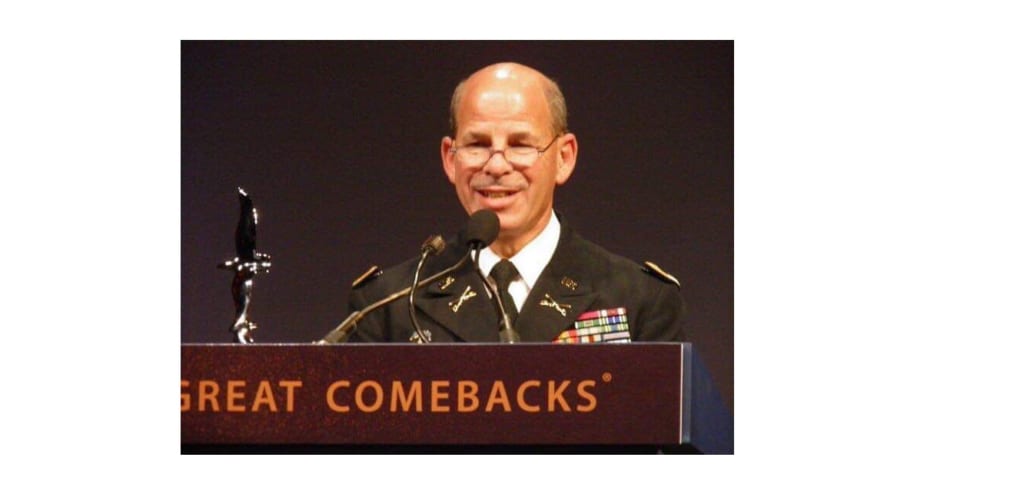
Colonel Justin Blum with Introduction by retired Navy Veteran Douglas R. Stocks
I’ve known Colonel Justin Blum for almost ten years and have learned much of his story over those years. For UOAA’s observance of Veterans Day, I asked Justin to share his story in greater depth. It is typical for us to remember our Veterans as heroes, but we don’t think or even imagine that they also may have been through a life-altering illness or traumatic event resulting in an ostomy. My wife Joanna (an ostomate) and I had the opportunity to spend an evening with Justin and his wife Leah after the Durham Run for Resilience 5K this past October. I was reminded that evening of the hero that Justin truly is, and felt it was time that others knew the story of this humble and well-respected man.
In 1993, when Justin was a Major on active duty in the US Army, he underwent surgery for an ileostomy due to ulcerative colitis (UC) which had progressed to colon cancer. Justin’s ostomy did not slow him down and he became one of the most respected officers in the state of South Carolina and the only member of the Army Junior Reserve Officer Training Corps (JROTC) cadre with an ostomy. Justin has had a highly successful career and life of public service. Justin has faced the gamut of living with a chronic illness, to receiving a devastating diagnosis, to ostomy surgery, to survival and finally triumph.
Here is his story:
In the Fall of 1971, I was a freshman at Morris Harvey College in Charleston, West Virginia. I was feeling the stress of being away from home for the first time in my life and of getting adjusted to college life. I began noticing blood in the toilet after every bowel movement. I told my parents, who took me to a gastroenterologist during my Thanksgiving vacation at home. The gastroenterologist performed a sigmoidoscopy and determined that I had proctitis, an inflammation of the rectum and anus.
I transferred to Rider University in Trenton, NJ, for my second freshman semester to be closer to home, a decision made easier by the fact that Rider had an excellent ROTC program. I suffered with the proctitis and colitis for the next four years with only a prescription for the anti-inflammatory drug Azulfidine to combat the disease. In June of 1975, I underwent my physical exam at Fort Dix, NJ, to go into active duty in the Army. In the course of the physical, the Army doctor performed a rectal exam, and asked, “Do you know what you have?” I acknowledged that I had colitis. In one of those strange twists of fate, my passion for serving the Army outweighed the colitis so the examining doctor wrote “Fit for Duty”.
For the next twenty years I hid my ulcerative colitis from the Army. On days that I had attacks, I would explain that I was feeling bad due to having had too much scotch the night before. Stationed in South Korea in 1976/1977, all too often upon returning to the camp motor pool after patrolling along the DMZ, I would have such severe diarrhea that I could not make it to the latrine and instead would jump into the nearest garbage bin since it was the closest “facility” I could find. I spent the next 13 years seeing civilian gastroenterologists for the colitis and who continued to prescribe Azulfidine. Finally, in 1990, my colitis was so bad I sought help at Eisenhower Army Hospital at Fort Gordan, Georgia where I began seeing Major Armstrong, a gastroenterologist, who informed me that due to my heath condition, resulting from severe flare-ups of UC, he strongly recommended surgery for an ileostomy. My reaction, not unusual I am sure for people receiving this news, was an immediate, “No! Unless I have one foot in the grave with my back against the wall, I refuse to have this surgery resulting in my living with an ostomy bag!” This was twenty years after my first diagnosis of UC in November 1971. However, just a few years later after a colonoscopy, Major Armstrong told me that I needed ostomy surgery as soon as possible.
On February 28, 1993, I had surgery to remove my entire colon due to UC, which had advanced to colon cancer, and I was left with an ileostomy. As was not uncommon in those days, and even sadly still happens today, I had only one session with the ostomy nurse on how to manage my ostomy. The day after surgery, I developed a leak in my appliance and called for the nurse, but no one responded. I looked at myself in the latrine mirror with my ostomy bag hanging down, and I thought I looked like the Elephant Man. After 10 days I was discharged but did not have access to an ostomy nurse or assistance of any kind except for follow up appointments three hours away at Eisenhower Hospital. I wanted to continue to serve on active duty, so I put my mind toward getting in the best physical condition possible. I started walking 9 miles a day, passed my physical fitness test, and was able to stay on active duty. In 1995 I was promoted to Lieutenant Colonel and in 1996 retired from active duty and transferred to reserve status, continuing to work for the US Army as a high school JROTC Instructor.
Life as an ostomate was fine except that I was experiencing pain from irritation of the skin around my stoma and I did not know of any ostomy nurses in the local hospitals and I didn’t know where to turn for help except for the still fledgling Internet of 1996. I was able to find a Crohn’s/Colitis chatroom on AOL (America Online). In that chatroom I was able to talk with numerous people who had either an ileostomy or a colostomy. On one occasion, an experienced ostomate was able to talk me through the steps to alleviate an intestinal blockage saving me a trip to the emergency room. I was able to find an ostomy support group at the local hospital, but because they met at 10:00 AM and I was working an hour away, I was unable to attend their meetings. Despite all I learned from online resources I was still plagued with skin irritation around my stoma site which continued for the next 10 plus years.
Life took a turn for the better when in 2010, I received a letter from the nurse who ran the local ostomy support group, which talked about (the now former) Great Comebacks Program; a national honor program started by ostomate and former point kicker for the San Diego Chargers, Rolf Benirschke. This program recognized people who had lived an exemplary and inspiring life while living with an ostomy. In 2011 I was the recipient of the Tony Snow Public Service Award, a subgroup of the Great Comebacks Program which emphasizes those in uniform living with an ostomy.
However, it was not the award that changed things for me, it was my ongoing communication with the ostomy nurses that I met through this program who eventually solved the problem of the skin irritation and pain that I had struggled with for so many years.
I have accomplished more in my life as an ostomate as a result of the care I have been able to obtain since my story was brought to the national level. If not for my quality of life-improving dramatically as a result of this assistance, these accomplishments would not have become a reality. I owe so much to three WOC nurses: Donna Sellers, Joanna Burgess, and Joy Hooper. I met them through the Great Comebacks program, and they have always offered their help readily. I have now been free from pain for the past nine years.
There are many who do not have the same easy access to professionals that I have had. I am very fortunate! That is why I believe everyone should seek out or become involved with a community of ostomates either through an online support group or hospital-based support group if possible. All ostomates should help other ostomates achieve the quality of life made possible by their life-saving surgery. Having UC and then colon cancer at age 40 meant years of pain and discomfort in my life. Ostomy surgery gave me a new life. Before I retired from teaching, I used my experience with my ostomy to motivate my JROTC cadets, inspiring them to never give up on anything and reminding them they can accomplish anything they set their mind to. I no longer see myself as the Elephant Man, but as a man with a beautiful wife, supportive children and two amazing grandchildren. Life is good!
The UOAA thanks you for your service Colonel Justin Blum and honors your accomplishments!
- 1995 – Promoted to Lieutenant Colonel
- 1996 – Retired from active duty; continued to work for the US Army as an Army JROTC instructor in the United States Army Cadet Command.
- 2003-Named the United States Army JROTC Senior Instructor of the year
- 2009 – Promoted to Colonel, in the South Carolina State Guard
- 2010- Named Volunteer of the Year for the State of South Carolina
- 2011- Named US Army JROTC Senior Instructor of the Year for the second time.
- 2011 – Named the Tony Snow recipient for Public Service
- 2019 – Lawson R. McElroy Award for Engaged Learning







Col Blum, I’m so proud of you & your accomplishments!
God bless you & your family! SFC E.