 https://www.ostomy.org/wp-content/uploads/2022/02/Your-Ostomy-is-Just-the-Beginning-Part-11.jpg
325
336
Contributor
https://www.ostomy.org/wp-content/uploads/2017/02/UOAAlogofinal2.png
Contributor2022-02-14 10:34:132022-02-14 11:03:32Your Ostomy is Just the Beginning- Part 2
https://www.ostomy.org/wp-content/uploads/2022/02/Your-Ostomy-is-Just-the-Beginning-Part-11.jpg
325
336
Contributor
https://www.ostomy.org/wp-content/uploads/2017/02/UOAAlogofinal2.png
Contributor2022-02-14 10:34:132022-02-14 11:03:32Your Ostomy is Just the Beginning- Part 2Patient’s Concerns about Surgery
The reaction to intestinal or urinary diversion surgery varies from one individual to the other. To some, it will be a problem, to other, a challenge; where one person considers its life-saving, another finds it a devastating experience. Each person will adapt or adjust in their own way and in their own time. Peer support from UOAA affiliated support groups can be critical to a patient’s quality of life and acceptance.
Learn more about how to Find a Mental Health Provider After Ostomy Surgery that has a background in working with patients dealing with a variety of health conditions.
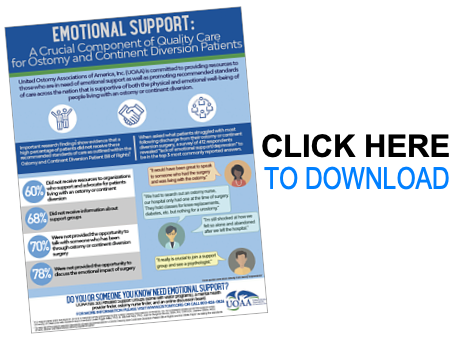
Crucial Role of Emotional Support – Infographic
Body Image/Self-Esteem Concerns
Permanent and significant changes in the body’s appearance and functional ability may change the way the person internalizes their body image and self-concept.
Fear of loss is normal and facing any loss is difficult. What are patients giving up by having this operation? Is there any gain? How changed will they be? Such thoughts may lead to weeping or depression, or they may be denied.
It is important to understand the impact of the ostomy surgery on the patient’s change in self-image and how they perceive themselves. It may be accepted as the lesser of two evils, or they may refuse to acknowledge its existence, or may hold onto the belief that it is a temporary situation.
Within the rehabilitation process there are times that patients should have the opportunity to express or deny their feelings, about their surgery, the changes in their body or their self-image
Self-Care Concerns
Patients have to be reassured that they will be taught self-care and that they will be able to master the management process. Basic anatomy and physiology should be explained to new patients, so they can better understand the extent of their surgery. Management options should be offered.
Patients should begin to assist the ostomy nurse with caring for the ostomy as soon as possible. Becoming involved in this process will begin to build confidence and help the patient to regain control of his situation.
Relationship Concerns
Patients may fear that their social role may be changed and that others may not accept them as in the past. One of the first concerns seems to be how to tell others about your surgery, who to tell and when.
Patients should be prepared to explain their surgery with a few brief statements such as, “An ostomy is a surgical procedure for the diversion of bowel (or bladder).”
They should understand that they do not have to tell everyone about the surgery. Be selective about who and how much to tell. It may be only to friends who will be supportive throughout the rehabilitation process.
Returning to the workplace may present a concern about restroom facilities, interaction with co-workers, and feelings of being “watched.”
Maybe a few of their co-workers may need to know in the event of an emergency.
Employability and insurability are issues for some individuals. If these issues develop, seek help from healthcare professionals and/or talk with others who have found solutions to any of these issues.
Sexuality issues are common concerns for the new ostomate. Linked closely to our feelings of sexuality is how we think about ourselves and our body image.
Any sexuality concerns should be discussed between the patient and his partner. It is likely that the partner will have anxieties due to a lack of information. An intimate relationship is one in which it matters how well two people can communicate about the most personal of human functions, that is, bodily elimination and sex.
Ostomy surgery may present more concerns for single individuals. When to tell depends upon the relationships. Brief casual dates may not need to know. If the relationship grows and leads to intimacy, the partner needs to be told about the ostomy prior to a sexual experience.
Phases of Psychological Adaptation
Almost every patient goes through four phases of recovery following an accident or illness that results in loss of function of an important part of the body. The patient, along with the family, goes through these phases, varying only in the time required for each phase. People may experience the various phases of adaptation in a different order and at varying rates. Some people may skip certain phases entirely and some may move up and down at different times.
These phases are shock, denial, acknowledgment and resolution.
Shock or Panic
Usually occurs immediately after surgery. The patient is unable to process information and may be tearful, anxious and forgetful. This phase may last from days to weeks.
Defense/Retreat/Denial
This phase may last for weeks or months and delays the adaptation process. During this phase, the individual denies or minimizes the significance of the event and defends himself against the implications of the crisis. You may note the avoiding of reality and “wishful” thinking.
Acknowledgment
As the patient moves to the next step of acknowledgment, he begins to face the reality of the situation. As you give up the existing old structure, you may enter into a period, at least temporarily, of depression, of apathy, of agitation, of bitterness, and of high anxiety.
Adaptation/Resolution
During this phase, the acute grief begins to subside. The patient copes with their situation in a constructive manner and begins to establish new structures. They develop a new sense of worth. This phase may take one to two years.
With the aid of an ostomy nurse and a UOAA ostomy visitor and support group,
you learn about living with a stoma.
Read Our Latest Posts About Emotional Health
https://www.ostomy.org/wp-content/uploads/2022/02/Your-Ostomy-is-Just-the-Beginning-Part-11.jpg
325
336
Contributor
https://www.ostomy.org/wp-content/uploads/2017/02/UOAAlogofinal2.png
Contributor2022-02-14 10:34:132022-02-14 11:03:32Your Ostomy is Just the Beginning- Part 2 https://www.ostomy.org/wp-content/uploads/2021/11/128267515_10158938732764254_8684178582637976707_n.jpeg
1536
2048
Contributor
https://www.ostomy.org/wp-content/uploads/2017/02/UOAAlogofinal2.png
Contributor2021-11-09 10:56:242021-11-09 10:58:28Navigating Through the Covid-19 Pandemic with Medical PTSD and My Ostomy
https://www.ostomy.org/wp-content/uploads/2021/11/128267515_10158938732764254_8684178582637976707_n.jpeg
1536
2048
Contributor
https://www.ostomy.org/wp-content/uploads/2017/02/UOAAlogofinal2.png
Contributor2021-11-09 10:56:242021-11-09 10:58:28Navigating Through the Covid-19 Pandemic with Medical PTSD and My Ostomy https://www.ostomy.org/wp-content/uploads/2021/10/70120400_10212903987691859_4946324817587470336_n.jpg
960
960
Contributor
https://www.ostomy.org/wp-content/uploads/2017/02/UOAAlogofinal2.png
Contributor2021-10-22 13:30:122021-10-22 13:30:12We All Need Ostomy Friends
https://www.ostomy.org/wp-content/uploads/2021/10/70120400_10212903987691859_4946324817587470336_n.jpg
960
960
Contributor
https://www.ostomy.org/wp-content/uploads/2017/02/UOAAlogofinal2.png
Contributor2021-10-22 13:30:122021-10-22 13:30:12We All Need Ostomy FriendsContact Us

United Ostomy Associations of America
P.O. Box 2293
Biddeford, ME 04005-2293
Call us toll-free at: 1-800-826-0826.
Our Information Line hours are Monday-Friday, 9am to 3pm EST. If you have an emergency, please dial 911 or contact your local medical professional.
Please understand that UOAA is a private, nonprofit, advocacy and informational organization. We are not a medical facility and we do not have medical or legal professionals on staff. Therefore, UOAA does not provide Medical, Mental Health, Insurance or Legal Advice. Visit UOAA Virtual Ostomy Clinic provided by The Wound Company for non-emergency, virtual ostomy support.